


















Lesson 8 of 44 · Core Concepts: State, Power, Legitimacy
Legitimacy and Authority
Why do people obey? Learn Weber's traditional, charismatic and legal-rational authority, how regimes gain and lose legitimacy, and test a simple compliance model.
A traffic officer is outnumbered by the cars on the road, yet drivers stop at red lights, even at empty intersections at night. A tax office cannot watch every citizen, yet most people file returns. If every rule had to be enforced by a person with a stick, governing would be impossibly expensive. States work because most people, most of the time, follow rules without being forced. The reason is legitimacy.
Legitimacy is the belief that a ruler or rule has the right to be obeyed. It is not the same as being popular, and it is not the same as being legal. This lesson explains Weber's classic account of why people accept authority, how regimes try to produce the belief, and what happens when it breaks.
What you will learn
- the difference between legitimacy, legality and authority
- Weber's three types: traditional, charismatic and legal-rational
- other sources of legitimacy, such as performance, democracy and nationalism
- how legitimacy is lost, and what regimes do when they lose it
- a simple model of obedience that combines belief and enforcement
Key terms
Legitimacy: a widely held belief that a ruler, rule or institution is rightful.
Authority: power that is accepted as rightful by those subject to it.
Legality: conformity to the law; a regime may be legal but not legitimate, or the reverse.
Charisma: a personal quality that followers see as exceptional.
Performance legitimacy: support that comes from delivering results, such as growth or security.
Legitimacy, legality and authority
Three words are often confused. Legality is a matter of rules: did the act follow the law? Legitimacy is a matter of belief: do people think the rule is rightful? Authority is the combination: a command people obey because they accept the right to give it. A military government may issue legal orders under its own decrees without being thought rightful. A mass movement may be seen as legitimate by millions while breaking the law, as civil rights campaigners in several countries argued about unjust laws.
Weber's three types
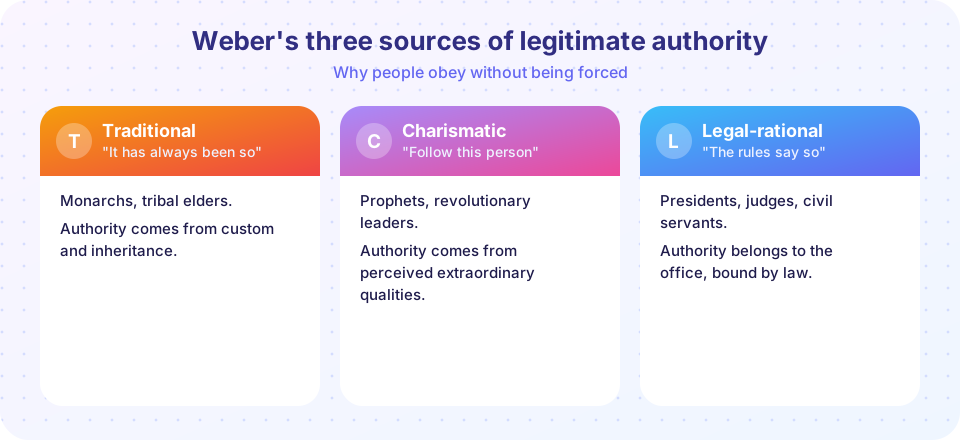
Max Weber, in work published after 1920, described three pure types of authority, each with its own basis for the claim of rightfulness.
Traditional authority. Rule is accepted because "it has always been so." Hereditary monarchs, tribal chiefs and village elders hold this kind of authority. Obedience is owed to the person who holds an inherited position, and challenging custom is shocking.
Charismatic authority. Rule is accepted because of the extraordinary personal qualities attributed to a leader: prophets, revolutionary heroes, some populist leaders. It is unstable. Charisma has to be proven again and again, and it is hard to pass on. Weber called the process by which it settles into routine the routinization of charisma: movements build offices and rules, or choose successors, to survive their founder.
Legal-rational authority. Rule is accepted because it follows impersonal rules created by a lawful procedure. The officeholder is obeyed as a holder of an office, not as a person. Modern bureaucracies, courts and elected governments rest on this basis. A tax inspector has authority because the law grants it, and it ends when the person leaves the job.
Weber stressed these are ideal types, simplified models for thinking. Real regimes mix them. A British monarch (tradition) acts within a constitution (legal-rational). A democratic leader may also have charisma.
| Type | Basis | Typical weakness |
|---|---|---|
| Traditional | Custom, inheritance | Slow to adapt; crises of succession |
| Charismatic | Exceptional qualities | Unstable; depends on one person |
| Legal-rational | Rules and offices | Can seem cold; needs trust in the rules |
Other sources of legitimacy
Weber's list is a starting point. Scholars have added others.
- Democratic legitimacy. Rule is rightful because the people consent through free and fair elections. Abraham Lincoln's phrase "government of the people, by the people, for the people" captures it.
- Performance. People accept rule that delivers prosperity, order or security. Some authoritarian regimes rely heavily on economic growth. Because performance can fall, this basis is fragile.
- Nationalism. Rule is rightful because it expresses the nation, or because leaders are "one of us."
- Ideology and religion. A governing doctrine, or a claim to rule in the name of a faith, can supply the justification.
- Procedure and fairness. Tom Tyler's research on policing found that people comply more when they feel treated fairly and respectfully, regardless of the outcome of their own case.
Why even dictators want legitimacy
Pure force is costly and risky. Soldiers and officials must be willing to follow orders, and every extra layer of coercion needs someone to watch the watchers. Regimes therefore spend effort on parades, ceremonies, constitutions, controlled elections and propaganda, even when no real choice is offered. Researchers have found that regimes that win a legitimacy claim need less repression to stay in place.
How legitimacy is lost
Legitimacy can erode slowly or collapse suddenly. Common triggers include:
- Economic crisis that breaks the promise of performance.
- Corruption that shows rules apply to ordinary people but not rulers.
- Defeat in war that disproves a claim of strength.
- Rigged elections that cut the link to consent.
- Violence against peaceful citizens, which can turn bystanders into opponents.
Eastern Europe in 1989 is a well-known example. Communist regimes had relied on a mix of ideology, Soviet backing and performance. Once Soviet support was withdrawn and economies stagnated, mass demonstrations met little resistance, because officials and soldiers themselves no longer believed in the system.
Common misconceptions
"Legitimacy means everyone likes the government." It means people accept the right to rule, even when they dislike a particular decision. People can oppose a policy and still accept the process.
"Legal always means legitimate." Legality is about rules; legitimacy is about belief. Unjust laws can be legal.
"Charismatic leaders are always bad." Charisma is a source of authority, neither good nor bad in itself. What matters is what the leader does with it and whether institutions can limit them.
Try it
The first demonstration is a model, not data. Each of 10,000 imaginary citizens has a personal threshold for obeying. A citizen obeys if legitimacy plus the effect of enforcement is above their threshold. The heat map shows how much obedience results from different mixes. It illustrates the idea that legitimacy and enforcement can substitute for each other.
Press Run (or Ctrl + Enter) to see the result here.
Program input · what you'd type while the program runs
Type the answers before you press Run, one per line. Each time the program reads a line (with input()), it gets the next line from this box.
Notice that the same obedience level can come from many mixes, so a regime with little legitimacy must spend more on enforcement. Change the 0.6 to 1.0 to imagine a world where force works as well as belief. In reality, force also has costs and can reduce legitimacy, which this simple model leaves out.
The second demonstration is a sorter for Weber's three types. Read each case and compare your answer to the printed one.
Press Run (or Ctrl + Enter) to see the console output here.
No output.
Check your understanding
Quick check · 5 questions
of 5 answered You scored / 5 · perfect!
-
1. Which source of authority did Weber link to modern bureaucracies and courts?
Legal-rational authority rests on impersonal rules and offices. -
2. What does the routinization of charisma mean?
Movements institutionalize charisma so they can survive their founder. -
3. A law is passed properly but most people think it is unjust. What is true?
Legality and legitimacy are different concepts. -
4. Why is performance legitimacy fragile?
When growth or security falls, the basis of support may disappear. -
5. In the toy model, what must a regime with low legitimacy do to keep obedience high?
Enforcement can substitute for belief, though at a cost the model does not show.
Summary
- Legitimacy is a belief in the rightfulness of rule; legality is conformity with law, and authority is accepted power.
- Weber's three types are traditional, charismatic and legal-rational; real regimes mix them.
- Democratic consent, performance, nationalism, ideology and fair procedure add further sources.
- Legitimacy erodes through crisis, corruption, defeat, rigged elections and violence.
- Regimes with less legitimacy tend to rely more on coercion, which is expensive and risky.
Next: Social Contract Theory
Track your progress
Create a free account to tick off lessons and pick up where you left off on any device.
of Political Science lessons completed