


















Lesson 12 of 44 · Political Ideologies
Liberalism and Conservatism
Compare classical liberalism, social liberalism and conservatism: Locke, Smith, Mill, Green, Burke and Oakeshott, core values, internal debates and common misunderstandings.
Liberalism and conservatism dominate the politics of many democracies, yet their names confuse people. In the United States, "liberal" means someone on the center-left who supports a stronger welfare state. In much of Europe and Australia, "liberal" often means a supporter of free markets and civil liberties, closer to what Americans might call libertarian or moderate conservative. "Conservative" can mean defending free markets in one country and protecting a state-run health system in another.
Because labels shift, this lesson goes to the core ideas and the thinkers behind them. Once you know what each tradition values and why, the labels in any country become easier to read.
What you will learn
- the core values of liberalism and its two main branches
- the conservative case for tradition and gradual change
- how the two traditions overlap and where they disagree
- how to place a policy argument on this map
- common misunderstandings of both traditions
Key terms
Liberalism: a tradition that places individual liberty, rights and consent at the center.
Laissez-faire: the doctrine that government should interfere little in the economy.
Harm principle: Mill's rule that power can be used against a person only to prevent harm to others.
Conservatism: a tradition that values established institutions and prefers gradual change.
Tradition: knowledge and practices passed down, which conservatives see as a store of wisdom.
Classical liberalism
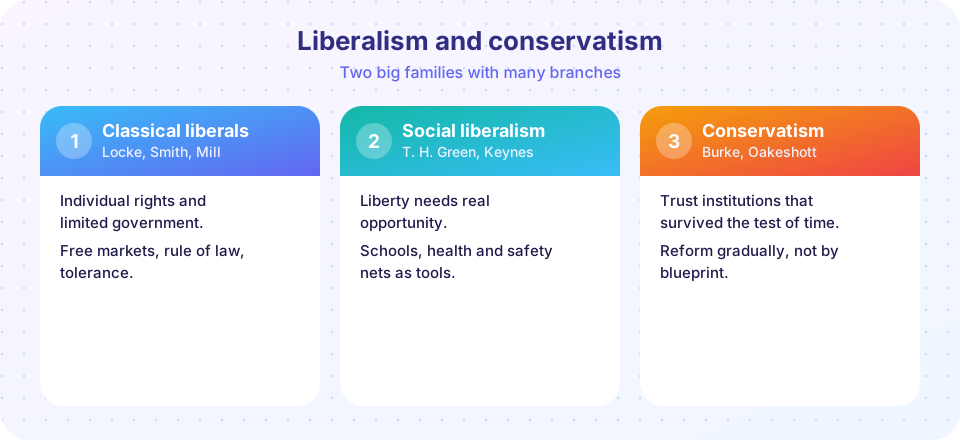
Liberalism grew out of the Enlightenment and the struggles against absolute monarchy and religious persecution in seventeenth- and eighteenth-century Europe. Its founding idea is that individuals have rights that government must respect, and that government rests on consent. John Locke provided the language of natural rights and limited government. Adam Smith, in The Wealth of Nations (1776), argued that markets guided by self-interest could produce widespread prosperity, with government limited to defense, justice and certain public works.
John Stuart Mill's On Liberty (1859) gave the tradition its best known rule, the harm principle: the only purpose for which power can rightfully be used against a member of a civilized community, against their will, is to prevent harm to others. Mill defended freedom of speech with the argument that even false opinions help us see the truth, and that the habit of questioning keeps beliefs alive. Classical liberals typically favor:
- constitutional limits on government and the rule of law,
- free speech, religious toleration and equal legal rights,
- private property and open markets, and
- low taxes and limited public spending, with debates about how limited.
Social liberalism
By the late nineteenth century, many liberals saw that formal rights did not guarantee real freedom. A person with no education, no health care and no job may be legally free and still be unable to act. Thinkers such as T. H. Green, L. T. Hobhouse and, in the twentieth century, John Maynard Keynes and William Beveridge argued that the state can expand liberty by providing education, social insurance and a safety net. This is social liberalism (sometimes called modern or new liberalism).
Keynes's economic ideas, set out in the 1936 General Theory, gave governments a role in managing demand during recessions. Beveridge's 1942 report led to the postwar British welfare state. Social liberals typically favor public schools, health insurance, anti-discrimination laws and progressive taxation, while still defending civil liberties. The difference from classical liberalism is about how to secure liberty: by limiting the state, or by using it to widen opportunity.
Neoliberalism and libertarianism
In the twentieth century some thinkers revived classical ideas. Friedrich Hayek, in The Road to Serfdom (1944), warned that central planning threatens freedom. Milton Friedman argued for free markets and monetary rules. From the 1970s, policies such as privatization and deregulation under governments in the United Kingdom and the United States were often labelled neoliberal, a term used mostly by critics. Libertarians, such as Robert Nozick, push the idea of individual rights further and argue for a minimal state. Scholars disagree about the term "neoliberalism" and its use, so check how each author defines it.
Conservatism
Modern conservatism is usually traced to Edmund Burke's Reflections on the Revolution in France (1790). Burke did not oppose all change; he opposed change by abstract blueprint. Society, he argued, is a partnership "between those who are living, those who are dead, and those who are to be born." Institutions that have grown through long experience hold knowledge that no one person could write down. Reform should be gradual and respect what works, a principle sometimes put as "change in order to conserve."
The twentieth-century philosopher Michael Oakeshott described the conservative disposition as a preference for the familiar over the unknown, the tried over the untried, and the present over utopian promises. Conservative thought typically stresses:
- tradition and established institutions such as family, church, local community and law,
- order and authority, since freedom needs a stable setting,
- skepticism about rapid, large-scale social engineering, and
- human imperfection: people are not perfectible, so institutions must work with human nature as it is.
Conservatism has branches. Fiscal conservatives emphasize low taxes and balanced budgets. Social conservatives emphasize traditional moral values. National conservatives emphasize national identity and borders. One-nation conservatives, a tradition associated with Benjamin Disraeli, argue that the privileged have duties toward the poor and favor social cohesion. In some countries conservative parties are also strongly religious; in others they are mostly secular.
Overlap and disagreement
The traditions share more than slogans suggest. Many conservatives and classical liberals both favor market economies and distrust central planning. Many social liberals and one-nation conservatives both accept a safety net. The deeper differences are about starting points:
| Question | Classical liberal | Social liberal | Conservative |
|---|---|---|---|
| Main value | Individual liberty | Liberty with real opportunity | Order, continuity, community |
| Role of the state | Limited | Active to widen opportunity | Protect institutions; varies |
| View of change | Welcomes progress | Welcomes reform | Cautious, gradual |
| View of tradition | Questions it | Reforms it | Respects it |
A useful test is how each reacts to a rule such as a minimum wage, a ban on a harmful drug or a school curriculum: What does it do to individual choice? To real opportunity? To established practice? The same policy can look good or bad depending on which question you weigh most.
Common misconceptions
"Conservatives oppose all change." Burke accepted reform when it grew out of existing institutions. Conservatives differ on how much and how fast.
"Liberals are anti-market." Classical liberals defend markets strongly; social liberals accept markets with regulation and public services.
"Liberal and conservative mean the same thing everywhere." The words have different meanings in the United States, Europe, Latin America and elsewhere.
Try it
The first demonstration compares three tax schedules that echo the traditions: a flat tax, a progressive schedule and a flat tax with an exemption for low incomes. The rates are invented for illustration, not recommendations. The point is that each schedule embodies a different view of fairness.
Press Run (or Ctrl + Enter) to see the result here.
Program input · what you'd type while the program runs
Type the answers before you press Run, one per line. Each time the program reads a line (with input()), it gets the next line from this box.
Which schedule would you expect each tradition to prefer, and why might a thinker within a tradition choose a different one? Fairness here has at least two meanings: everyone pays the same share, or everyone sacrifices a similar amount.
The second demonstration is a quick sorter: read each argument and decide which tradition it draws on most.
Press Run (or Ctrl + Enter) to see the console output here.
No output.
Check your understanding
Quick check · 5 questions
of 5 answered You scored / 5 · perfect!
-
1. What is Mill's harm principle?
Mill argued that preventing harm to others is the only rightful reason to override a person's liberty. -
2. Which pair fits social liberalism?
Green and Keynes argued that the state can widen real freedom. -
3. Burke's Reflections on the Revolution in France (1790) opposes:
Burke favored gradual reform grounded in established institutions. -
4. Which group stresses duties of the privileged toward the poor to keep the nation together?
This is the tradition associated with Disraeli. -
5. Why do the words liberal and conservative cause confusion?
In the US and Europe, for example, 'liberal' refers to different positions.
Summary
- Classical liberalism stresses liberty, rights, consent and limited government; Mill's harm principle is its best known rule.
- Social liberalism holds that the state can widen real freedom through education, social insurance and economic management.
- Conservatism values tradition, order and gradual change; Burke and Oakeshott are central thinkers.
- The traditions overlap on markets and differ on starting points; labels vary by country.
Next: Socialism and Marxism
Track your progress
Create a free account to tick off lessons and pick up where you left off on any device.
of Political Science lessons completed