


















Lesson 41 of 44 · Projects and Practice
Practice: Designing a Comparative Case Study
Plan a small comparative study: ask a causal question, choose cases, check variation, test how likely a pattern is by chance, and write down the limits.
Reading research is one skill; designing it is another. In this project you will plan a small comparative study from scratch. You will not collect real data here, because the point is the design: which question to ask, which cases to compare, what evidence to gather and how honest to be about the limits. Good designs make a weak dataset useful, and bad designs make a large dataset useless.
What you will learn
- How to turn a topic into a causal question.
- How to select cases that vary in the cause and the outcome.
- How to check whether a pattern could be chance.
- How to write limits and rival explanations.
Key terms
Research question: a specific question the study answers, usually of the form "Does X affect Y?" or "Why does Y differ?"
Hypothesis: a testable answer to the research question.
Rival explanation: another factor that could explain the outcome.
Operationalization: defining how a concept will be measured.
Triangulation: using several types of evidence to check one claim.
Step 1: a narrow question
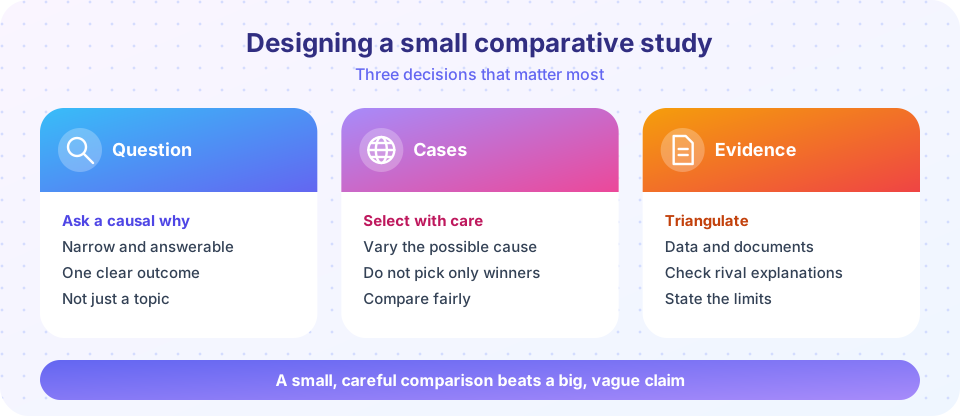
A topic is not a question. "Voting" is a topic; "Does compulsory voting raise turnout in national elections?" is a question. A good question is causal, specific about the outcome and the cause, and answerable with evidence you can get. Test it by asking: what would a surprising answer look like? If every possible answer seems equally boring or impossible to check, narrow it further.
Write the hypothesis next. For example: "Countries that require citizens to vote and enforce the rule with fines have higher turnout than otherwise similar countries without such rules." Notice that the hypothesis names the comparison: otherwise similar. That phrase is the heart of a most similar systems design.
Step 2: operationalize
Decide how you will measure the key terms. Turnout could be votes cast divided by registered voters, or by the voting-age population; the two can differ when registers are inaccurate. Compulsory voting could mean a legal duty, or a duty that is actually enforced; those are different. Write your definitions down and keep them fixed.
Step 3: choose the cases
Use the rules from the comparative method lesson: vary the cause and the outcome, keep other major factors similar, avoid choosing only cases that fit, and watch for diffusion. The tool below checks a case table for the most common mistakes. The cases are hypothetical placeholders, so replace them with real ones only after you have collected evidence.
Press Run (or Ctrl + Enter) to see the console output here.
No output.
The checker flags deviant cases, which are often the most interesting: a country with the cause but not the outcome (or the reverse) points to another factor you may have missed.
Step 4: ask how likely chance is
With few cases, a neat pattern can appear by luck. A permutation test asks: if the outcome labels were shuffled at random, how often would the pattern be at least as strong as what you saw? You can compute this directly.
Press Run (or Ctrl + Enter) to see the result here.
Program input · what you'd type while the program runs
Type the answers before you press Run, one per line. Each time the program reads a line (with input()), it gets the next line from this box.
A fairly high chance value tells you not to be impressed. It is a warning against overclaiming, not a proof that the cause is irrelevant: with eight cases, even real effects are hard to detect.
Step 5: gather evidence from more than one source
A comparison of numbers needs context. For each case, add documents (laws, party platforms), expert accounts, and data from different sources, and then check that they agree. If your claim is that a fine raises turnout, you should find evidence on how the fine is enforced and whether people respond to it, not only before-and-after totals. This is the logic behind process tracing.
Step 6: rival explanations and limits
List at least three rival explanations. Why might turnout differ between your cases for reasons other than compulsory voting? Possible rivals include registration rules, election day being a holiday, the closeness of the race and political culture. For each, say what you would observe if it were true and whether your cases can rule it out. Finally, write a limits paragraph: what your design cannot show, how your cases might not generalize, and what further evidence would change your mind.
Step 7: write it up
Use a six-part structure: Question, Hypothesis, Design (cases and measures), Evidence, Rivals, Limits. Keep each part short. A reader should be able to see exactly what you did and challenge it.
Common misconceptions
"A good design needs many cases." Careful comparison of a few cases can be informative, but only with clear logic and honest limits.
"If the pattern holds, the cause is proven." It supports the hypothesis, and rival explanations must still be addressed.
"Limits make a study weak." Stating limits makes a study credible and lets others build on it.
Check your understanding
Quick check · 4 questions
of 4 answered You scored / 4 · perfect!
-
1. Which is a research question rather than a topic?
A question names a cause, an outcome and a comparison that evidence can address. -
2. What does a deviant case suggest?
Cases that break the pattern often reveal omitted causes or flawed measures. -
3. What does a permutation test tell you?
It estimates how surprising the observed pattern is under pure chance. -
4. Why use several kinds of evidence?
Triangulation guards against errors in any single source.
Summary
- Turn a topic into a narrow causal question and write a testable hypothesis.
- Operationalize key concepts and choose cases that vary the cause and the outcome.
- Check chance with a permutation test and look closely at deviant cases.
- Triangulate evidence, list rival explanations and state limits plainly.
Track your progress
Create a free account to tick off lessons and pick up where you left off on any device.
of Political Science lessons completed