


















Lesson 21 of 44 · Political Systems and Institutions
Chapter 4 Review: Political Systems and Institutions
Review chapter 4: democracy and authoritarianism, constitutions, separation of powers, presidential and parliamentary systems, and federal and unitary states, with a quiz.
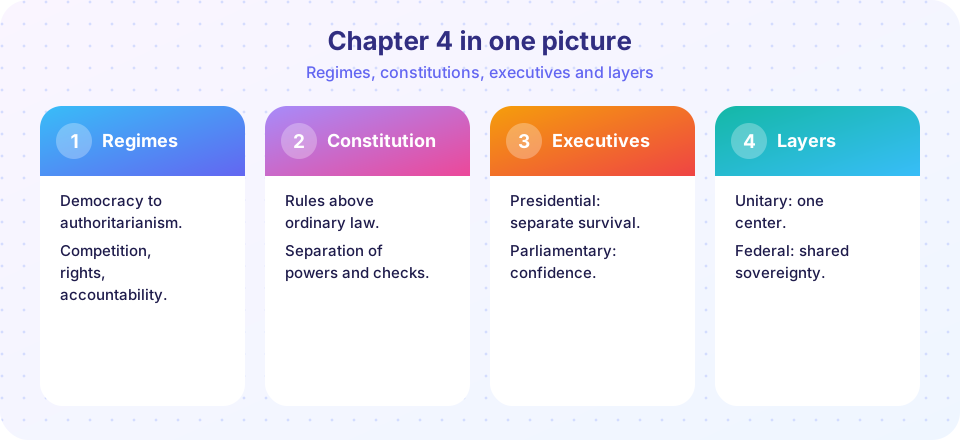
You have covered regimes, constitutions, executive-legislative designs and territorial structure. This review gathers them in a table and a picture, then tests you with ten questions that mix all four lessons. Use the table as a quick profile when you meet a new country in the news.
What you will learn
- recall the main definitions and typologies from the chapter
- apply a five-question institutional profile to a country
- distinguish look-alike terms such as devolution and federalism, or semi-presidential and parliamentary
Recap table
| Topic | Key terms | Key names |
|---|---|---|
| Democracy | Electoral, liberal, polyarchy, hybrid, backsliding | Schumpeter, Dahl, Levitsky and Way |
| Authoritarianism | Personalist, one-party, military, totalitarian | Linz |
| Constitutions | Codified, rigid, judicial review | Montesquieu, Madison |
| Veto players | More veto players, less change | Tsebelis |
| Executives | Presidential, parliamentary, semi-presidential | Linz, Duverger |
| Territory | Unitary, federal, devolution, subsidiarity | Riker, Elazar, Tiebout |
The five-question profile
For any country ask: (1) Who can vote and compete? (2) What is the constitution like, and is it followed? (3) How are executive and legislature linked? (4) Is power divided between national and regional levels? (5) Who can veto a decision? Try it on the United States, Germany, France and the United Kingdom, using the overview lesson as a start.
Common misconceptions
"Presidential equals democratic and parliamentary equals weak." Both are democratic designs, with different strengths.
"Federal means a strong national government." It means constitutionally protected regional powers.
"If a constitution says it, it happens." Compliance and enforcement are what matter.
Try it
The first tool matches descriptions to terms, as a self-test.
Press Run (or Ctrl + Enter) to see the console output here.
No output.
The second tool builds a profile table for four countries so you can compare at a glance.
Press Run (or Ctrl + Enter) to see the result here.
Program input · what you'd type while the program runs
Type the answers before you press Run, one per line. Each time the program reads a line (with input()), it gets the next line from this box.
Check your understanding
Quick check · 10 questions
of 10 answered You scored / 10 · perfect!
-
1. Which scholar defined polyarchy through participation and contestation?
Robert Dahl used polyarchy for actual democracies. -
2. What is the dictator's dilemma?
Repression makes subordinates hide bad news. -
3. Which source gave 'power should be a check to power'?
Montesquieu's The Spirit of the Laws (1748). -
4. What does a 2/3 amendment threshold in a 435-seat chamber require?
Two-thirds of 435 is 290. -
5. Which describes cohabitation in France?
It occurs when parliament's majority opposes the president. -
6. Which is a feature of federalism?
Federations rely on a constitutional court or similar umpire. -
7. In the median voter model, what happens to two competing parties?
Under the model's assumptions, convergence on the median occurs. -
8. What is devolution?
Unlike federalism, devolved powers rest on national law. -
9. Why do more veto players slow policy change?
Probabilities multiply across veto points. -
10. Which regime type aims at total control over public and private life?
Linz separated totalitarian regimes from ordinary authoritarian ones.
Summary
- Regimes run from liberal democracy through hybrids to authoritarian and totalitarian rule.
- Constitutions and separation of powers aim to limit government; veto players slow change.
- Presidential, parliamentary and semi-presidential systems link executive and legislature in different ways.
- Unitary, federal and confederal designs divide power vertically; subsidiarity guides who decides.
Next: Return to the Political Science course page for the rest of the course.
Track your progress
Create a free account to tick off lessons and pick up where you left off on any device.
of Political Science lessons completed