


















Lesson 28 of 44 · Public Policy
Policy Making and Implementation: From Agenda to Delivery
Learn how issues reach the policy agenda, how decisions are made, and why implementation changes policy, with models from Kingdon, Lindblom and Lipsky.
Not every problem becomes a policy. Thousands of issues compete for scarce attention, and only a few are picked up by legislators and agencies. Once something is chosen, a second challenge begins: turning decisions into practice. This lesson follows the policy cycle through its first four stages, and shows why the distance between a law on paper and a service in a community can be wide.
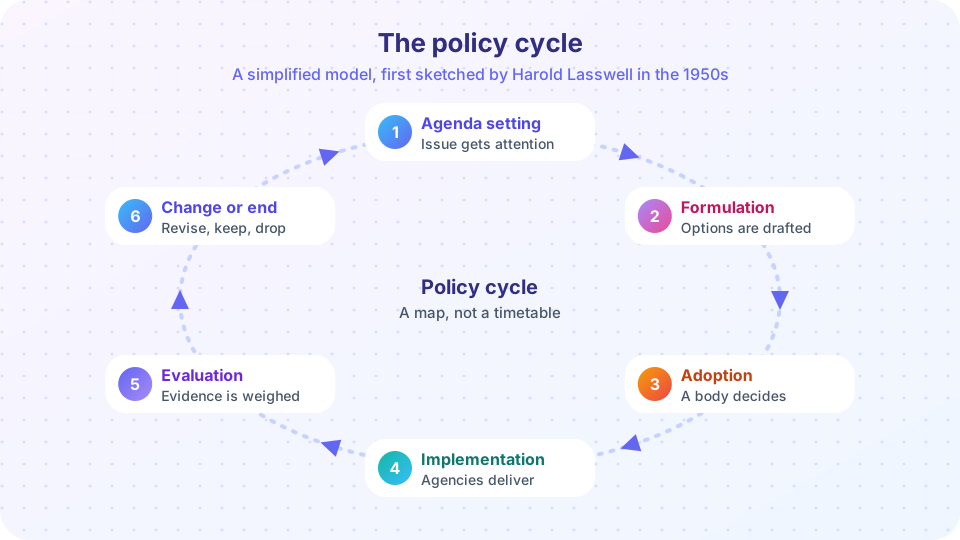
What you will learn
- How issues get onto the agenda: Kingdon's three streams and punctuated equilibrium.
- How decisions are made: rational-comprehensive and incremental models, and bounded rationality.
- Why implementation matters: top-down, bottom-up and street-level views.
- Why long implementation chains can break down.
Key terms
Agenda setting: the process by which some issues get serious attention while others do not.
Policy window: a brief opportunity when a problem, a solution and political will align.
Incrementalism: making policy through small adjustments to existing policy.
Street-level bureaucrat: a public employee, such as a teacher, police officer or caseworker, who deals directly with citizens and exercises discretion.
Implementation: carrying out a policy decision through organizations and people.
Agenda setting
Why do some problems reach the top of the agenda? John Kingdon's Agendas, Alternatives, and Public Policies (1984) proposed the multiple streams framework. Three streams flow largely independently: the problem stream (indicators, crises and feedback that draw attention to a condition), the policy stream (specialists generating and refining ideas), and the politics stream (public mood, election results, interest group campaigns). When the streams join, a policy window opens, often briefly, and policy entrepreneurs who have a solution ready push it through.
Frank Baumgartner and Bryan Jones (1993) added punctuated equilibrium: policy is usually stable, shaped by established networks and routines, but sudden shifts in attention, which they link to changes in how an issue is framed, can break the equilibrium and trigger fast change. The two ideas share an insight: policy change tends to be lumpy rather than smooth.
Press Run (or Ctrl + Enter) to see the result here.
Program input · what you'd type while the program runs
Type the answers before you press Run, one per line. Each time the program reads a line (with input()), it gets the next line from this box.
The simulation is only an illustration, because real streams are not independent and entrepreneurs can couple them deliberately. It does show why windows are rare and why people with ready proposals have an advantage.
Formulating and adopting
How do decision-makers choose among options? The rational-comprehensive ideal says to define the goal, list all alternatives, predict every consequence and pick the best. Herbert Simon (1947) objected that human minds and organizations have bounded rationality: time, information and attention are limited, so people "satisfice", choosing an option that is good enough. Charles Lindblom's "The Science of Muddling Through" (1959) described incrementalism: decision-makers compare small variations on the status quo, which is manageable and politically safer, though it can lock in old mistakes.
Other actors shape formulation too. Paul Sabatier's advocacy coalition framework (1988) sees policy subsystems as arenas where coalitions with shared beliefs, including officials, scientists and interest groups, compete to translate those beliefs into policy. Adoption then happens in the formal arenas of legislatures, executives, courts or referendums, where veto players, actors whose agreement is required, can block change.
Implementation: where plans meet reality
Jeffrey Pressman and Aaron Wildavsky's Implementation (1973) studied a federal program in Oakland, California, that had broad support yet delivered little. They argued that when delivery requires many separate agreements, even small chances of delay add up. A chain of independent steps succeeds only if every step does, so the success probability is the product of the step probabilities.
Press Run (or Ctrl + Enter) to see the result here.
Program input · what you'd type while the program runs
Type the answers before you press Run, one per line. Each time the program reads a line (with input()), it gets the next line from this box.
The numbers are an illustration of the logic, not a measurement of any real program. Still, they explain why designers try to shorten chains, reduce the number of agencies that must agree, or give a single organization clear responsibility.
Three views of implementation
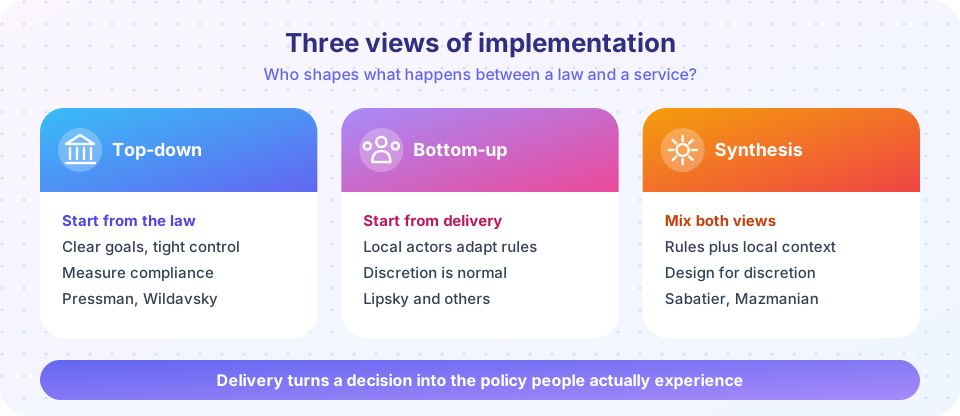
The top-down view starts with the decision and asks whether delivery matched the goals. The bottom-up view starts with the people delivering the service. Michael Lipsky's Street-Level Bureaucracy (1980) showed that teachers, police officers and social workers must manage heavy caseloads with limited resources, so they develop routines and use discretion, and their practices effectively become policy. Daniel Mazmanian and Paul Sabatier (1980) and others proposed synthesis approaches that combine clear rules with attention to local context. In practice, how much discretion to allow is a central design question: too little, and services cannot adapt; too much, and they may drift from the law's goals or treat people unequally.
Common misconceptions
"Once a bill passes, policy has been made." Implementation can reshape, delay or dilute a policy. Agencies write rules, and front-line workers interpret them.
"Incrementalism means doing nothing." It means changing policy through many small steps. Over time those steps can add up to large changes.
"Windows always lead to the best solution." The streams framework describes what gets adopted, not what is best. Ready-made proposals win windows, whatever their quality.
Check your understanding
Quick check · 4 questions
of 4 answered You scored / 4 · perfect!
-
1. In Kingdon's framework, what is a policy window?
Windows open when the three streams join, and entrepreneurs with solutions ready can push proposals through. -
2. What did Lindblom mean by 'muddling through'?
Incrementalism compares limited alternatives close to the status quo, which is manageable but can reinforce past errors. -
3. Why did Pressman and Wildavsky stress long chains of decisions?
When delivery depends on many independent steps, the success probability multiplies and shrinks quickly. -
4. What is distinctive about street-level bureaucrats?
Lipsky argued that front-line workers' routines and decisions effectively make policy.
Summary
- Agendas are shaped by streams (Kingdon) and sudden shifts in attention (punctuated equilibrium).
- Decision-making is bounded and often incremental; coalitions and veto players matter.
- Implementation determines what a policy means in practice.
- Long chains of required agreements make failure likely, and street-level discretion shapes outcomes.
Track your progress
Create a free account to tick off lessons and pick up where you left off on any device.
of Political Science lessons completed