


















Lesson 29 of 44 · Public Policy
Policy Tools and Evaluation: What Governments Use and How We Judge It
Explore the toolkits governments use, why they intervene, and how analysts evaluate results with counterfactuals, difference-in-differences and cost-benefit analysis.
Suppose a government wants less air pollution. It could ban the worst polluters, tax pollution, subsidize clean technology, run an information campaign, or build public transit itself. These are different policy tools, and choosing among them is a central part of policy design. After choosing, analysts want to know whether the policy worked. That is the job of evaluation.
This lesson covers both halves: the main families of tools, the reasons governments intervene in the first place, and the methods used to judge impact.
What you will learn
- The four toolkits of nodality, authority, treasure and organization.
- Why governments intervene: externalities, public goods and information problems.
- How to measure impact with a counterfactual, difference-in-differences and cost-benefit analysis.
- Why evidence is helpful but never the whole decision.
Key terms
Externality: a cost or benefit that affects people who are not part of a transaction, such as pollution.
Public good: something that is non-excludable and non-rivalrous, such as national defense.
Counterfactual: what would have happened without the policy.
Net present value (NPV): the sum of future benefits and costs, discounted to today's value.
Nudge: a change in how choices are presented, without banning options or changing incentives much.
Why intervene?
Economists give several classic reasons. Externalities mean that markets ignore some costs: a factory's smoke harms neighbors who are not paid. Arthur Pigou argued that a tax equal to the external harm can make private and social costs line up. Public goods such as street lighting are hard to fund voluntarily, because everyone can enjoy them whether or not they pay. Information problems, such as patients being unable to judge drug safety, justify standards and disclosure. Governments also intervene for fairness, to protect the vulnerable or to redistribute resources, which is a value choice rather than a market correction.
Garrett Hardin's 1968 essay on the "tragedy of the commons" argued that shared resources get overused. Elinor Ostrom, who won the 2009 Nobel Memorial Prize in Economic Sciences, showed with case studies in Governing the Commons (1990) that communities sometimes manage shared resources successfully through their own rules, so neither state control nor privatization is the only answer.
Press Run (or Ctrl + Enter) to see the result here.
Program input · what you'd type while the program runs
Type the answers before you press Run, one per line. Each time the program reads a line (with input()), it gets the next line from this box.
Toolkits of government
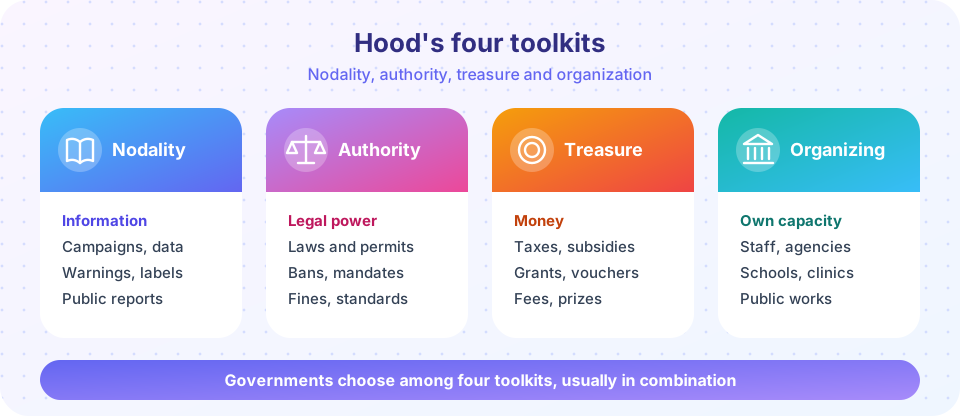
Christopher Hood's The Tools of Government (1983) organized the tools into four families, summarized by the mnemonic NATO.
- Nodality is the government's position at the center of information networks: public information campaigns, warnings, labels, official statistics and data portals.
- Authority is legal power: laws, bans, permits, mandates and standards, backed by fines.
- Treasure is money: taxes, subsidies, grants, vouchers, fees and prizes.
- Organization is the state's own capacity: public schools, hospitals, military, staff and infrastructure.
Evert Vedung's shorthand for tools of influence is sticks, carrots and sermons: regulation, economic incentives and information. In practice governments combine tools. Tobacco policy mixes taxes (treasure), smoke-free laws (authority), warning labels and campaigns (nodality) and cessation services (organization). Nudges, popularized by Richard Thaler and Cass Sunstein (2008), change defaults and framing, for example automatic enrollment in pension plans. Studies of large-scale nudge programs have found real but typically smaller effects than those reported in early academic trials, which is a reminder to evaluate rather than assume.
Evaluation
Outputs are what the program produces, such as clinic visits or kilometers of road. Outcomes are the changes in people's lives, such as health or travel times. Impact is the part of the outcome caused by the policy. To estimate impact, you need a counterfactual: an estimate of what would have happened without the policy. Comparing before and after is risky, because other things change. Common methods include:
- Randomized controlled trials, which assign people or places to treatment or control by chance.
- Difference-in-differences, which compares the change in a treated group with the change in a comparison group.
- Regression discontinuity, which compares units just above and below an eligibility cutoff.
Press Run (or Ctrl + Enter) to see the console output here.
No output.
The estimate of 6 points relies on the parallel trends assumption. If the groups were already moving apart, the method would be misleading. That is why careful evaluators test the assumption and report its limits.
Cost-benefit analysis
Cost-benefit analysis adds up the costs and benefits of a policy in money terms. Because money now is worth more than money later, future amounts are discounted. With benefits B_t and costs C_t in year t and a discount rate r, the net present value is NPV = Σ (B_t − C_t) / (1 + r)^t. A positive NPV means benefits exceed costs. The choice of discount rate can change the answer for long-lived projects, and many things, such as dignity or ecosystems, are hard to price, so analysts also report who gains and who pays.
Press Run (or Ctrl + Enter) to see the result here.
Program input · what you'd type while the program runs
Type the answers before you press Run, one per line. Each time the program reads a line (with input()), it gets the next line from this box.
The output shows the NPV shrinking as the discount rate rises, and turning negative somewhere past 15 percent. Different rates reflect different views on how much to value the future.
Common misconceptions
"If outcomes improved after a policy, the policy worked." Other factors may have caused the change. You need a counterfactual.
"Cost-benefit analysis is value-free." Choices about what to count, how to price it and which discount rate to use involve values. Good analysis makes them explicit.
"Nudges replace laws." Nudges are one tool. Evidence suggests they work well in some settings and poorly in others.
Check your understanding
Quick check · 5 questions
of 5 answered You scored / 5 · perfect!
-
1. In Hood's NATO scheme, what does 'treasure' refer to?
Treasure covers money tools: taxes, subsidies, grants, fees and similar instruments. -
2. What is the main idea behind a Pigouvian tax?
By making the producer pay the external cost, the tax moves the market toward the efficient quantity. -
3. Why is a counterfactual needed in evaluation?
Without a counterfactual you cannot separate a policy's effect from other changes. -
4. What assumption does difference-in-differences rely on?
The method attributes the extra change in the treated group to the policy only if the groups would otherwise have moved in parallel. -
5. As the discount rate rises, what usually happens to the NPV of a project with up-front costs and later benefits?
Higher discount rates shrink the present value of future benefits, while up-front costs stay the same.
Summary
- Governments intervene to address externalities, public goods, information problems and fairness.
- Hood's four toolkits, nodality, authority, treasure and organization, are usually combined.
- Evaluation needs a counterfactual; methods include trials, difference-in-differences and regression discontinuity.
- Cost-benefit analysis uses discounting, and its choices involve values.
Next: Chapter review
Track your progress
Create a free account to tick off lessons and pick up where you left off on any device.
of Political Science lessons completed