


















Lesson 22 of 44 · Elections, Parties and Voting
Elections, Parties and Voting: The Big Picture
See how electoral rules, party systems and voter behavior fit together before you study each one in detail, with a quick toy election to try.
Elections are the most visible moment in politics. Millions of people line up, tick a box or tap a screen, and a few days later a government changes or stays the same. Yet the headline result hides a long chain of choices: who was allowed to vote, how the ballot was designed, which parties existed, how votes were turned into seats, and why each voter chose as they did.
This chapter takes that chain apart. You will learn three things: the rules of elections, the parties that compete under those rules, and the voters who decide. They are linked. Rules shape which parties survive, parties shape the choices voters see, and voters' choices feed back into who writes the rules next time.
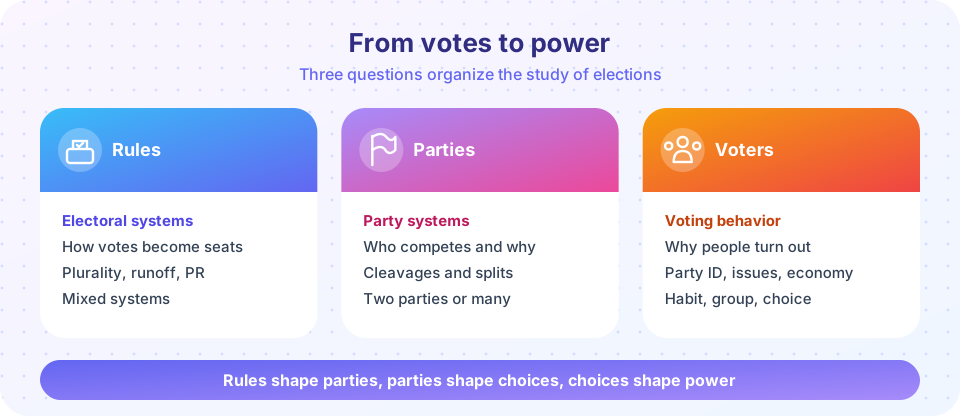
What you will learn
- Why the same votes can produce different winners under different rules.
- How party systems relate to electoral systems and to social divisions.
- Which classic theories explain why people vote the way they do.
- How the lessons in this chapter connect to each other.
Key terms
Election: a formal process in which citizens choose officeholders or decide on proposals.
Electoral system: the rules that turn votes into seats or offices.
Party system: the pattern of competition among parties in a country.
Turnout: the share of eligible people who actually vote.
The chapter in five slides
Elections have three layers
Rules change outcomes
The same ballots can give different winners.
Parties follow the rules
Voters mix three motives
Your turn
A first taste: the wrong winner
Consider a country with five districts and 100 voters in each. Two parties, A and B, compete. Under a plurality rule, the party with more votes in a district wins that district's single seat. Run the toy election below and see who wins the seats and who wins the votes.
Press Run (or Ctrl + Enter) to see the console output here.
No output.
Party A wins three of the five seats with only 37.2 percent of the votes. Party B piles up huge margins in two districts, and those extra votes do not earn it anything. This is not a trick: it is how single-seat districts work, and it is why electoral systems get a whole lesson of their own.
Counting parties
Political scientists need a way to say how many parties "really" compete. Counting every name on the ballot is misleading, because tiny parties barely matter. Markku Laakso and Rein Taagepera proposed the effective number of parties: the inverse of the sum of squared shares, N = 1 / Σ(p²). If two parties split the vote evenly, N is 2. If four parties each get a quarter, N is 4. Unequal shares give a number in between.
Press Run (or Ctrl + Enter) to see the result here.
Program input · what you'd type while the program runs
Type the answers before you press Run, one per line. Each time the program reads a line (with input()), it gets the next line from this box.
You will use this measure again in the lessons on electoral systems and party systems.
What each lesson covers
- Electoral systems: plurality, runoff, ranked-choice, proportional and mixed rules, with a seat calculator.
- Party systems: Duverger's law, social cleavages, and how many parties a country supports.
- Voting behavior: the Columbia, Michigan and rational-choice schools, turnout, and economic voting.
- Chapter review: the whole chapter in one picture, a recap table and a ten-question quiz.
Common misconceptions
"The party with the most votes always wins." Under districts and plurality rules, it may not. The toy election above shows how.
"Proportional systems are always fairer." They match seats to votes more closely, but they can make governments harder to form. "Fair" depends on what you value, a point you will revisit.
Check your understanding
Quick check · 3 questions
of 3 answered You scored / 3 · perfect!
-
1. Which three layers organize this chapter?
The chapter looks at electoral rules, the parties that compete under them, and the voters who choose. -
2. In the toy election, why does party A win more seats than B despite fewer votes?
Plurality in single-seat districts counts only who finishes first in each district, so surplus votes earn nothing. -
3. What does an effective number of parties of 2.0 mean?
The measure weights parties by size, so it describes how fragmented the competition is, not the raw count of names on the ballot.
Summary
- Elections combine rules, parties and voters, and each shapes the others.
- The same votes can give different seat totals under different rules.
- The effective number of parties summarizes how fragmented a party system is.
- This chapter covers electoral systems, party systems and voting behavior.
Next: Electoral systems
Track your progress
Create a free account to tick off lessons and pick up where you left off on any device.
of Political Science lessons completed