


















Lesson 34 of 44 · Comparative Politics
Chapter 7 Review: Comparative Politics
Review comparative method, regimes and democratization and meet Lijphart's majoritarian and consensus models, with a recap table and a ten-question quiz.
This chapter introduced the logic of comparison, the classification of regimes, the waves and causes of democratization, and the pitfalls of choosing cases. To close, we add one more comparative tool: Arend Lijphart's contrast between two ways of organizing democracy.
What you will learn
- How Lijphart's majoritarian and consensus models differ.
- How to connect the chapter's concepts, names and designs.
- Where each design or explanation is strongest and weakest.
Key terms
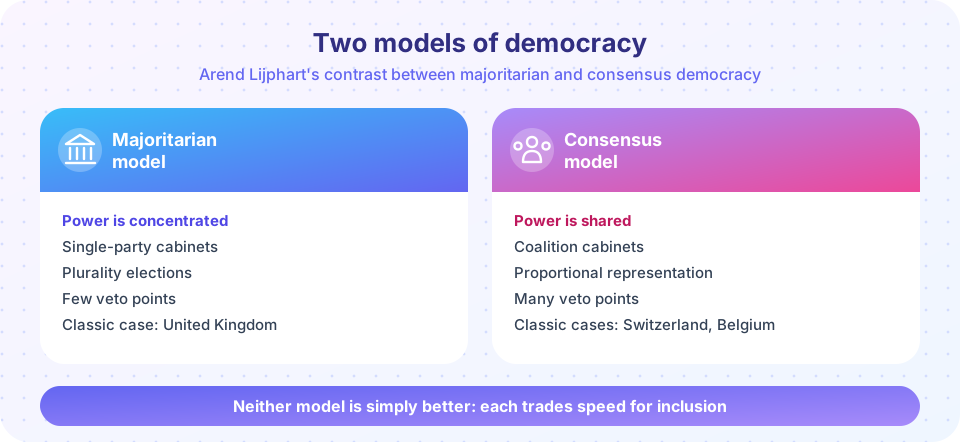
Majoritarian democracy: a model that concentrates power in the hands of the majority, as in a single-party cabinet.
Consensus democracy: a model that spreads power through coalitions, proportional representation and multiple veto points.
Veto point: a place in the political system where a decision can be blocked.
Polyarchy: Dahl's term for real-world democracy with contestation and inclusion.
Lijphart's two models
In Patterns of Democracy (1999), Lijphart compared thirty-six democracies on ten institutional features and found two clusters. The executives-parties dimension covers the party system, the electoral system, the cabinet, the relationship between executive and legislature, and interest-group politics. The federal-unitary dimension covers federalism, the strength of the second chamber, constitutional rigidity, judicial review and central bank independence. Countries near the majoritarian pole, such as the United Kingdom, concentrate power; those near the consensus pole, such as Switzerland and Belgium, share it. Lijphart argued that consensus democracies perform at least as well on economic management and often better on inclusiveness, though critics dispute parts of that claim.
Recap table
| Topic | Core idea | Names and examples |
|---|---|---|
| Comparison | Substitute for experiments; many variables, few cases | Mill (1843), Przeworski and Teune (1970) |
| Regime types | Contestation and inclusiveness; hybrids blur the line | Dahl (1971), Geddes, Levitsky and Way |
| Democratization | Waves and reversals; wealth sustains more than it creates | Huntington (1991), Lipset, Przeworski et al. |
| Case selection | Vary cause and outcome; avoid selecting only successes | Geddes (1990), crucial and deviant cases |
| Models of democracy | Majoritarian versus consensus | Lijphart (1999) |
Try it
Press Run (or Ctrl + Enter) to see the console output here.
No output.
Press Run (or Ctrl + Enter) to see the result here.
Program input · what you'd type while the program runs
Type the answers before you press Run, one per line. Each time the program reads a line (with input()), it gets the next line from this box.
Chapter quiz
Quick check · 10 questions
of 10 answered You scored / 10 · perfect!
-
1. Why is comparison used in political science?
Researchers compare carefully chosen cases to see which factors go with outcomes. -
2. What does a most similar systems design hold roughly constant?
MSSD picks cases alike in most respects so the differing factor stands out. -
3. Which two dimensions define Dahl's polyarchy?
Polyarchy is high on both public contestation and inclusive participation. -
4. What is competitive authoritarianism?
Levitsky and Way used it for hybrid regimes with real but unfair competition. -
5. According to Przeworski and colleagues, wealth mainly does what?
They found wealth did not strongly trigger transitions but rich democracies rarely collapsed. -
6. What is the danger of selecting only cases with the outcome you want to explain?
Selecting on the dependent variable can make real effects seem weak or absent. -
7. Huntington's third wave of democratization began in which year, roughly?
He dated the third wave from Portugal's revolution in 1974. -
8. Which is a feature of the consensus model?
Consensus democracies spread power through coalitions and proportional systems. -
9. What is a veto point?
More veto points make change harder, which is typical of consensus and federal systems. -
10. What does process tracing study?
It examines the steps of a causal mechanism using detailed evidence.
Summary
- Comparison tests explanations, but few cases and many variables call for careful design.
- Regimes can be mapped along contestation and inclusiveness, and measures differ.
- Democratization comes in waves with reversals; wealth sustains democracy more than it creates it.
- Lijphart contrasted majoritarian and consensus democracies on two dimensions.
Track your progress
Create a free account to tick off lessons and pick up where you left off on any device.
of Political Science lessons completed