


















Lesson 43 of 44 · Projects and Practice
Political Science Cheat Sheet: Elections, Policy, Comparison, World Politics
A one-page recap of elections, public policy, comparative politics and international relations: key ideas, formulas, names and a quick decision guide.
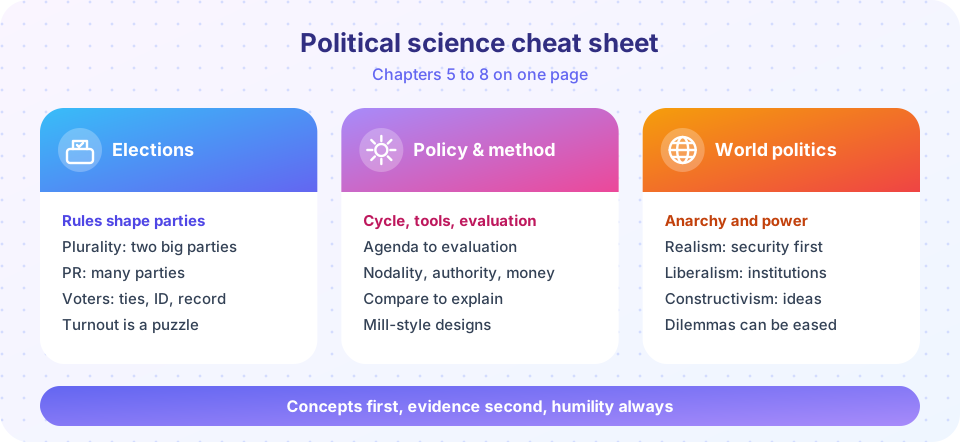
Keep this page open before an exam or discussion. It condenses chapters 5 to 8 into one picture, a table of formulas, a list of names and a decision guide. It is a memory aid, not a substitute for the lessons: each line links back to an idea you have already worked through.
What you will learn
- The core idea of each chapter in one line.
- The formulas you can compute.
- Which thinker goes with which idea.
The big ideas in one line each
- Elections: electoral rules turn votes into seats and shape how many parties compete.
- Voters: votes reflect group ties, party identification and judgments of performance, in mixtures.
- Policy: it runs through stages that are a map, not a timetable; implementation reshapes what policy means.
- Tools: governments combine information, authority, money and their own organization.
- Evaluation: you need a counterfactual; state assumptions and limits.
- Comparison: compare to test explanations; vary the cause and the outcome; avoid selecting only successes.
- Regimes: contestation and inclusiveness; hybrids blur the line; wealth sustains democracy more than it creates it.
- World politics: anarchy means no higher authority; realism, liberalism and constructivism highlight power, institutions and ideas; war is a bargaining failure; trade follows comparative advantage.
Formulas
| Quantity | Formula | Use |
|---|---|---|
| Effective number of parties | N = 1 / Σ(p²) |
How fragmented a party system is |
| Gallagher index | G = √(½ Σ(v − s)²) |
Gap between vote and seat shares |
| D'Hondt quotient | votes / (seats won + 1) |
Highest quotient gets the next seat |
| Sainte-Laguë quotient | votes / (2 × seats won + 1) |
Highest quotient gets the next seat |
| Calculus of voting | R = pB − C + D |
Why people vote |
| Pedersen volatility | ½ Σ abs(change in share) |
Shifts between elections |
| Net present value | Σ (B − C) / (1 + r)^t |
Value of a policy over time |
| Bargaining range of war | [p − cA, p + cB] |
Settlements both sides prefer to war |
Press Run (or Ctrl + Enter) to see the result here.
Program input · what you'd type while the program runs
Type the answers before you press Run, one per line. Each time the program reads a line (with input()), it gets the next line from this box.
Names to remember
| Name | Idea |
|---|---|
| Duverger (1951) | Plurality favors two parties |
| Lipset and Rokkan (1967) | Four cleavages shape party systems |
| Lazarsfeld; Campbell et al.; Downs | Columbia, Michigan and rational-choice voting models |
| Kingdon (1984) | Multiple streams and policy windows |
| Lindblom (1959) | Incrementalism |
| Pressman and Wildavsky (1973); Lipsky (1980) | Implementation; street-level bureaucrats |
| Hood (1983) | NATO tool families |
| Dahl (1971); Huntington (1991) | Polyarchy; waves of democratization |
| Lijphart (1999) | Majoritarian and consensus democracy |
| Waltz; Keohane; Wendt | Neorealism; institutionalism; constructivism |
| Axelrod (1984); Fearon (1995) | Cooperation in repeated games; war as bargaining failure |
Decision guide
Which tool for which question? Run the guide and then adapt it.
Press Run (or Ctrl + Enter) to see the console output here.
No output.
A final reminder on humility
Political science describes tendencies, not laws, and many classic findings are debated. Whenever you use an idea, state its assumptions, say where it might fail, and look for evidence from more than one kind of source.
Check your understanding
Quick check · 4 questions
of 4 answered You scored / 4 · perfect!
-
1. Which formula measures how fragmented a party system is?
The effective number of parties is the inverse of the sum of squared shares. -
2. Which pair of terms goes with Kingdon?
Kingdon's framework explains agenda change as streams joining at a policy window. -
3. In the decision guide, which concept helps explain why a law did not work in practice?
Implementation research studies how delivery reshapes policy. -
4. Which scholar is linked to the idea that war is a bargaining failure?
Fearon's 1995 article explains war through information, commitment and indivisibility problems.
Summary
- Elections, policy, comparison and world politics each have a short list of core ideas and formulas.
- Associating names with ideas helps recall.
- Use the decision guide to pick a concept for a question, and always state assumptions and limits.
Next: Where to go next
Track your progress
Create a free account to tick off lessons and pick up where you left off on any device.
of Political Science lessons completed