


















Lesson 9 of 44 · Core Concepts: State, Power, Legitimacy
Social Contract Theory
Why obey the state? Compare Hobbes, Locke, Rousseau and Rawls on the state of nature and the social contract, with a simulation and a veil of ignorance demo.
Suppose there were no government at all: no police, no courts, no laws. What would life be like, and would you be better or worse off? This thought experiment, called the state of nature, is the starting point of social contract theory. The theory then asks a second question: if people would agree to set up a government, what powers would they give it and on what terms?
Social contract thinkers do not claim that a contract was ever signed. The idea is a test. If rules could be justified to everyone who must obey them, the rules are legitimate; if not, they are suspect. The argument shaped the American and French revolutions, modern constitutions and the way we talk about rights.
What you will learn
- how the thought experiment of the state of nature works
- the contrasting answers of Hobbes, Locke and Rousseau
- Rawls's modern version: the original position and the veil of ignorance
- main criticisms from feminist, Marxist and other perspectives
- how a simple model shows why a sovereign can help cooperation
Key terms
State of nature: an imagined condition without government, used to test why rules are needed.
Social contract: an imagined agreement through which people create a government and accept duties.
Natural rights: rights thought to belong to people prior to any government.
General will: Rousseau's idea of what citizens want together as a community.
Veil of ignorance: Rawls's device in which rule makers do not know their own place in society.
Thomas Hobbes: safety through a sovereign
Thomas Hobbes wrote Leviathan in 1651, shortly after the English Civil War. He imagined people in the state of nature as roughly equal in strength and cunning, driven by self-preservation, competition and fear. With no common power to keep them in awe, life would be a "war of all against all." His most quoted description says that life there would be "solitary, poor, nasty, brutish, and short."
Reason, Hobbes said, leads people to give up their right to do anything they like and to transfer power to a sovereign who can enforce agreements. The bargain is: obedience in exchange for security. For Hobbes, even a harsh government is better than the chaos of no government, so people have very limited rights to resist. Critics point out that this gives rulers a great deal of power and few checks.
John Locke: rights and limited government
John Locke's Two Treatises of Government (1689) paints a milder state of nature. People are governed by a law of nature that tells them not to harm others in "life, health, liberty, or possessions." The trouble is that everyone is judge in their own case and conflicts are hard to settle. Government is created to protect natural rights more reliably.
Because government exists for this purpose, it is a trust. If a ruler violates it, people may replace the government. Locke's view lies behind the idea of consent of the governed, limited government, the right to revolt against tyranny and the protection of property. The American Declaration of Independence (1776) echoes his language. Critics note that Locke's account of property and his own involvement in colonial ventures were linked to the exclusion of women, enslaved people and indigenous peoples from full rights, which later thinkers challenged.
Jean-Jacques Rousseau: the general will
Rousseau opened The Social Contract (1762) with the line "Man is born free, and everywhere he is in chains." In his view, the problem is to find a form of association in which each person, while uniting with all, obeys only themselves and remains as free as before. His answer is a community in which citizens make the laws together according to the general will, the common interest, as distinct from the will of all, which is just the sum of private wants.
Because the general will is the citizens' own will, obeying the law is a kind of freedom. Rousseau inspired ideas of popular sovereignty and direct participation, but critics, such as Isaiah Berlin, warned that a community that claims to know the true will of the people can be used to justify forcing individuals "to be free."
John Rawls: fairness behind a veil
In A Theory of Justice (1971), John Rawls revived the contract idea for modern societies. He asks you to imagine choosing the basic rules of society from an original position behind a veil of ignorance: you do not know your class, talents, gender, race, religion or even your idea of a good life. Because you might end up anywhere, you would choose rules that are fair to everyone.
Rawls argued that such choosers would pick two principles: (1) equal basic liberties for all, and (2) social and economic inequalities allowed only if they are open to all under fair equality of opportunity and work to the benefit of the least advantaged (the difference principle). His critics include Robert Nozick, who argued in Anarchy, State, and Utopia (1974) for a minimal state, and utilitarians, who say we should aim at the greatest total welfare.
| Thinker | State of nature | Government exists to | Right to resist |
|---|---|---|---|
| Hobbes | War of all against all | Provide security | Very limited |
| Locke | Mostly peaceful but insecure | Protect natural rights | Yes, against tyranny |
| Rousseau | Free but not yet moral | Express the general will | Citizens are the sovereign |
| Rawls | (Not used; original position instead) | Secure fair terms of cooperation | Civil disobedience in some cases |
Criticisms
- No one signed. Critics such as David Hume noted that most people never consented in any real sense. Defenders reply that the contract is a hypothetical test, not a historical claim.
- Who was left out? Carole Pateman's The Sexual Contract (1988) argues that classic contract theory assumed a hidden agreement that kept women subordinate. Charles Mills's The Racial Contract (1997) argues a parallel point about race.
- Rational self-interest is a narrow starting point. Others stress care, community and tradition.
- Marxists say the state serves the owners of capital whatever the story of consent.
Common misconceptions
"The social contract was a real event." It is a thought experiment about justification, not a historical document.
"Hobbes, Locke and Rousseau all agree." They differ on human nature, the purpose of government and the right to resist.
"The veil of ignorance means equal outcomes." Rawls permits inequalities if they improve the position of the least advantaged and offices are open to all.
Try it
The first demonstration is a simulation of Hobbes's argument. Imagine a population that can be Peaceful or Raiders. Peaceful people who meet each other both gain 3. A Raider who meets a Peaceful person takes 5, leaving the victim 0. Two Raiders fight and each gets 1. Each generation, the strategy that earns more spreads. In the second case a sovereign punishes raiding, cutting a Raider's payoff by 2.5. The numbers are invented to illustrate the logic.
Press Run (or Ctrl + Enter) to see the result here.
Program input · what you'd type while the program runs
Type the answers before you press Run, one per line. Each time the program reads a line (with input()), it gets the next line from this box.
The model captures one idea: when raiding pays, it spreads, and an enforcer who changes the payoffs can reverse that. It leaves out many things Locke and Rousseau cared about, such as rights, voice and who controls the enforcer.
The second demonstration is Rawls's veil of ignorance. Three societies give different incomes to a poor, a middle and a rich person. Not knowing which one you will be, how would you rank them by average income, and by the worst position (Rawls's maximin rule)?
Press Run (or Ctrl + Enter) to see the console output here.
No output.
The two rules choose different societies. Which would you choose if you did not know your position? That question is the heart of the argument. Note that Rawls himself held that people behind the veil would prefer the maximin logic for basic liberties and the difference principle; other philosophers dispute this.
Check your understanding
Quick check · 6 questions
of 6 answered You scored / 6 · perfect!
-
1. In Hobbes's state of nature, life is best described as:
Hobbes thought that without a common power people would be in constant conflict. -
2. Which thinker said government is a trust that can be replaced if it violates natural rights?
Locke's Two Treatises argued for consent and a right to resist tyranny. -
3. What is Rousseau's general will?
He distinguished the general will from the will of all, the sum of private interests. -
4. What does the veil of ignorance remove?
Rule makers choose without knowing their class, talents or identity. -
5. Which criticism says classic contract theory hid the subordination of women?
Carole Pateman argued that a sexual contract underlay the social contract. -
6. In the simulation, what changes when the sovereign penalizes raiding?
The penalty reverses the payoff advantage of raiding.
Summary
- The social contract is a thought experiment that tests whether rules can be justified to those who obey them.
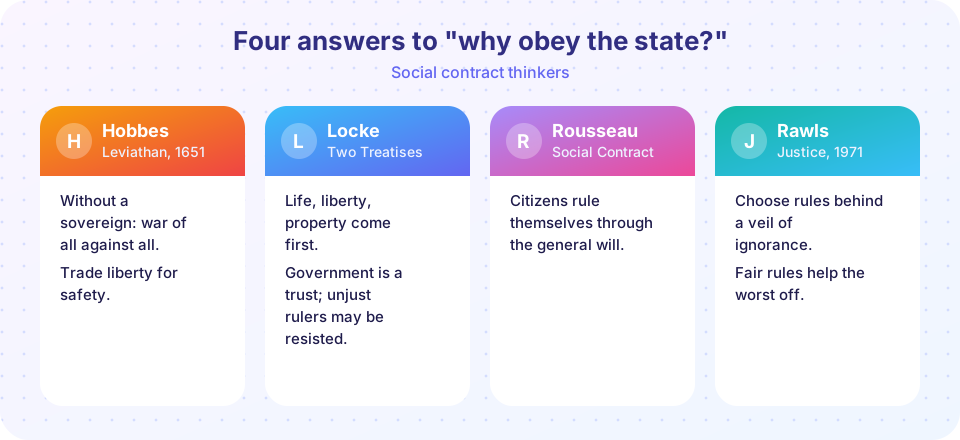
- Hobbes argues for a strong sovereign, Locke for limited government and natural rights, Rousseau for self-rule by the general will, Rawls for fair rules chosen behind a veil of ignorance.
- Criticisms ask who was included, whether consent is real, and whether self-interest is the right starting point.
- A simple simulation shows how a sovereign can change incentives and make cooperation stable.
Next: Chapter 2 Review
Track your progress
Create a free account to tick off lessons and pick up where you left off on any device.
of Political Science lessons completed