


















Lesson 10 of 44 · Core Concepts: State, Power, Legitimacy
Chapter 2 Review: State, Power, Legitimacy
Review chapter 2: Weber's state, Montevideo criteria, three faces of power, three types of authority and the social contract thinkers, with a ten-question quiz.
This chapter gave you the four big concepts that the rest of the course builds on. You can now say what a state is, how power can work even without force, why people accept rule as rightful, and what social contract thinkers said about obedience. Use this page to check that the pieces fit together before you move on to ideologies.
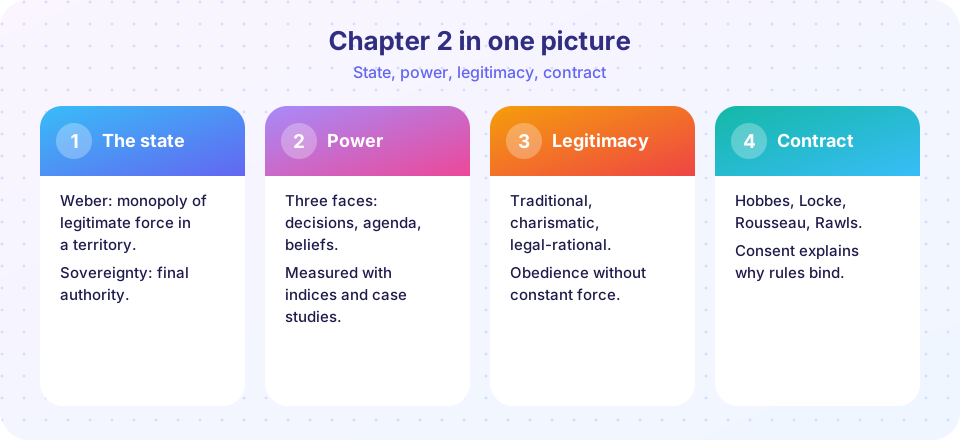
What you will learn
- test your recall of the four concepts and their key thinkers
- connect the concepts: how sovereignty, power, legitimacy and consent relate
- spot the typical mistakes in each area
Recap table
| Topic | Key idea | Names and dates |
|---|---|---|
| State | Monopoly of legitimate force in a territory | Weber, 1919 |
| Statehood | Population, territory, government, foreign relations | Montevideo, 1933 |
| Sovereignty | Supreme authority inside, independence outside | Westphalia, 1648 (traditional date) |
| Power | Three faces: decisions, agenda, beliefs | Dahl, Bachrach and Baratz, Lukes |
| Voting power | Banzhaf index counts critical votes | Banzhaf, 1965 |
| Authority | Traditional, charismatic, legal-rational | Weber |
| Contract | Hobbes, Locke, Rousseau, Rawls | 1651, 1689, 1762, 1971 |
How the pieces connect
Imagine a country as a building. Sovereignty is the roof: the claim that no outside power rules inside. Power is the machinery: the ability to get things done. Legitimacy is the foundation: the shared belief that gives the building stability. The social contract is the story residents tell about why they live there. A building with a weak foundation needs expensive props (coercion); a building with no machinery cannot deliver what people need. Both capacity and consent matter.
Common misconceptions
"Sovereign means all-powerful." Sovereignty is a legal and political claim; actual capacity varies, and states are bound by treaties and ties.
"The three faces are three different kinds of people." They are three ways of seeing the same phenomenon; real cases often combine them.
"Contract theorists wanted to describe history." They wanted to test whether rule can be justified.
Try it
The first demonstration is a spaced practice generator. It chooses concept prompts at random so that you can quiz yourself out loud.
Press Run (or Ctrl + Enter) to see the console output here.
No output.
The second demonstration charts the self-assessed strength of each of the four concepts so you can decide what to reread. Replace the numbers with your own.
Press Run (or Ctrl + Enter) to see the result here.
Program input · what you'd type while the program runs
Type the answers before you press Run, one per line. Each time the program reads a line (with input()), it gets the next line from this box.
Check your understanding
Quick check · 10 questions
of 10 answered You scored / 10 · perfect!
-
1. Who defined the state by its claim to a monopoly of legitimate force?
Weber's 1919 lecture 'Politics as a Vocation' gave this definition. -
2. Which is NOT a Montevideo criterion?
Recognition is not on the list; its role is debated. -
3. A committee never schedules a bill. Which face of power is this?
Controlling the agenda is Bachrach and Baratz's second face. -
4. Which type of authority is the least stable, needing constant proof?
Charisma depends on a person and must be reconfirmed. -
5. What does a high Banzhaf index mean?
The index counts how often a voter is decisive in coalitions. -
6. Which thinker said life without government would be 'solitary, poor, nasty, brutish, and short'?
This line is from Leviathan (1651). -
7. What does a legitimate but illegal action show?
Belief in rightfulness and legal validity are distinct. -
8. What is the general will?
Rousseau distinguished it from the will of all. -
9. Why did UN membership rise sharply between 1955 and 1970?
Dozens of former colonies became independent states. -
10. Which describes the difference principle in Rawls?
It permits inequality only under those conditions.
Summary
- Weber's state: legitimate monopoly of force over a territory; Montevideo lists the criteria of statehood.
- Power has three faces, and voting weight differs from voting power.
- Weber's three types of authority explain why people obey; real regimes mix them.
- Social contract thinkers test whether rule can be justified to those who obey it.
Track your progress
Create a free account to tick off lessons and pick up where you left off on any device.
of Political Science lessons completed