


















Lesson 27 of 44 · Public Policy
Public Policy: The Big Picture
Get the big picture of public policy: how problems reach the agenda, how decisions are made and carried out, and how results are judged.
Whenever a government decides what to do, or not to do, about a problem, it is making public policy. Policies set speed limits, fund schools, fix the interest rate on student loans, regulate drugs and protect rivers. Thomas Dye's well-known definition is that public policy is whatever governments choose to do or not to do, which is useful because it reminds us that inaction is also a choice.
Political science treats policy as a process with many actors: legislators, agencies, courts, interest groups, experts, the media and ordinary citizens. This chapter follows that process from the moment a problem is noticed to the moment results are judged. Here is the map.
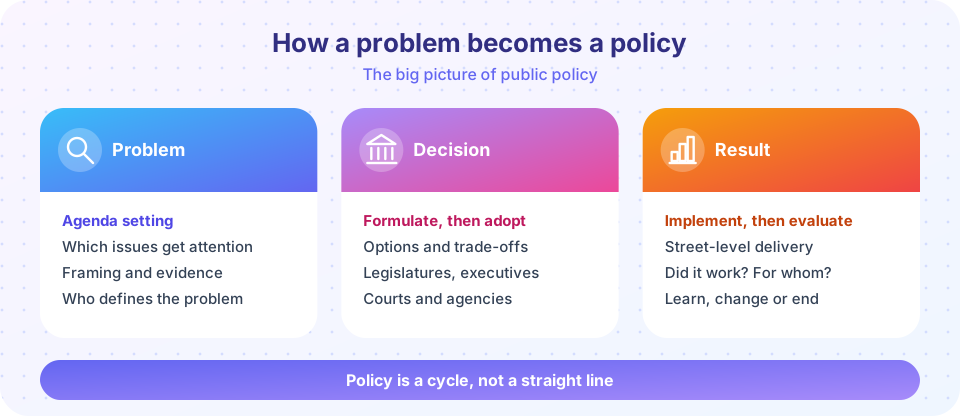
What you will learn
- What public policy is and who takes part in making it.
- How the stages model helps organize the process, and where it falls short.
- Why the same problem can lead to very different policies depending on how it is framed.
- What each lesson in this chapter covers.
Key terms
Public policy: a course of action, or deliberate inaction, adopted by government to address a problem.
Policy actors: the people and organizations that shape policy, such as legislators, agencies, interest groups and the media.
Framing: how a problem is described, which shapes what solutions seem sensible.
Policy instrument (tool): a means government uses to pursue a goal, such as a law, a tax or a campaign.
The chapter in slides
Policy is a process
Many actors, many veto points
Tools matter
Evidence counts
Why the stages model is useful
In the 1950s Harold Lasswell proposed breaking decision-making into stages, and later scholars developed the policy cycle: agenda setting, formulation, adoption, implementation, evaluation, and then change or termination. The model is a map, not a timetable. Real policy often skips stages, loops back, or runs several at once: implementation can change a policy as much as the original law did. But a map helps you ask the right question at each point: Who decided this was a problem? Who drafted the solution? Who has to carry it out? How will we know if it worked?
The same problem, different frames
How a problem is described shapes the policy that follows. Rising obesity can be framed as a personal responsibility issue, a public health issue, an urban design issue or a food industry issue. Each frame points toward different tools and different winners and losers. Run the example below, then add a frame of your own.
Press Run (or Ctrl + Enter) to see the console output here.
No output.
One question per stage
The next little program walks through the cycle and prints one guiding question for each stage. Use these questions when you analyze any real policy debate.
Press Run (or Ctrl + Enter) to see the console output here.
No output.
What each lesson covers
- Policy making and implementation: agenda setting, Kingdon's streams, incrementalism, and why plans change on the way to delivery.
- Policy tools and evaluation: the toolkits governments use, the case for intervention, and how analysts measure results.
- Chapter review: a one-page summary and a ten-question quiz.
Common misconceptions
"Policy is made by one decision-maker." Most policies involve many actors and many chances to change or block them.
"If a law passes, the problem is solved." Implementation can dilute, reshape or stall a policy.
"Policy analysis is neutral." Analysis relies on values, such as how to weigh efficiency against equity. Good analysts make those values visible.
Check your understanding
Quick check · 3 questions
of 3 answered You scored / 3 · perfect!
-
1. What is the policy cycle best described as?
The cycle helps analysts ask structured questions, but real processes loop back and overlap. -
2. Why does framing matter in policy debates?
Different descriptions of the same problem lead to different tools, actors and winners and losers. -
3. Under Dye's definition, is deliberate inaction a policy?
Dye defined public policy as whatever governments choose to do or not to do.
Summary
- Public policy is what governments choose to do or not to do, shaped by many actors.
- The policy cycle is a map of stages, not a strict timetable.
- Framing influences which solutions look sensible.
- This chapter covers making, delivering, tooling and evaluating policy.
Track your progress
Create a free account to tick off lessons and pick up where you left off on any device.
of Political Science lessons completed