


















Lesson 17 of 44 · Political Systems and Institutions
Democracy and Authoritarianism
What makes a regime democratic? Compare Schumpeter, Dahl and liberal definitions, learn hybrid and authoritarian regime types, and simulate Downs's median voter model.
The word democracy comes from the Greek demos (people) and kratos (rule). That sounds simple, until you ask what "rule by the people" means for a country of fifty million. People cannot decide every issue together. So countries have settled on ways to make the idea workable, and scholars have argued for a century over which features are essential. A regime can hold elections and still silence critics. Another may have strong courts but weak voter choice. Telling these apart matters, because the label shapes how the world treats a government.
This lesson compares major definitions of democracy, describes the authoritarian alternatives and the gray zone in between, and shows a classic model of how competition for votes shapes what parties offer.
What you will learn
- minimal, procedural and liberal definitions of democracy
- Dahl's eight conditions of polyarchy
- types of authoritarian regime: personalist, one-party, military and others
- hybrid regimes and democratic backsliding
- how the median voter model explains party convergence
Key terms
Democracy: a regime where citizens choose and can remove their leaders through free and fair competition.
Polyarchy: Dahl's term for real-world democracies with broad participation and contestation.
Authoritarianism: rule that limits political competition and concentrates power in a few hands.
Totalitarianism: a regime that seeks total control over public and private life through ideology, a single party and terror.
Hybrid regime: a regime that mixes democratic and authoritarian features.
Defining democracy
Minimal (electoral) definition. Joseph Schumpeter, in Capitalism, Socialism and Democracy (1942), described democracy as an institutional arrangement in which individuals acquire the power to decide by means of a competitive struggle for the people's vote. On this view, democracy is a method for choosing leaders. It is simple to apply but can include regimes that hold competitive elections and still violate rights.
Robert Dahl's polyarchy. Dahl argued that real democracies need two things: broad participation (almost all adults can vote and run for office) and open contestation (opponents can compete). To make these real he listed institutional guarantees: elected officials, free and fair elections, inclusive suffrage, the right to run for office, freedom of expression, alternative information, and associational autonomy (the freedom to form parties and groups). Dahl used the term "polyarchy" for actual systems because he thought a perfect democracy was an ideal that no country fully reaches.
Liberal democracy. This adds protections for individual rights, rule of law, independent courts and limits on the majority. Fareed Zakaria and others warn of illiberal democracy: regimes with elections but weak protection of rights. Others argue that rights are part of what makes elections meaningful.
Participatory and deliberative views stress that people should take part in decisions beyond voting, through assemblies, juries and debate.
Scholars measure democracy with indices. Examples include Freedom House ratings, the Polity project and the Varieties of Democracy (V-Dem) data set. They differ in design and in how they treat gray cases, so a country can score differently across indices.
Authoritarian regimes
Authoritarian rulers limit competition and concentrate power. Researchers distinguish several types, based on who holds power and how.
| Type | Who rules | Typical features |
|---|---|---|
| Personalist | One leader and a loyal circle | Rule through patronage and personal ties |
| One-party | A ruling party | Party membership shapes careers; controlled elections |
| Military | The armed forces | Rule by a council or junta, often temporary |
| Monarchical | A royal family | Hereditary rule, sometimes with advisory bodies |
| Theocratic | Religious authorities | Legitimacy claimed through religion |
Juan Linz separated authoritarian regimes, which tolerate limited pluralism, from totalitarian regimes, which aim to control every area of life through a mobilizing ideology and a single party. Nazi Germany and the Stalinist Soviet Union are standard examples of totalitarianism.
Authoritarian rulers face a recurring problem: the dictator's dilemma. They need information, but people afraid of punishment will not tell them the truth. They also need allies, but strong allies can turn into rivals. So they use tools such as co-optation, patronage and repression, along with propaganda, controlled courts and carefully managed elections. Some of the strongest modern authoritarian regimes hold elections, parliaments and courts, and use them to manage elites and to signal strength.
The gray zone: hybrid regimes
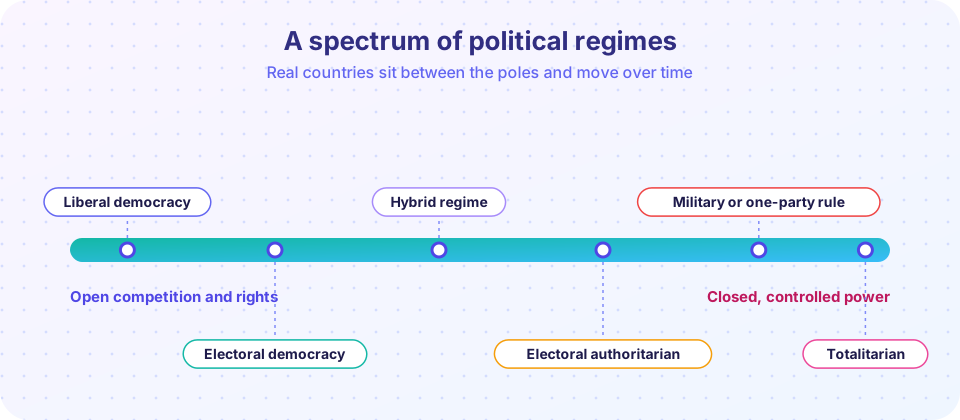
Many countries fall between the poles. Steven Levitsky and Lucan Way call the common form competitive authoritarianism: elections are held and opposition parties exist, but the playing field is tilted by control of media, courts and resources. Larry Diamond used the label "hybrid regime." Whether such systems are stable, or move toward more democracy or autocracy, is debated.
Scholars also describe democratic backsliding: a gradual weakening of democratic institutions by elected leaders, through changes to courts, electoral rules, media and civil society, often by legal means. It is harder to detect than a coup because each step can look legal.
What helps democracy last?
Research suggests several factors, none of them certain. Wealthier countries are more likely to stay democratic once they are democratic (Przeworski and colleagues), though wealth does not clearly cause democracy. Other factors include institutions that spread power, a strong civil society, an independent judiciary, and political cultures that accept losing elections. International pressure and regional organizations can help. Waves of democratization (Samuel Huntington counted three: 1828 to 1926, 1943 to 1962, and from 1974) have been followed by reversals, so change goes both ways.
Democratic competition: the median voter
The economist Anthony Downs, in An Economic Theory of Democracy (1957), built on an idea of Harold Hotelling's to explain why parties often sound alike. Imagine voters spread along a left-right line, each voting for the nearer party. If you are one of two parties, moving toward the center wins you voters in the middle and costs you only the ones at the edge, who have nowhere else to go. The median voter theorem says that, under these conditions, both parties end at the position of the median voter.
The model is elegant, and its assumptions are strong: one dimension, two parties, full information and voters with fixed preferences. In reality, parties also worry about turnout, activists, donors and the possibility of new rivals, so positions do not always converge. The model remains a standard starting point for thinking about competition.
Common misconceptions
"A country with elections is a democracy." Elections are necessary but not sufficient. Competition, rights and rule of law matter too.
"Authoritarian regimes are all alike." They differ in who rules and how stable they are.
"Democracy always protects minorities." Majority rule alone can threaten minorities; protections for rights and independent courts are needed.
Try it
The first demonstration simulates the median voter model. 20,000 voters are spread along a left-right scale. Two candidates take turns moving to the position that wins them the most votes against the other's current position. Watch where they end up. This is a model with strong simplifying assumptions.
Press Run (or Ctrl + Enter) to see the result here.
Program input · what you'd type while the program runs
Type the answers before you press Run, one per line. Each time the program reads a line (with input()), it gets the next line from this box.
Try placing the voters in two camps by replacing the normal distribution with a mix of two peaks. When voters polarize, the model predicts less to gain from moderation, though the story becomes more complex.
The second demonstration is a regime-scoring toy. It rates a country on four features, each from 0 to 1, and averages them. It is not a real index; it shows why definitions drive classification.
Press Run (or Ctrl + Enter) to see the result here.
Program input · what you'd type while the program runs
Type the answers before you press Run, one per line. Each time the program reads a line (with input()), it gets the next line from this box.
Check your understanding
Quick check · 5 questions
of 5 answered You scored / 5 · perfect!
-
1. Which definition treats democracy as a competitive struggle for the people's vote?
Schumpeter, 1942, defined democracy as a method for choosing leaders by competitive elections. -
2. What two dimensions does Dahl's polyarchy combine?
Broad participation and open contestation are the two core dimensions. -
3. What is competitive authoritarianism?
Levitsky and Way used the term for regimes with elections but an uneven playing field. -
4. In Downs's model, where do the two parties end up?
Under the model's assumptions, parties converge on the median voter. -
5. Why is democratic backsliding hard to detect?
Changes to courts, media and electoral rules are often gradual and formally legal.
Summary
- Definitions of democracy range from minimal (competitive elections) to liberal (adding rights and rule of law); Dahl's polyarchy requires participation and contestation.
- Authoritarian regimes include personalist, one-party, military, monarchical and theocratic types; totalitarianism seeks total control.
- Hybrid regimes and backsliding show that regimes move along a spectrum.
- The median voter model explains why competition can pull parties together, under strong assumptions.
- How you define democracy changes how you classify countries.
Track your progress
Create a free account to tick off lessons and pick up where you left off on any device.
of Political Science lessons completed