


















Lesson 1 of 44 · Getting Started
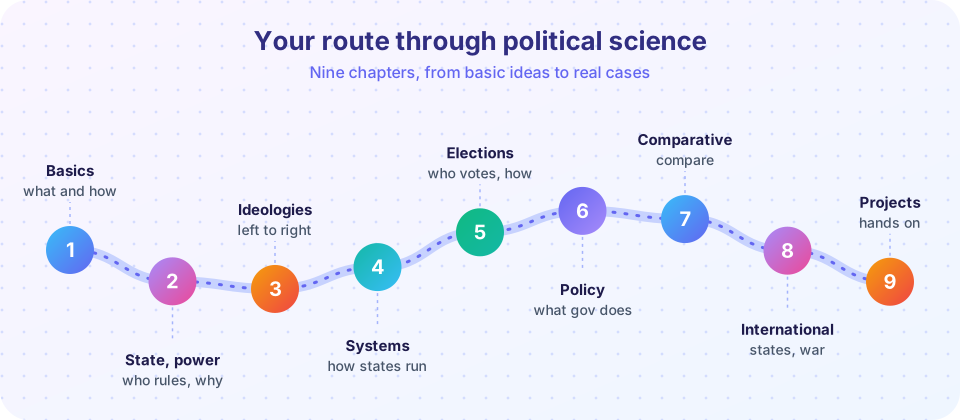
Course Map: Your Route Through Political Science
Start here: who this free political science course is for, how to study it, and a map of all nine chapters from state and power to elections and world politics.
Political science is the systematic study of power, government and collective decisions. It asks who rules, how they gain and keep authority, why people obey, and what happens when they do not. It also asks how institutions such as parliaments, courts and voting rules shape the choices a society can make. This course teaches the subject from the ground up, using the common core that university courses, the International Baccalaureate and Advanced Placement programs share.
You do not need to know anything about politics to start. You need curiosity, a willingness to read arguments you may disagree with, and a habit of asking "how do we know?" The course gives you vocabulary, famous thinkers, real cases and small runnable demonstrations so that ideas become concrete.
Educational information only. This course describes how politics works and how scholars study it. It does not tell you how to vote or which party to support. Where experts disagree, we show several views. The interactive parts are simple demonstrations of ideas, not real polls, forecasts or official indices.
What you will learn
- who this course is for and what you need before you start
- the nine chapters and how they fit together
- a study method that works for a reading-heavy subject
- how to use the demonstrations and quizzes in each lesson
Key terms
Politics: the activity through which groups make binding decisions despite disagreement.
Government: the people and institutions that make and enforce those decisions.
Political science: the organized, evidence-based study of politics and government.
Institution: a stable set of rules and organizations, such as a constitution or a court.
Who this course is for
This course suits three kinds of learner. The first is a student of about 14 to 18 who meets politics, government or civics in school and wants a clear, well-organized explanation. The second is a first-year university student who needs a map of the field before the reading lists begin. The third is an adult who follows the news and wants to understand it better, without taking a side.
No mathematics beyond percentages and simple averages is needed. A few lessons use short Python or JavaScript programs. You can run them with one click in the page, and you never have to install anything. If you cannot read code, read the explanation around it; the idea matters more than the syntax.
The nine chapters
Each chapter answers one big question. Early chapters give you tools, later chapters use them.
Foundations first
How governments work
The wider world
Chapters 1 to 4 are in the first half of the course; chapters 5 to 9 follow.
Chapter 1 explains what political scientists study and how they gather evidence. Chapter 2 introduces the three big concepts: the state, power and legitimacy. Chapter 3 surveys the main ideologies, the packages of beliefs that guide political movements. Chapter 4 looks at regimes and institutions: democracy and authoritarianism, constitutions, presidential and parliamentary systems, and federal and unitary states. The remaining chapters cover elections and parties, public policy, comparative politics, international relations, and practice projects.
How to study this course
Politics is a subject you learn by comparing and arguing, not by memorizing a list. These habits help.
- Read the lesson once for the story. Do not stop for every term.
- Read again with the key-terms box. Say each definition in your own words.
- Run every demonstration. Change a number and predict the result before you press Run.
- Take the quiz without looking back. A wrong answer shows exactly where to reread.
- Explain it to someone. If you can explain the social contract to a friend in two minutes, you own it.
Use the chapter reviews as checkpoints. A short, regular schedule beats a long cram: for most learners three or four hours a week for about five months covers the whole course.
A study planner
The widget below turns your weekly hours into a finish date. The hours per chapter are suggestions for planning, not a rule. It is a simple calculator, nothing more.
Common misconceptions
"Political science is about opinions." It includes values, but the field's core work is describing and explaining politics with evidence, and comparing claims against that evidence.
"Studying politics means choosing a side." Understanding an ideology is different from adopting it. Strong students can state a view they reject so clearly that its supporters would accept the summary.
"It is only about elections." Elections matter, but so do courts, bureaucracies, interest groups, wars and everyday rules such as school budgets.
Try it
Press Run (or Ctrl + Enter) to see the result here.
Program input · what you'd type while the program runs
Type the answers before you press Run, one per line. Each time the program reads a line (with input()), it gets the next line from this box.
Check your understanding
Quick check · 4 questions
of 4 answered You scored / 4 · perfect!
-
1. Which description fits political science best?
The field studies power and decision making systematically and tests explanations against evidence. -
2. What is the role of the demonstrations in this course?
They are labelled demonstrations; they illustrate ideas and are not real measurements. -
3. Which study habit does the lesson recommend before checking the quiz answers?
Retrieving ideas from memory shows what you really know and what to reread. -
4. Is studying an ideology the same as supporting it?
Good students can state a view they reject so fairly that its supporters accept the summary.
Summary
- Political science studies power, government and collective decisions with evidence.
- The course has nine chapters that move from concepts to institutions to the wider world.
- Study in short, regular sessions, run each demonstration, and test yourself.
- The course teaches how politics works; it does not tell you whom to support.
Track your progress
Create a free account to tick off lessons and pick up where you left off on any device.
of Political Science lessons completed