


















Lesson 37 of 44 · International Relations
Conflict, Cooperation and Institutions in World Politics
Learn why states fight and cooperate: the security dilemma, the prisoner's dilemma, Fearon's bargaining model of war, trade theory and international institutions.
If states are sovereign and no world government can enforce agreements, why does cooperation exist at all? And if war is so costly, why does it still happen? This lesson tackles both puzzles with a few simple models. The models are drastic simplifications, and their value is in clarifying logic: they show how rational actors can end up in outcomes nobody wanted, and what changes could help.
What you will learn
- How the security dilemma and the prisoner's dilemma explain arms races.
- Why repeated interaction and institutions can foster cooperation.
- Fearon's bargaining model: why war happens despite its costs.
- How comparative advantage supports the case for trade, and what international organizations do.
Key terms
Prisoner's dilemma: a game in which each player's best choice leads to an outcome worse for both than mutual cooperation.
Nash equilibrium: a set of choices in which no player can do better by changing alone.
Bargaining range: the set of settlements that both sides prefer to fighting.
Comparative advantage: the ability to produce something at a lower opportunity cost than others.
Collective security: an arrangement in which states agree to respond together to aggression.
The security dilemma as a game
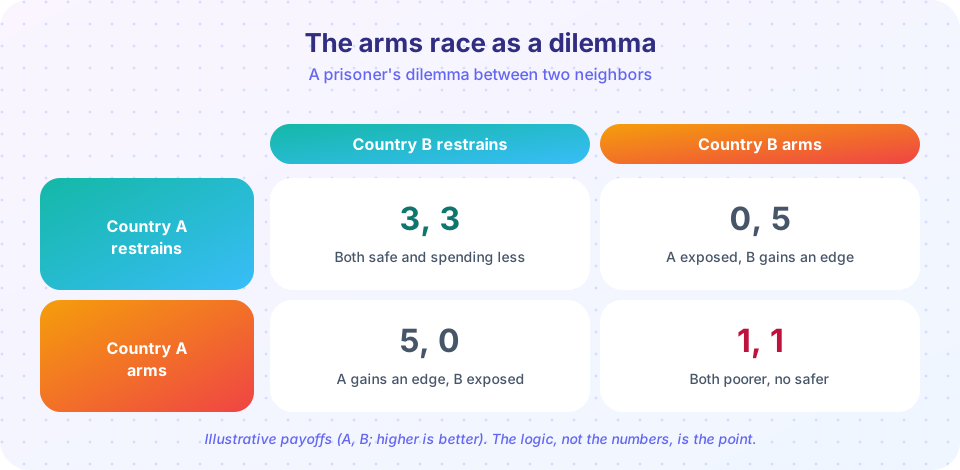
Imagine two neighbors who each want to be safe but cannot be sure of the other's intentions. Each can restrain or arm. In the payoff table, if both restrain, each gets 3; if one arms while the other restrains, the armer gets 5 and the other 0; if both arm, each gets 1. Whatever the other does, arming gives you more: against restraint you get 5 instead of 3, and against arming you get 1 instead of 0. So both arm, ending at (1, 1), worse than (3, 3). That is the prisoner's dilemma, and it captures the logic of the security dilemma. The payoffs are illustrative, and only their ordering matters.
Escaping the trap
Robert Axelrod's computer tournaments (reported in The Evolution of Cooperation, 1984) invited researchers to submit strategies for the repeated prisoner's dilemma. The simplest entry, tit for tat, cooperates first and then copies the other player's last move. It performed very well. Axelrod drew lessons: be nice (do not defect first), be provocable (respond to defection), be forgiving, and be clear. When the "shadow of the future" is long, because players expect to meet again, cooperation can be sustained.
The tournament below runs a small version of the idea. It is a teaching simulation: results depend on which strategies are in the pool, so do not read it as a law of nature.
Press Run (or Ctrl + Enter) to see the result here.
Program input · what you'd type while the program runs
Type the answers before you press Run, one per line. Each time the program reads a line (with input()), it gets the next line from this box.
Why do wars happen?
War is costly: it destroys lives and wealth. So in principle both sides should prefer a negotiated deal that gives each what it would expect from fighting, without the cost. James Fearon's article "Rationalist Explanations for War" (1995) used this logic to ask what stops such deals. If a state wins a war with probability p and values the prize at 1, with costs cA and cB for the two sides, then A would accept any settlement worth at least p − cA, and B would accept giving A at most p + cB. Every settlement between these numbers is better for both than war. A bargain exists whenever war is costly. Fearon identified three obstacles: private information with incentives to misrepresent (each side bluffs about strength), commitment problems (a side cannot credibly promise to honor a deal if power will shift), and issue indivisibility (the stake cannot be split, though he considered this the weakest explanation).
Press Run (or Ctrl + Enter) to see the console output here.
No output.
The lesson of the model is that war is a failure of bargaining, and that wars are likelier when information is poor and promises are not credible. Peace is promoted by communication, transparency and institutions that make commitments reliable.
Trade and comparative advantage
David Ricardo (1817) showed that countries can gain from trade even if one is better at producing everything. What matters is opportunity cost. In the example below, country A needs fewer hours for both goods, yet it should not make everything itself.
Press Run (or Ctrl + Enter) to see the console output here.
No output.
Real trade involves winners and losers within countries, adjustment costs and political fights over who bears them, so economists also study compensation and the distribution of gains.
International institutions
After the Second World War, states built institutions to manage cooperation. The United Nations (1945) has a General Assembly of all member states and a Security Council of fifteen members, five of them permanent (China, France, Russia, the United Kingdom and the United States), each with a veto. The Bretton Woods conference (1944) created the International Monetary Fund and the World Bank; the General Agreement on Tariffs and Trade (1947) became the World Trade Organization in 1995. The idea of collective security is that aggression anywhere is a concern for all, though the veto and divergent interests limit it in practice. Hegemonic stability theory, associated with Charles Kindleberger and Robert Gilpin, says an open order needs a leading power to supply public goods, a claim Keohane questioned.
Common misconceptions
"The prisoner's dilemma means cooperation is impossible." Repetition, reputation, monitoring and institutions can sustain cooperation.
"Wars happen because leaders are irrational." Fearon's model shows that fully rational actors can still fight when information or commitment problems block deals.
"Free trade helps everyone equally." Aggregate gains can coexist with large losses for particular groups.
Check your understanding
Quick check · 5 questions
of 5 answered You scored / 5 · perfect!
-
1. In the arms-race payoff table, why do both countries arm?
Arming is a dominant strategy, but mutual arming leaves both worse off than mutual restraint. -
2. What was notable about tit for tat in Axelrod's tournaments?
Tit for tat cooperates first and reciprocates, and did very well in his tournaments. -
3. In Fearon's model, what is the bargaining range?
Because war is costly, there is a set of deals that leaves both better off than war. -
4. Which is one of Fearon's three obstacles to bargaining?
Private information, commitment problems and indivisible issues can prevent a deal. -
5. What does comparative advantage say?
Gains arise from differences in opportunity cost, not from absolute efficiency.
Summary
- The security dilemma resembles a prisoner's dilemma: each side's safe-looking move leads to a worse shared outcome.
- Repetition, reciprocity and institutions can sustain cooperation.
- Fearon explains war as a bargaining failure caused by information, commitment or indivisibility problems.
- Comparative advantage supports trade, with distributional consequences.
- Institutions such as the UN, IMF, World Bank and WTO structure cooperation, within limits.
Next: Chapter review
Track your progress
Create a free account to tick off lessons and pick up where you left off on any device.
of Political Science lessons completed