


















Lesson 31 of 44 · Comparative Politics
Comparative Politics: The Big Picture
See why political scientists compare countries, how they classify regimes and explain differences, and what to expect from the lessons in this chapter.
Why do some countries stay democratic for centuries while others swing between coups and elections? Why do some governments collect taxes easily while others cannot? Why do similar countries, with similar histories, take different paths? Questions like these are the business of comparative politics: the systematic comparison of political systems, institutions and processes across countries or regions, and across time.
Studying one country can teach you a great deal, but comparison lets you test explanations. If a factor seems to matter in one place, does it matter elsewhere? This chapter introduces the tools of comparison, the main ways of classifying regimes, and the leading explanations for political change.
What you will learn
- Why comparison is the closest thing political science has to an experiment.
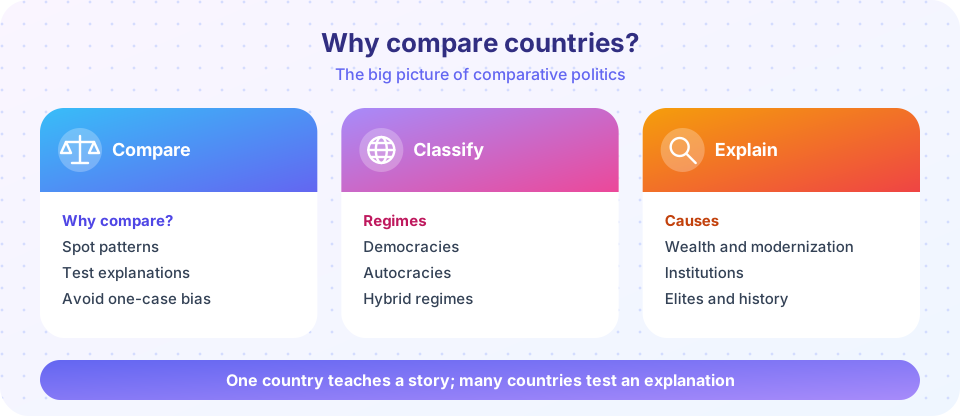
- The three basic tasks: compare, classify and explain.
- A first look at research designs and their pitfalls.
- What each lesson in this chapter covers.
Key terms
Comparative politics: the study of political systems across countries or time.
Case: one unit of analysis, such as a country in a given period.
Regime: the basic rules and institutions that determine who holds power and how.
Variable: a characteristic that can differ across cases, such as electoral system or income.
Hypothesis: a testable proposition about how variables are related.
The chapter at a glance
Three tasks
Types of regimes
Waves of change
Designs
Why compare?
Natural scientists can run experiments; political scientists mostly cannot. You cannot randomly assign countries to presidential or parliamentary government. Comparison is a substitute: by choosing cases carefully, you can see whether an outcome travels with a suspected cause. Scholars use comparison for three jobs. Describing: what do other systems look like, and how does ours fit? Classifying: which cases belong together? Explaining and testing: why do outcomes differ, and does a theory hold beyond its original case?
Comparison also guards against parochialism, the habit of treating one's own country as the norm. A feature that seems natural in one system, such as two-party competition, may be unusual elsewhere.
A first comparison
Suppose four hypothetical countries differ in a few features, and two of them have kept stable democracy. A table lets you spot candidate causes. Run the code and look at which features line up with the outcome.
Press Run (or Ctrl + Enter) to see the console output here.
No output.
Only one feature lines up in every case, but with four cases you cannot tell whether it is a cause or a coincidence. This is the central problem of comparative method: many possible explanations, few cases.
Press Run (or Ctrl + Enter) to see the result here.
Program input · what you'd type while the program runs
Type the answers before you press Run, one per line. Each time the program reads a line (with input()), it gets the next line from this box.
With four cases and twenty meaningless factors, you should expect several perfect matches by luck alone. With twenty cases, chance matches nearly vanish. Careful design must make up for small numbers.
What each lesson covers
- Democratization and regimes: how to define and measure democracy, waves of democratization, and the main explanations for regime change.
- The comparative method: Mill's methods, most similar and most different designs, case selection and common pitfalls.
- Chapter review: Lijphart's majoritarian and consensus models, a recap and a quiz.
Common misconceptions
"Comparing two countries proves a cause." Two cases cannot rule out other differences; they can suggest hypotheses to test further.
"Comparative politics is only about foreign countries." It includes comparisons among regions, states or provinces within one country and across time periods.
"Regime labels are facts." Classifying regimes involves judgment, and different datasets sometimes classify borderline cases differently.
Check your understanding
Quick check · 3 questions
of 3 answered You scored / 3 · perfect!
-
1. Why is comparison central to political science?
Researchers cannot randomly assign countries to institutions, so they compare cases to see which factors travel with outcomes. -
2. What is the main problem with few cases and many possible causes?
With few cases, several features may match the outcome by coincidence. -
3. Which task asks, 'Which cases belong together?'
Classification sorts cases into types, such as democracies, autocracies and hybrids.
Summary
- Comparative politics compares cases to describe, classify and explain.
- Comparison substitutes for experiments but has its own pitfalls, especially few cases and many variables.
- Regime types and research designs are the core tools, covered in the next lessons.
Track your progress
Create a free account to tick off lessons and pick up where you left off on any device.
of Political Science lessons completed