


















Lesson 26 of 44 · Elections, Parties and Voting
Chapter 5 Review: Elections, Parties and Voting
Review electoral systems, party systems and voting behavior with a one-picture recap, a summary table and a ten-question quiz.
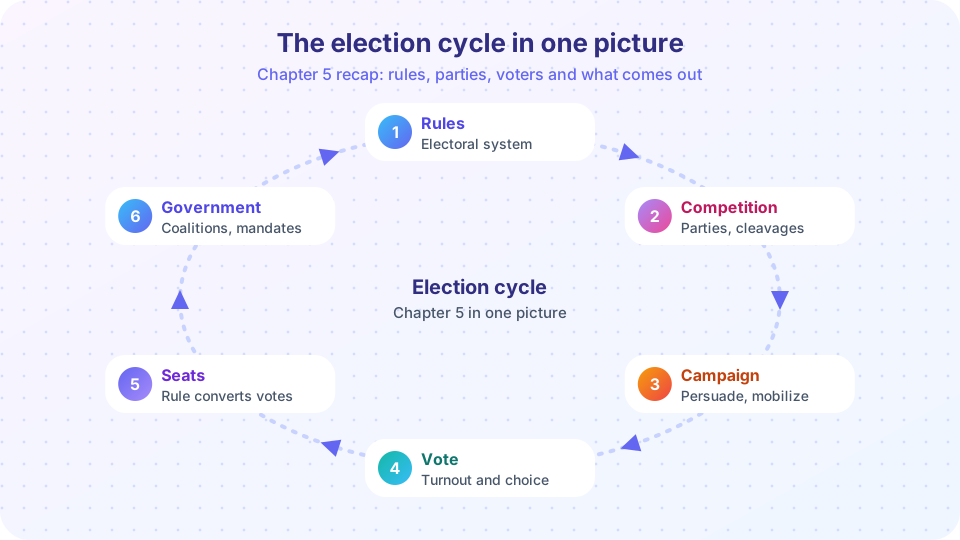
You have covered the machinery of elections: the rules that turn votes into seats, the party systems that form under those rules and social divisions, and the voters whose choices drive the whole process. This review pulls the pieces together and lets you test yourself.
What you will learn
- How the ideas from the whole chapter connect.
- Which numbers and formulas to remember.
- Where you still need practice.
Key terms
Plurality, PR, mixed: the three broad families of electoral systems.
Duverger's law: plurality rule tends toward two parties.
Cleavage: a lasting social division that parties organize around.
Party identification: a lasting attachment to a party.
Retrospective voting: judging incumbents by past performance.
Recap table
| Topic | Core idea | People and numbers to remember |
|---|---|---|
| Electoral systems | Rules convert votes to seats; district magnitude drives proportionality | D'Hondt (1, 2, 3...), Sainte-Laguë (1, 3, 5...), Gallagher index |
| Party systems | Rules and cleavages jointly shape party competition | Duverger (1951), Lipset and Rokkan (1967), effective number 1 / Σp² |
| Voting behavior | Votes reflect group ties, party identification and judgments of performance | Columbia, Michigan, Downs, Riker and Ordeshook, Fiorina |
Try it
Press Run (or Ctrl + Enter) to see the console output here.
No output.
Press Run (or Ctrl + Enter) to see the result here.
Program input · what you'd type while the program runs
Type the answers before you press Run, one per line. Each time the program reads a line (with input()), it gets the next line from this box.
Chapter quiz
Quick check · 10 questions
of 10 answered You scored / 10 · perfect!
-
1. What is district magnitude?
Magnitude is the number of seats a district elects, and larger magnitudes allow more proportional outcomes. -
2. In the UK 2019 example, the Liberal Democrats won roughly 11.6 percent of votes. What happened to their seat share?
Plurality rules in single-member districts penalize parties whose support is spread thinly. -
3. Which formula divides votes by 1, 3, 5 and so on?
Sainte-Laguë uses odd-number divisors and is somewhat friendlier to small parties than D'Hondt. -
4. What does a Gallagher index near zero indicate?
The index measures the gap between vote shares and seat shares, so a small value means the two are close. -
5. Which is the psychological effect of Duverger's law?
Anticipating the mechanical effect, voters and elites shift toward viable parties. -
6. Which pair is a classic Lipset-Rokkan cleavage?
Owner-worker, land-industry, church-state and center-periphery are the four cleavages. -
7. Which school introduced the funnel of causality and put party identification at its center?
The American Voter (1960) from the University of Michigan researchers developed this model. -
8. In R = pB - C + D, which term helps explain turnout when p is tiny?
Because p times B is tiny in a large electorate, duty and other non-instrumental motives carry much of the explanation. -
9. What does retrospective voting require of voters?
Voters can reward or punish past performance without detailed knowledge of every policy. -
10. A Pedersen index of 14 between two elections most closely means what?
The index is half the sum of absolute changes in party shares.
Summary
- Rules, parties and voters form a feedback loop.
- District magnitude and formula determine proportionality; Gallagher and effective-number measures summarize it.
- Cleavages and electoral rules jointly shape party systems.
- Votes reflect group ties, party identification and judgments of performance, in varying mixtures.
Track your progress
Create a free account to tick off lessons and pick up where you left off on any device.
of Political Science lessons completed