


















Lesson 20 of 44 · Political Systems and Institutions
Federal and Unitary States
Learn how unitary, federal and confederal states divide power between national and regional governments, with examples, arguments for and against, and a Tiebout sorting model.
The last lesson looked at how the executive and legislature relate. This lesson turns to a different question: how is power divided between the national government and governments of regions, provinces, states or cities? A country the size of Brazil, India or the United States cannot be run from one office. Even small countries must decide how much local choice to allow.
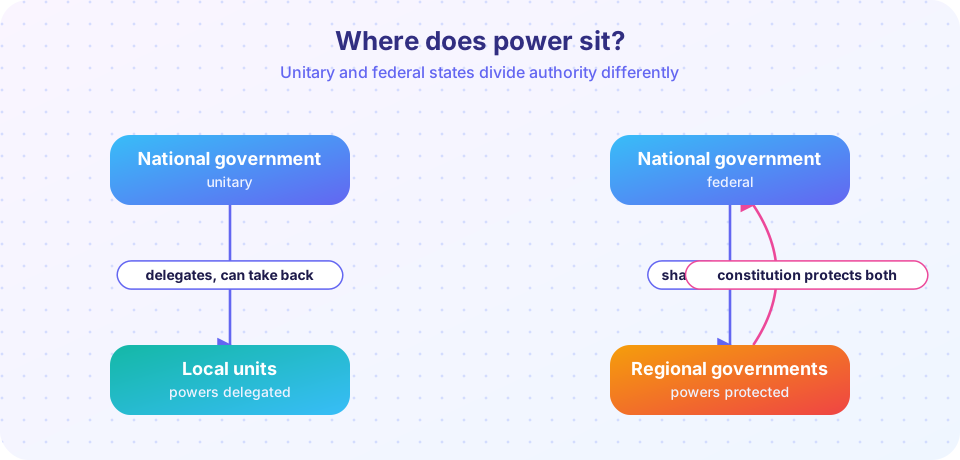
Political scientists call this the vertical division of power, and there are three main answers. In a unitary state, authority rests with the national government, which may delegate powers to local bodies. In a federal state, regions have constitutionally protected powers that the national government cannot simply take away. In a confederation, independent states delegate limited powers to a common body.
What you will learn
- the difference between unitary, federal and confederal systems
- the main features of federalism: constitutional division, a regional voice, courts as umpires
- examples such as the United States, Germany, Switzerland, India, France and the United Kingdom
- arguments for and against decentralization and the principle of subsidiarity
- a model in which people choose the jurisdiction that matches their preferences
Key terms
Unitary state: a state in which the national government holds final authority and may delegate powers.
Federation: a state in which constitutionally protected powers are divided between national and regional governments.
Confederation: a loose union of independent states with a weak central body.
Devolution: delegating powers from the center to regional bodies, which can in principle be reversed.
Subsidiarity: the principle that decisions should be taken at the lowest level that can handle them well.
Unitary states
In a unitary state, there is one source of sovereign authority. France is a classic example: departments and regions exist, and since the decentralization laws of 1982 they have more responsibilities, but their powers come from national law. Japan and many smaller countries are also unitary. A unitary state can still be decentralized: devolution in the United Kingdom since 1999 created parliaments or assemblies in Scotland, Wales and Northern Ireland. Because the UK Parliament remains sovereign, it could in principle change or end these arrangements, so the UK is unitary in law although in practice powerful devolved governments exist.
Advantages claimed for unitary systems include uniform national policies, simpler accountability and less duplication. Disadvantages include distance from local needs and tension in regions that want more control.
Federal states
A federation has at least two levels of government, each with its own area of authority protected by a constitution. The key features, drawn from the work of scholars such as Daniel Elazar and William Riker, are:
- A written constitutional division of powers that cannot be changed by the national government alone.
- Regional representation in the national government, often through a second chamber such as the US Senate or the German Bundesrat.
- An umpire, usually a constitutional or supreme court, to settle disputes over who has which power.
- Regions with their own governments and resources.
Typical examples are the United States, Canada, Australia, Germany, Switzerland, India, Brazil and Nigeria. Federations differ widely. In the United States, the Tenth Amendment reserves to states the powers not given to the federal government, but the federal role has grown over time. Germany has "administrative federalism," where the federal level mostly makes laws and the states mostly carry them out. Switzerland's cantons keep strong powers and the country uses frequent referendums. India is federal with a strong center and many states drawn along language lines.
Federations often arise when separate units come together (the US in 1787, Switzerland in 1848) or when a large diverse country decides to hold together by giving regions autonomy (India, Belgium, Nigeria). Riker argued that federations arise from bargaining that gives smaller units security without full merger.
Confederations
A confederation is a looser union. The Articles of Confederation (1781 to 1789) in the early United States left the central government without the power to tax, which was one reason the framers wrote a new constitution. The European Union is sometimes compared to a confederation or called a unique "union of states," but scholars debate the label because it has supranational courts and law.
Arguments for decentralization
- Local knowledge. Local governments may understand local needs better.
- Diversity. Different regions can have different policies for different preferences.
- Experiment. In 1932, Justice Louis Brandeis called states "laboratories of democracy," able to try new policies at small scale.
- Checks on power. Dividing power among levels creates another barrier to tyranny.
- Peace in divided societies. Autonomy can reduce conflict between ethnic or linguistic groups, though it may also strengthen separatism.
Arguments against
- Inequality across regions, where rights or services depend on where you live.
- Race to the bottom, if regions weaken standards to compete for business, a point contested by evidence.
- Duplication and confusion about who is responsible, which makes accountability hard.
- Local elites may capture local governments.
- Slowing national action, when regions block national goals. In US history, "states' rights" arguments were used to defend slavery and, later, segregation.
Subsidiarity and fiscal federalism
Subsidiarity is the principle that decisions should be taken at the lowest level that can handle them. It appears in Catholic social thought and in European Union treaties. In practice, local governments are usually given tasks like schools, local roads and waste, while the national level handles defense, currency and issues that spill across borders, such as air pollution. Fiscal federalism studies how to match taxing and spending powers; a common solution is for the national government to collect most taxes and pass on grants to regions.
Tiebout sorting
The economist Charles Tiebout suggested in 1956 that people "vote with their feet": if neighboring jurisdictions offer different bundles of taxes and services, residents move to the one that suits them. Competition among local governments can then supply public goods in line with preferences. The model needs many jurisdictions, easy movement and full information, which are only partly true, but it explains an advantage of decentralization. The simulation below illustrates it.
Common misconceptions
"Federal means big national government." In political science, "federal" refers to the constitutional division of powers between levels, not the size of the center.
"Unitary states have no local government." They often have strong local government, but its powers come from the national level.
"Federations are always more democratic." They can protect minorities and local choice, but they can also entrench regional inequality.
Try it
The first demonstration is a Tiebout sorting model. 1,000 residents each prefer a tax level between 0 and 1. In the national case, everyone gets one policy of 0.5. In the federal case, three regions set 0.2, 0.5 and 0.8 and residents move to the one closest to their preference. We measure how far people are from their preferred policy. Moving is free in this model, which is a strong simplification.
Press Run (or Ctrl + Enter) to see the result here.
Program input · what you'd type while the program runs
Type the answers before you press Run, one per line. Each time the program reads a line (with input()), it gets the next line from this box.
The model leaves out moving costs, spillovers between regions and the value of national uniformity. Add a moving cost by making people stay put unless the gain is above 0.05, and see how the result changes.
The second demonstration is a sorter that assigns tasks to the level of government that usually handles them in a federal system, following the subsidiarity idea. Real assignments differ by country.
Press Run (or Ctrl + Enter) to see the console output here.
No output.
Check your understanding
Quick check · 5 questions
of 5 answered You scored / 5 · perfect!
-
1. What distinguishes a federal state from a unitary state?
In a federation the national government cannot simply take back regional powers. -
2. Which is an example of devolution rather than federalism?
The UK Parliament remains sovereign and could in principle alter devolved arrangements. -
3. What did Justice Brandeis call the states in 1932?
He argued that states could try social and economic experiments. -
4. What is subsidiarity?
It is a principle of placing decisions as close to citizens as is effective. -
5. In the Tiebout model, how do people reveal their preferences?
They vote with their feet.
Summary
- Unitary states hold final authority at the center; federations protect regional powers constitutionally; confederations are loose unions.
- Federal features: written division of powers, regional voice in a second chamber, a court as umpire, and regional governments.
- Decentralization brings local knowledge, diversity and experimentation, but risks inequality, duplication and obstruction.
- Subsidiarity and Tiebout sorting offer logic for dividing tasks across levels.
Next: Chapter 4 Review
Track your progress
Create a free account to tick off lessons and pick up where you left off on any device.
of Political Science lessons completed