


















Lesson 38 of 44 · International Relations
Chapter 8 Review: International Relations
Review actors, anarchy, realism, liberalism, constructivism, the security dilemma, bargaining and trade with a summary picture, recap table and ten-question quiz.
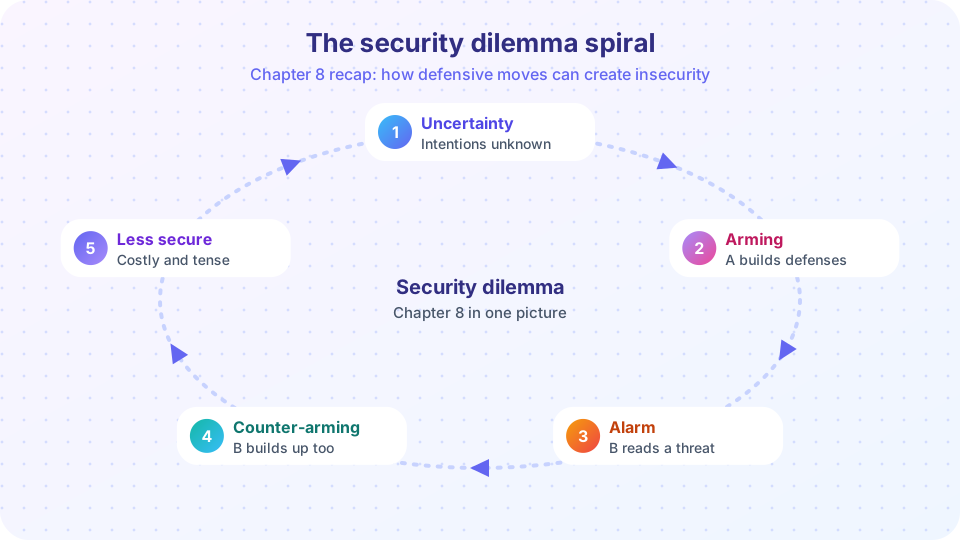
World politics is the study of how actors manage security, trade and shared problems without a world government. You have met the key actors and levels of analysis, three major theories, and models of conflict and cooperation. Use this page to connect the pieces and practice.
What you will learn
- How the chapter's ideas link to one another.
- Which thinkers go with which concepts.
- How to find equilibria in simple games.
Key terms
Anarchy: no central authority above states.
Balance of power: a distribution in which no state can dominate.
Security dilemma: one side's search for security reduces the other's.
Nash equilibrium: no player can gain by changing alone.
Comparative advantage: lower opportunity cost of producing a good.
Recap table
| Topic | Core idea | Names |
|---|---|---|
| Structure | Anarchy means no higher authority, not chaos; three levels of analysis | Waltz (1959, 1979) |
| Realism | Power and security; balancing; security dilemma | Thucydides, Morgenthau, Herz, Jervis, Mearsheimer |
| Liberalism | Democracy, trade, institutions | Kant, Doyle, Keohane |
| Constructivism | Ideas, norms and identities shape interests | Wendt, Finnemore and Sikkink |
| Conflict | Prisoner's dilemma; bargaining failures cause war | Axelrod (1984), Fearon (1995) |
| Trade and institutions | Comparative advantage; UN, IMF, World Bank, WTO | Ricardo (1817), Keohane |
Try it
Press Run (or Ctrl + Enter) to see the result here.
Program input · what you'd type while the program runs
Type the answers before you press Run, one per line. Each time the program reads a line (with input()), it gets the next line from this box.
The stag hunt, an idea from Rousseau, has two equilibria: both hunt the stag (best for both) or both take the hare (safe but poorer). It is often used to model situations where the problem is trust rather than temptation.
Press Run (or Ctrl + Enter) to see the console output here.
No output.
Chapter quiz
Quick check · 10 questions
of 10 answered You scored / 10 · perfect!
-
1. Which pair correctly matches thinker and idea?
Waltz's neorealism explained behavior by the system's structure. -
2. What does it mean that the international system is anarchic?
Anarchy is a statement about structure, not about disorder. -
3. Who developed the idea of the security dilemma in the early 1950s?
John Herz introduced the concept in 1950, and Robert Jervis developed it later. -
4. Which finding supports liberalism?
The democratic peace is a central empirical claim of liberal theory. -
5. Which tournament result did Axelrod highlight?
Tit for tat, a nice and reciprocal strategy, performed strongly. -
6. In Fearon's model, why can war be avoided in principle?
The costs of war create a range of settlements better for both sides. -
7. What is a commitment problem?
When future power changes, promises may not be believed, which can lead to war. -
8. Which institution was created in 1995 to succeed the GATT?
The WTO replaced the GATT framework in 1995. -
9. How many permanent members does the UN Security Council have?
China, France, Russia, the United Kingdom and the United States are permanent members with a veto. -
10. What does comparative advantage imply?
Gains come from differences in opportunity costs.
Summary
- IR explains behavior at three levels in a system without a central authority.
- Realism, liberalism and constructivism offer different but complementary lenses.
- Simple games clarify arms races, trust and bargaining failures.
- Trade and institutions shape cooperation, with limits and distributional effects.
Track your progress
Create a free account to tick off lessons and pick up where you left off on any device.
of Political Science lessons completed