


















Lesson 5 of 44 · Core Concepts: State, Power, Legitimacy
Chapter 2 Overview: State, Power and Legitimacy
Preview chapter 2 of the political science course: the state and sovereignty, the faces of power, legitimacy and authority, and the social contract thinkers.
Almost every political argument rests on a few big concepts. When people ask whether a government has the right to tax, whether a protest is justified, or whether a treaty can limit a country's choices, they are using ideas about the state, power and legitimacy, whether or not they use the words. This chapter gives you those ideas in their classic form, with the thinkers who built them and the debates that still divide scholars.
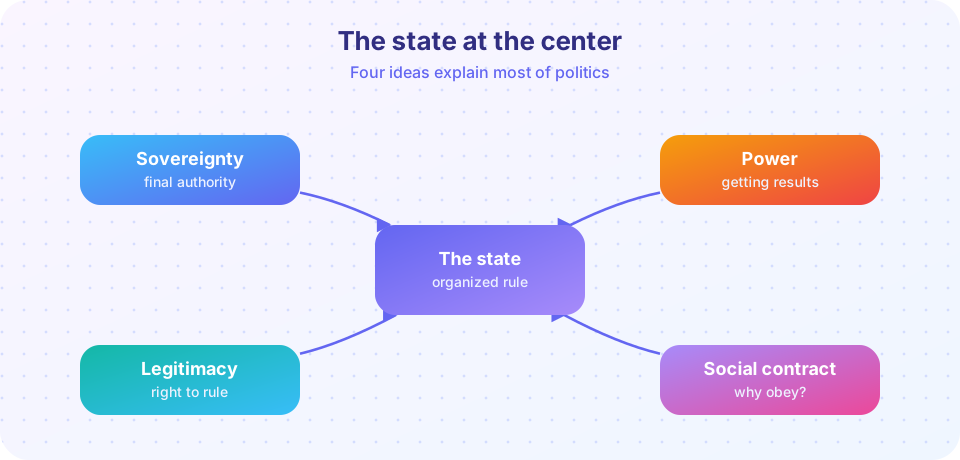
The four lessons that follow move from the structure to the justification. First, what a state is and what sovereignty means. Second, what power is and how it works even when nobody seems to be forcing anyone. Third, why people accept rules as rightful. Fourth, the old question of why anyone should obey at all, as answered by the social contract thinkers.
What you will learn
- the big picture of chapter 2 and how its four lessons connect
- why these concepts are contested, not settled
- what to look for in each lesson
Key terms
State: an organization that claims final authority over a territory and its population.
Sovereignty: the claim to supreme authority within a territory and independence from outside control.
Legitimacy: the widespread belief that a ruler or rule is rightful.
Authority: power that is accepted as rightful.
Four questions
And two more
Each lesson ends with a quiz and two demonstrations.
What each lesson covers
- The State and Sovereignty: Max Weber's definition, the 1933 Montevideo criteria, the rise of the nation-state after the Peace of Westphalia and the growth in the number of states since 1945.
- Power and Its Faces: Robert Dahl's pluralist view, the agenda-setting second face, Steven Lukes's third face, and a measure of voting power called the Banzhaf index.
- Legitimacy and Authority: Weber's three types, why even harsh regimes want legitimacy, and what happens when it drains away.
- Social Contract Theory: Hobbes, Locke, Rousseau and Rawls, and a simulation of why a state of nature might need a sovereign.
- Chapter 2 Review: a recap and a ten-question quiz.
How the concepts fit together
A useful way to remember the links is to ask four questions about any government. Who holds final authority (sovereignty)? What can they actually get done (power)? Do people believe they should obey (legitimacy)? What story justifies the arrangement (the contract)? A regime can be strong on one and weak on another. A military junta may hold power without legitimacy; a respected constitutional monarchy may keep legitimacy while real power sits with elected ministers.
Common misconceptions
"The state is the same as the government." The government is the current team in charge. The state is the lasting set of institutions and claims, which continues when governments change.
"Power always means force." Much power works through agenda control, persuasion and habit, not violence.
"Legitimacy is the same as legality." A law can be valid on paper while widely thought unjust, and a movement can be widely thought rightful while breaking the law.
Try it
The first demonstration prints a one-line "map" of the four concepts and asks which one a news headline is mainly about. It is a keyword toy for practice.
Press Run (or Ctrl + Enter) to see the console output here.
No output.
The second demonstration scores four invented entities against the four traditional criteria of statehood you will meet in the next lesson.
Press Run (or Ctrl + Enter) to see the result here.
Program input · what you'd type while the program runs
Type the answers before you press Run, one per line. Each time the program reads a line (with input()), it gets the next line from this box.
Check your understanding
Quick check · 4 questions
of 4 answered You scored / 4 · perfect!
-
1. Which pair of concepts are NOT the same?
The state outlasts governments, and power can work without force. -
2. What does legitimacy mean?
Legitimacy is the widespread belief that a ruler or rule is rightful. -
3. Which lesson will cover Hobbes and Locke?
The social contract thinkers are the subject of the fourth lesson. -
4. A regime has power but little legitimacy. What is it likely to rely on?
When rule is not believed rightful, more enforcement is needed.
Summary
- The chapter covers the state and sovereignty, power, legitimacy and the social contract.
- The state is not the same as the government; legitimacy is not the same as legality.
- Strong rule combines authority, capacity and belief.
- Thinkers disagree, and the debates continue.
Track your progress
Create a free account to tick off lessons and pick up where you left off on any device.
of Political Science lessons completed