


















Lesson 11 of 44 · Political Ideologies
Chapter 3 Overview: Political Ideologies
Preview chapter 3: what an ideology is, why the left-right spectrum is a useful but flawed map, and what liberalism, conservatism, socialism and other ideologies cover.
An ideology is a set of connected beliefs about how society works, what is wrong with it, what would be better, and how to get there. It is a map and a compass at once. A conservative, a socialist and a liberal can look at the same unemployment figures and describe different problems and different cures, not because they read different statistics but because their maps differ.
This chapter surveys the main families of ideas that shape modern politics. It does not try to convert you to any of them. It tries to describe each from the inside, in a form its own supporters would recognize, and to note the criticisms its opponents make.
What you will learn
- what ideologies are and what functions they serve
- why the left-right spectrum is useful and where it misleads
- what each lesson of this chapter covers
- how to describe a view fairly before you criticize it
Key terms
Ideology: a system of beliefs that explains politics and guides action.
Left and right: a rough way to sort positions, originally from seating in the French National Assembly in 1789.
Spectrum: a line along which positions are placed; useful for simplification, but it hides other dimensions.
Party platform: the stated program of a party, often drawn from one or more ideologies.
Where "left" and "right" come from
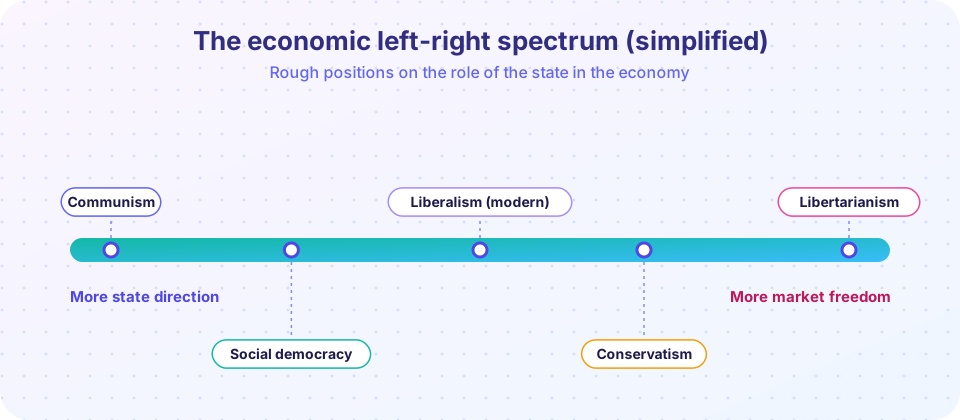
In 1789, during the French Revolution, delegates in the National Assembly physically sat according to their views. Supporters of the king's veto sat on the president's right, and supporters of radical change sat on his left. The labels stuck. Today "left" usually signals support for more equality and a larger state role in the economy, while "right" usually signals support for markets, tradition and order. But the meaning shifts: in the nineteenth century, "liberal" was a left label in Europe, and today the same word has different meanings in the United States and Europe.
A single line is a handy shortcut and a poor description. People who want low taxes and strict moral rules are far from the line's two ends in different ways. For that reason many scholars add a second dimension, such as personal freedom versus authority, as you will see in the lesson on other ideologies.
The functions of an ideology
Ideologies do four jobs. They explain why things are as they are, evaluate them against values, orient people by offering a group identity, and program action by suggesting what to do. Because they simplify, they can make complex issues clear, and they can also lock people into slogans.
Liberalism
Conservatism
Socialism
Other families
Many people mix ideas from several families.
What each lesson covers
- Liberalism and Conservatism: Locke, Smith, Mill and the move from classical to social liberalism; Burke, Oakeshott and the conservative case for tradition.
- Socialism and Marxism: early socialists, Marx and Engels, reform versus revolution, social democracy and communism in the twentieth century.
- Other Ideologies: nationalism, fascism, anarchism, feminism, environmentalism and religion in politics, plus a two-axis map.
- Chapter 3 Review: recap and a ten-question quiz.
Reading an ideology fairly
Use four steps. First, state the core values: what does the ideology treat as most important? Second, identify its diagnosis: what does it say is wrong? Third, list its remedies: what policies and institutions follow? Fourth, find its internal debates: every ideology has factions. Only then compare and criticize. If you cannot state a view so that its followers say "yes, that is what we believe," you have not understood it yet.
Common misconceptions
"Ideology is something only extremists have." Everyone holds a set of political beliefs; the term describes the system of ideas, not an insult.
"Left and right are fixed meanings." They change with time and place. A position on the right in one country may be on the left in another.
"Each person fits one box." Many people hold mixed views: for example, pro-market on the economy and liberal on personal lifestyle.
Try it
The first demonstration is a short opinion scorer. It asks six statements on a 1 to 5 scale and gives a rough economic and social score. It is a teaching toy, not a validated test, and the results depend entirely on how the statements are written. Change the answers to see how the scores respond.
Press Run (or Ctrl + Enter) to see the console output here.
No output.
The second demonstration places six ideologies on the same simplified axis as the picture, with approximate positions that you can change.
Press Run (or Ctrl + Enter) to see the result here.
Program input · what you'd type while the program runs
Type the answers before you press Run, one per line. Each time the program reads a line (with input()), it gets the next line from this box.
Check your understanding
Quick check · 4 questions
of 4 answered You scored / 4 · perfect!
-
1. Where do the terms left and right come from?
Delegates sat according to their views on the king's powers and the Revolution. -
2. Which is a limitation of the left-right line?
One line cannot show the many separate dimensions of political belief. -
3. Which step comes first in reading an ideology fairly?
Understand first; criticize later. -
4. Which is NOT one of the four functions of an ideology listed?
Ideologies explain, evaluate, orient and program; tax collection is a state function.
Summary
- An ideology is a connected set of beliefs that explains, evaluates, orients and guides action.
- Left and right began in 1789 and are only a rough map; meanings shift across time and place.
- This chapter covers liberalism, conservatism, socialism and other families such as nationalism, anarchism, feminism and environmentalism.
- Understand a view in its own terms before you criticize it.
Track your progress
Create a free account to tick off lessons and pick up where you left off on any device.
of Political Science lessons completed