


















Lesson 19 of 44 · Political Systems and Institutions
Presidential and Parliamentary Systems
Compare presidential, parliamentary and semi-presidential systems: separate survival versus confidence votes, coalition governments, Linz's critique and examples.
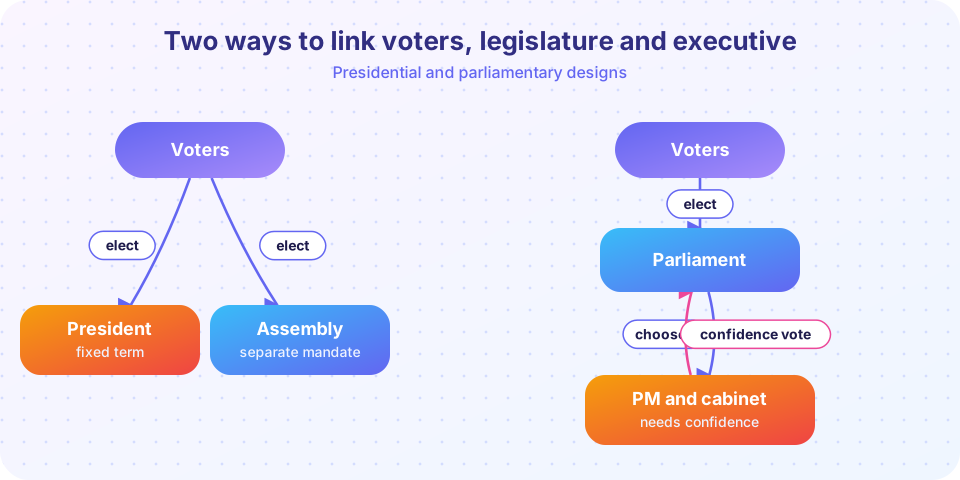
Democracies fall into two main families, depending on how the head of government is chosen and kept in office. In a presidential system, voters elect the executive separately from the legislature, and the president serves for a fixed term. In a parliamentary system, voters elect the legislature, and the legislature, or a majority in it, chooses the government and can remove it. A third group, semi-presidential systems, mixes both.
The difference sounds technical, but it shapes everyday politics. It decides whether a government needs a standing majority, whether elections can be called early, how coalitions form, and how hard it is to get rid of a leader who has lost public trust.
What you will learn
- the defining features of presidential, parliamentary and semi-presidential systems
- the idea of separate survival versus confidence
- how coalition governments are formed, with a coalition calculator
- Linz's critique of presidentialism and counterarguments
- examples of each system and their variations
Key terms
Presidential system: a system where the executive is elected separately and has a fixed term.
Parliamentary system: a system where the executive depends on the confidence of the legislature.
Vote of no confidence: a vote by which the legislature can remove the government.
Coalition government: a government formed by two or more parties that together hold a majority.
Semi-presidential system: a system with both an elected president and a prime minister responsible to parliament.
Presidential systems
In a presidential system:
- the president is both head of state and head of government, elected by the people (directly or through an electoral college);
- the president serves a fixed term and cannot normally be removed by the legislature except by impeachment for serious offenses;
- the legislature is elected separately, with its own mandate and term.
Scholars call this separate origin and survival. The United States is the classic case, and many Latin American countries have copied the design, along with countries such as Indonesia, Nigeria and South Korea. An advantage is clarity: voters know whom they are electing to run the executive, and a fixed term gives stability. A disadvantage is that president and legislature can be controlled by different parties, which is called divided government, and neither can force an election to resolve the standoff.
Parliamentary systems
In a parliamentary system:
- the head of state is a largely ceremonial figure: a monarch (the United Kingdom, Canada, Japan, Spain) or a president chosen by parliament or elected for ceremonial duties (Germany, Italy, India);
- the head of government, usually called prime minister or chancellor, and the cabinet come from the legislature and need its confidence to stay in office;
- a vote of no confidence can remove them, and in many systems the government can also dissolve parliament and call an election.
This is called a fusion of powers, since the executive grows out of the legislature. It tends to make decisions faster, because a government with a majority can usually pass its program. It also makes governments more directly accountable: if they lose the majority, they fall. Critics note that this can concentrate power in the cabinet and that coalition collapses can cause instability.
Coalitions
When no party wins a majority of seats, which is typical under proportional representation, parties bargain to form a coalition government. In many countries the largest party leads, but not always. Typical coalition outcomes are:
- Minimal winning coalition: just enough parties for a majority, so that no partner can be removed without losing the majority.
- Minority government: a party or group without a majority governs with support from others on key votes. Common in Scandinavia.
- Grand coalition: the two largest parties govern together, as in Germany at various times.
William Riker's theory of minimal winning coalitions predicted that parties would avoid including more partners than needed, since each extra partner means sharing the spoils. Real coalitions often include more partners, because ideology and policy closeness matter too, which later research by Lawrence Dodd, Michael Laver and Kenneth Shepsle stressed.
Semi-presidential systems
Maurice Duverger coined the term for systems with a directly elected president with real powers, alongside a prime minister who needs parliament's confidence. France under the Fifth Republic (1958) is the best known. When president and parliamentary majority come from the same side, the president leads. When they differ, there is cohabitation and the prime minister takes the main role in domestic policy. France experienced this in 1986 to 1988, 1993 to 1995 and 1997 to 2002. Other examples include Portugal, Poland and Finland (the latter reduced presidential powers over the years).
Is one design better? Linz's argument
In an influential 1990 article, "The Perils of Presidentialism," Juan Linz argued that parliamentary systems are safer for new democracies. His reasoning: in presidential systems, president and legislature each claim a dual democratic legitimacy, with no constitutional way to decide who is right in a deadlock; a fixed term makes it hard to get rid of a failing president; and the winner-take-all contest for one office raises the stakes. Linz noted that many Latin American presidential democracies collapsed in the 20th century.
Other scholars pushed back. Studies by Matthew Shugart and John Carey, and others, found that the effect depends on details, such as the party system, the powers of the president and electoral rules. A presidential system with a few disciplined parties, and with limited presidential powers, can work well. Comparative evidence shows correlation, not simple cause, since presidentialism was more common in regions with other risk factors.
| Feature | Presidential | Parliamentary |
|---|---|---|
| Executive chosen by | Voters, separately | Legislature (after elections) |
| Can the legislature remove the executive? | Only by impeachment | Yes, by no confidence |
| Can the executive dissolve the legislature? | Generally no | Often yes |
| Policy speed with divided control | Possible gridlock | Government needs a majority |
| Examples | USA, Brazil, Mexico | UK, Germany, India, Japan |
Common misconceptions
"The prime minister is the head of state." In most parliamentary systems the monarch or ceremonial president is the head of state, and the prime minister is head of government.
"Presidential systems are always more stable." A fixed term gives some stability, but deadlock and the difficulty of removing a failing leader can create instability.
"Parliamentary systems always need coalitions." Under some voting rules, such as in the United Kingdom, one party often wins a majority.
Try it
The first demonstration finds all the minimal winning coalitions in an imagined parliament of 100 seats. A coalition is minimal winning if it has a majority and no member could leave without losing it. The seat numbers are invented.
Press Run (or Ctrl + Enter) to see the result here.
Program input · what you'd type while the program runs
Type the answers before you press Run, one per line. Each time the program reads a line (with input()), it gets the next line from this box.
Change the seats and see which parties become indispensable. A party that appears in every minimal coalition is a kind of veto player.
The second demonstration simulates what happens to a coalition when one partner leaves, then reports whether the government survives a confidence vote.
Press Run (or Ctrl + Enter) to see the console output here.
No output.
Check your understanding
Quick check · 5 questions
of 5 answered You scored / 5 · perfect!
-
1. What defines a parliamentary system?
The government must keep parliament's confidence. -
2. What is divided government?
It is common in presidential systems with separate elections. -
3. What is cohabitation in France?
It occurs when parliament's majority opposes the president's party. -
4. What was Linz's main worry about presidentialism?
He argued that rival claims of legitimacy and fixed terms create rigid conflict. -
5. Which is a minimal winning coalition?
No partner is surplus to the majority.
Summary
- Presidential systems have separate origin and survival of the executive; parliamentary systems make the executive depend on parliament's confidence.
- Semi-presidential systems combine an elected president and a prime minister, with cohabitation possible.
- Coalitions form when no party has a majority; minimal winning, minority and grand coalitions are common types.
- Linz argued that presidentialism is riskier for new democracies; later work finds the effect depends on details.
Track your progress
Create a free account to tick off lessons and pick up where you left off on any device.
of Political Science lessons completed