


















Lesson 23 of 44 · Elections, Parties and Voting
Electoral Systems: How Votes Become Seats
Compare plurality, runoff, ranked-choice, proportional and mixed electoral systems, and run seat calculators to see how the rules change who wins.
An electoral system is a set of rules that answers one question: given everyone's ballots, who gets the seats? It sounds technical, but it is among the most powerful choices a country makes. Change the rule and you can change the winner, the number of parties, and even how candidates campaign, without changing a single voter's mind.
In this lesson you will meet the main families of electoral systems, calculate seats with two proportional formulas, and measure how closely seat shares match vote shares.
What you will learn
- The three elements of any system: district size, ballot type and formula.
- How plurality, two-round, ranked-choice, list PR, STV and mixed systems work.
- How to apply the D'Hondt and Sainte-Laguë formulas.
- How to measure disproportionality with the Gallagher index.
Key terms
District magnitude: the number of seats elected in one district. Single-member districts have a magnitude of 1.
Plurality ("first past the post"): the candidate with the most votes wins, even without a majority.
Proportional representation (PR): a family of systems in which seats are allocated roughly in line with vote shares.
Threshold: the minimum vote share a party needs to win any seats under PR.
Disproportionality: the gap between parties' vote shares and seat shares.
Three building blocks
Every system combines three choices. District magnitude is how many seats a district elects. Ballot structure is what the voter does: pick one candidate, rank candidates, or choose a party list. Electoral formula is the arithmetic that converts votes to seats. Arend Lijphart's comparative work found that district magnitude is the single most important factor for proportionality: the more seats per district, the closer seat shares can match vote shares.
Plurality and majority systems
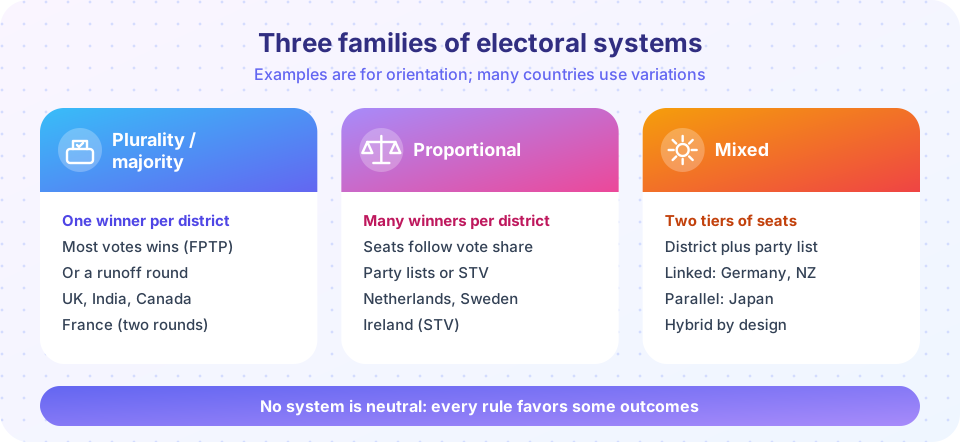
In plurality systems with single-member districts, such as the United Kingdom, India, Canada's federal elections and the US House, the candidate with the most votes in each district wins, with or without a majority. The system is simple and gives voters a clear local representative. Its price is disproportionality: winning parties often gain extra seats, and a party whose support is thinly spread can win few seats even with a large vote share.
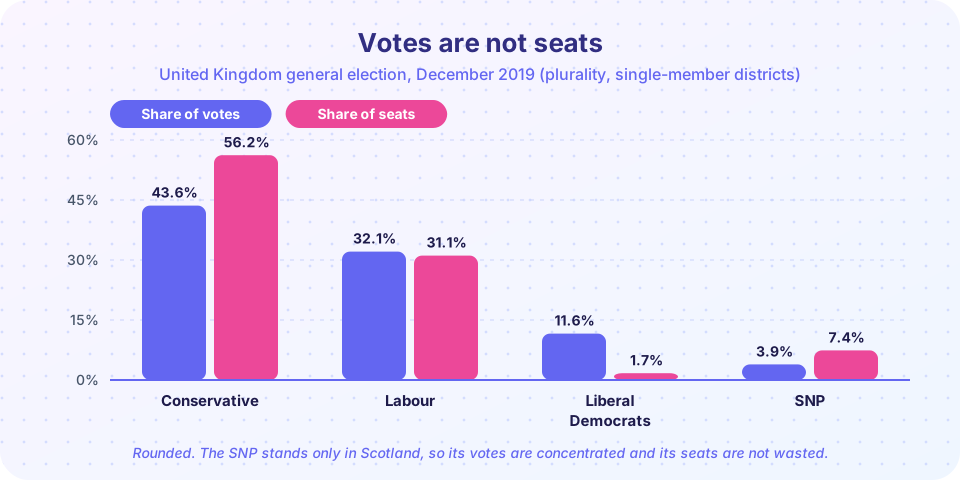
The chart below shows the UK's 2019 election, the figures rounded. The Conservative Party won 43.6 percent of votes but 56.2 percent of the 650 seats. The Liberal Democrats won 11.6 percent of votes but 1.7 percent of seats, while the Scottish National Party, whose voters are concentrated in Scotland, won 3.9 percent of votes across the UK and 7.4 percent of seats.
Two-round (runoff) systems try to deliver a majority winner. In France's presidential election, if no candidate has more than half the votes in round one, the top two meet in round two. Between rounds, parties bargain and voters can reconsider. Ranked-choice systems achieve a similar goal in one trip to the polls: voters rank candidates, the last-place candidate is eliminated and their ballots go to the next preference, until someone has a majority. Australia's House of Representatives uses this "preferential voting".
Proportional systems
In list PR, each party submits a list of candidates, voters choose a party (sometimes also a candidate), and each party's seats are roughly proportional to its votes. The Netherlands and Israel treat the whole country as one district; Sweden uses regional districts. Two formulas are common.
- D'Hondt divides each party's votes by 1, 2, 3 and so on, then hands out seats to the highest quotients. It slightly favors larger parties.
- Sainte-Laguë divides by 1, 3, 5 and so on. It is a little kinder to small parties.
Thresholds keep tiny parties out. Germany's federal threshold is 5 percent, for example, which prevents extreme fragmentation but wastes votes for parties that fall just short.
With single transferable vote (STV), used in Ireland and Malta, voters rank candidates in multi-member districts, and surplus and eliminated votes are transferred. It is proportional while letting voters choose among individual candidates, even within a party.
Mixed systems
Mixed systems use two tiers. In mixed-member proportional (MMP) systems, as in Germany and New Zealand, voters elect local district members and also vote for party lists; list seats are used to compensate so that overall seats follow the list vote. In parallel systems, as in Japan's lower house, the two tiers are counted separately, so the result is less proportional. Mixed systems try to combine a local link with fair overall outcomes.
Same ballots, different results
The calculator below applies both PR formulas to the same vote totals for an eight-seat district. Run it, then change the vote numbers or the number of seats.
Press Run (or Ctrl + Enter) to see the result here.
Program input · what you'd type while the program runs
Type the answers before you press Run, one per line. Each time the program reads a line (with input()), it gets the next line from this box.
Notice that party A gets five seats under D'Hondt but four under Sainte-Laguë, and party E, with 9.2 percent of the votes, wins a seat only under Sainte-Laguë. Neither formula is "correct"; they embody different trade-offs.
Measuring disproportionality
Political scientists summarize the gap between votes and seats with a single number. Michael Gallagher's least squares index is G = √(½ × Σ(vᵢ − sᵢ)²), where vᵢ and sᵢ are each party's vote and seat percentages. A perfectly proportional result gives 0, and larger values mean less proportional results.
Press Run (or Ctrl + Enter) to see the result here.
Program input · what you'd type while the program runs
Type the answers before you press Run, one per line. Each time the program reads a line (with input()), it gets the next line from this box.
The index is about 12 here, which is high by international standards, while many PR systems score in the low single digits. Notice also that the effective number of parties is lower for seats than for votes: the rule shrinks the party system.
Press Run (or Ctrl + Enter) to see the console output here.
No output.
Plurality hands the seat to Alder with 38 percent, but after Cedar is eliminated, Cedar's voters prefer Birch, who wins with 62 percent. The same ballots yield different winners.
Common misconceptions
"There is a perfect system." Arrow's impossibility theorem (1951) shows that no ranking-based method can satisfy every reasonable fairness condition at once, and Gibbard and Satterthwaite later showed that every non-dictatorial multi-candidate method can be manipulated by strategic voting. Choices involve trade-offs.
"PR always means unstable government." PR often needs coalitions, but many PR countries have stable governments. Stability depends on party system, constitution and political culture as well.
"Plurality always yields a majority government." It often does, but not always; hung parliaments occur.
Check your understanding
Quick check · 4 questions
of 4 answered You scored / 4 · perfect!
-
1. Which factor does comparative research find most strongly linked to proportionality?
With more seats per district, small parties can win seats with modest vote shares, so outcomes are more proportional. -
2. What is the main difference between D'Hondt and Sainte-Laguë?
Both are divisor methods for list PR. Their different divisor sequences change which parties receive the marginal seats. -
3. In a mixed-member proportional (MMP) system, what do list seats do?
MMP compensates for disproportionality in the district tier so that totals match party list support. -
4. What does a Gallagher index of 0 mean?
The index is the square root of half the sum of squared differences between vote and seat shares, so it is 0 only when every party's shares match.
Summary
- Electoral systems combine district magnitude, ballot structure and a formula.
- Plurality is simple but can distort; PR matches seats to votes; mixed systems combine tiers.
- Divisor formulas such as D'Hondt and Sainte-Laguë allocate list seats with slightly different biases.
- The Gallagher index measures the gap between votes and seats.
- No system is neutral, and every choice involves trade-offs.
Next: Party systems
Track your progress
Create a free account to tick off lessons and pick up where you left off on any device.
of Political Science lessons completed