


















Lesson 24 of 44 · Elections, Parties and Voting
Party Systems: Why Some Countries Have Two Parties and Others Have Many
Learn how electoral rules, social cleavages and party organization shape party systems, with a simulation of strategic voting and a volatility calculator.
A political party is an organization that nominates candidates, contests elections and tries to influence or control government. A party system is the pattern that results when several parties interact: how many matter, how far apart they are, and how stable the competition is. The United States and the Netherlands both have parties, but their party systems look nothing alike.
Why? Two broad answers dominate the literature. One looks at institutions, especially electoral rules. The other looks at society, especially the lasting divisions among groups. This lesson explains both, and shows why they work best together.
What you will learn
- What Duverger's law says, and why it is better described as a tendency.
- How social cleavages, as described by Lipset and Rokkan, produce parties.
- How party types and party systems are classified.
- How to measure volatility, one sign of an unstable party system.
Key terms
Duverger's law: the proposition that plurality rule in single-member districts favors a two-party system.
Cleavage: a lasting division in society, such as class or religion, that organizes political conflict.
Party family: a group of parties with shared ideological roots, for example Christian democratic or green parties.
Electoral volatility: the net shift of votes between parties from one election to the next.
Duverger's two effects
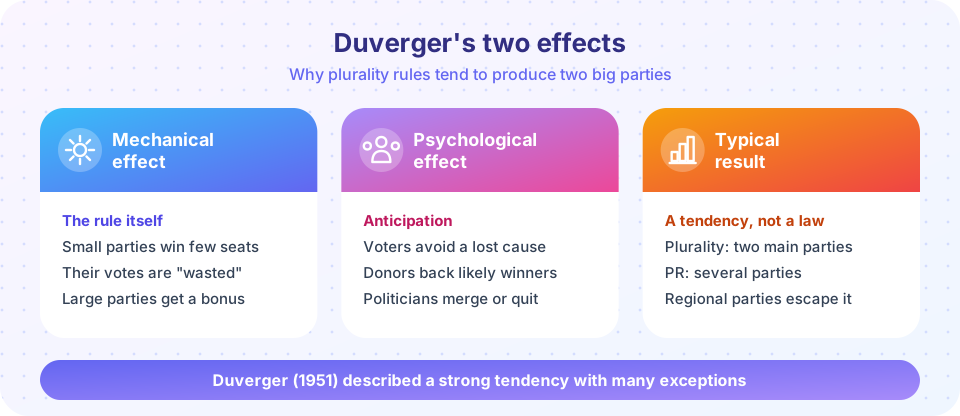
The French political scientist Maurice Duverger argued in Political Parties (1951) that plurality rule in single-member districts tends to produce two parties, while proportional representation tends to produce many. He identified two effects.
The mechanical effect is arithmetic. Under plurality rule a party that finishes third in most districts wins few seats, no matter how many votes it collects overall. The rule penalizes small parties.
The psychological effect is behavioral. Voters see that a vote for a trailing party is likely "wasted", so many switch to a viable choice. Donors, activists and ambitious politicians also anticipate this and join one of the larger parties. The result can be two dominant parties even before any votes are counted.
William Riker (1982) took the claim seriously as a near-law of political science, and also stressed its limits. Canada and India have plurality rules and more than two parties, because regional parties can win in their strongholds. Duverger's claim is best treated as a strong tendency, not a law of nature.
A simulation of strategic voting
The demonstration below is a simulation, not real data. Ten thousand voters are placed along a left-right line; each prefers the nearest of three parties. A fraction of voters who would sincerely support the trailing party instead vote for their preferred party among the top two. How does the trailing party fare as strategic voting grows?
Press Run (or Ctrl + Enter) to see the result here.
Program input · what you'd type while the program runs
Type the answers before you press Run, one per line. Each time the program reads a line (with input()), it gets the next line from this box.
In the model, the trailing party's share drops toward zero as strategic voting rises. Real voters are less tidy: many vote sincerely, and parties with regional bases survive.
Cleavages: the social side
If electoral rules were the whole story, every plurality country would look alike. They do not. Seymour Martin Lipset and Stein Rokkan (1967) argued that European party systems "froze" around the social divisions that were politically alive when mass suffrage arrived. They identified four cleavages from two historical upheavals.
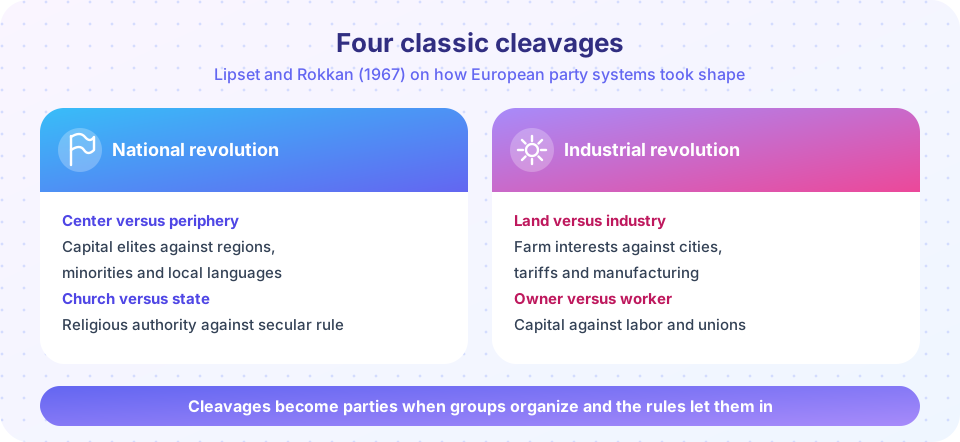
- Center versus periphery: capital-city elites against distinct regions and language groups.
- Church versus state: religious authority against secular state power.
- Land versus industry: agricultural interests against urban and industrial ones.
- Owner versus worker: capital against labor.
These conflicts produced party families such as Christian democratic, agrarian, liberal, conservative and social democratic parties. Later conflicts, such as environmental protection and immigration, helped create green and radical-right parties. The key point is that a cleavage only becomes a party when groups organize around it and the electoral system lets them in.
Types of parties and party systems
Duverger distinguished cadre parties, run by notables, from mass parties, built on large memberships. Otto Kirchheimer (1966) described the catch-all party, which broadens its appeal across social groups, and Richard Katz and Peter Mair (1995) proposed the cartel party, which relies heavily on state funding. These are ideal types, and real parties blend them.
Giovanni Sartori (1976) classified party systems by two features: the number of relevant parties and the ideological distance among them. He separated one-party and hegemonic systems from competitive ones such as two-party systems, limited pluralism (three to five parties, moderate distance) and polarized pluralism (many parties, large distances).
Measuring stability
How much do party systems change? Electoral volatility is often measured with the Pedersen index: the sum of the absolute changes in each party's vote share between two elections, divided by two. High volatility suggests weak party attachment and a less institutionalized system.
Press Run (or Ctrl + Enter) to see the console output here.
No output.
Pedersen's index counts the votes that moved between parties. It cannot tell you why: voters changing sides, new voters, and abstention all feed into it.
Common misconceptions
"Duverger's law means plurality countries must have two parties." It describes a pull, not a rule. Regional parties, strong minorities and federal structures create exceptions.
"Party systems are just products of electoral rules." Rules interact with social divisions. PR does not create religion or class conflict; it lets those divisions appear in parliament.
Check your understanding
Quick check · 4 questions
of 4 answered You scored / 4 · perfect!
-
1. What is the psychological effect in Duverger's argument?
The psychological effect works through expectations: people avoid wasting votes and effort on parties that are unlikely to win. -
2. Which pair is one of Lipset and Rokkan's four cleavages?
The four classic cleavages are center-periphery, church-state, land-industry and owner-worker. -
3. Why do Canada and India, which use plurality rules, have more than two significant parties?
Concentrated regional support lets small national parties win districts, softening the mechanical effect. -
4. A Pedersen volatility of 20 means roughly what?
Half the sum of absolute shifts equals the share of the vote that moved net between parties.
Summary
- Duverger identified a mechanical and a psychological effect that pull plurality systems toward two parties.
- Lipset and Rokkan traced party families to four historical cleavages.
- Party types and Sartori's classification help compare party systems.
- Volatility measures how much party support moves between elections.
- Institutions and social divisions work together, and neither tells the whole story.
Next: Voting behavior
Track your progress
Create a free account to tick off lessons and pick up where you left off on any device.
of Political Science lessons completed