


















Lesson 35 of 44 · International Relations
International Relations: The Big Picture
Get oriented in international relations: the actors, the idea of anarchy, the three levels of analysis and five turning points in world politics.
Domestic politics happens inside a state with laws, courts and police. International relations (IR) studies what happens between states, and among the many other actors that cross borders: international organizations, companies, rebel groups, charities and individuals. Here there is no world government to make binding laws or enforce them. How do states manage trade, war, climate and migration in such a setting? That question drives the whole field.
This lesson gives you the vocabulary and the big picture before you meet the major theories in the next one.
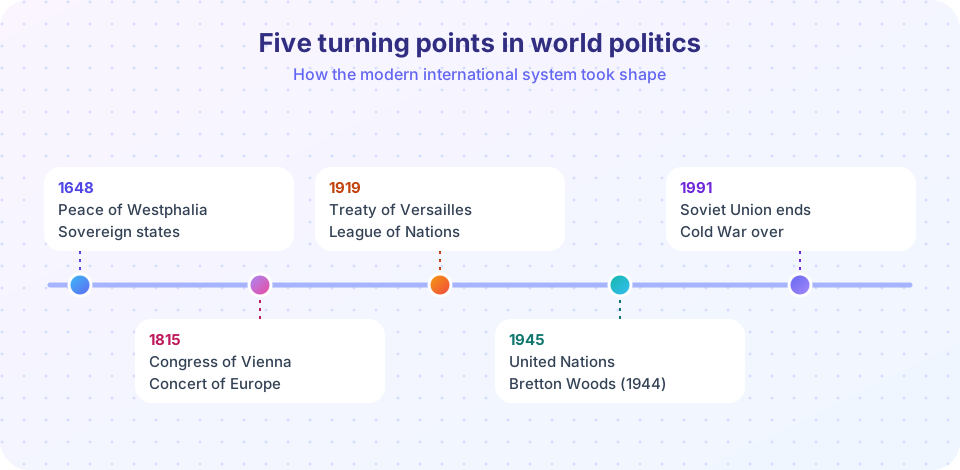
What you will learn
- Who the actors in world politics are, and what sovereignty means.
- What political scientists mean by anarchy, and why it does not mean chaos.
- The three levels of analysis: individual, state and system.
- Why the timeline of turning points matters for later lessons.
Key terms
Sovereignty: the claim of a state to supreme authority over its territory, without outside interference.
Anarchy (in IR): the absence of a central authority above states, not necessarily disorder.
Polarity: the number of great powers that dominate the system: one (unipolar), two (bipolar) or several (multipolar).
Levels of analysis: the different scales at which causes of international events can be sought.
Non-state actor: an actor that is not a government, such as a company or an NGO.
The chapter at a glance
Who acts in world politics?
No world government
Three levels of analysis
Three theory families
Actors and sovereignty
States remain the central actors: they field armies, sign treaties and control borders. The ideal of a system of independent, formally equal states is often traced to the Peace of Westphalia of 1648, which ended the Thirty Years' War in Europe. Historians note that the idea of sovereignty developed gradually, so Westphalia is better seen as a symbol than a single moment. The UN had 193 member states at the time of writing, which means the sovereign-state form now covers nearly the whole land surface of the planet.
Other actors matter too. International organizations such as the United Nations or the World Trade Organization provide forums and rules. Multinational companies shape trade and investment. NGOs and advocacy networks campaign on human rights and the environment, and armed groups can challenge a state's monopoly on force. The balance among them is a topic of active debate.
Anarchy is not chaos
In IR, anarchy means there is no authority above the state. It does not mean that states constantly fight. Scholars disagree on what anarchy implies: realists think it forces states to prioritize security and power; liberals think institutions and trade can build cooperation within anarchy; constructivists think anarchy's meaning depends on shared ideas. The next lesson explores these disagreements.
Levels of analysis
Kenneth Waltz's Man, the State, and War (1959) distinguished three "images" for explaining war. The individual level focuses on leaders, their beliefs and psychology. The state level focuses on regime type, domestic politics and economic interests. The system level focuses on the distribution of power among states and the structure of the international order. A full explanation of an event, such as the outbreak of the First World War, often draws on several levels at once.
Press Run (or Ctrl + Enter) to see the result here.
Program input · what you'd type while the program runs
Type the answers before you press Run, one per line. Each time the program reads a line (with input()), it gets the next line from this box.
Polarity
Scholars often describe the system by how power is distributed. A bipolar system, such as the Cold War order, is dominated by two powers; a multipolar one by several. The code below is a simplified polarity classifier for hypothetical power scores. Real power is multidimensional and hard to measure.
Press Run (or Ctrl + Enter) to see the console output here.
No output.
What each lesson covers
- Theories of international relations: realism, liberalism and constructivism, and a power-transition illustration.
- Conflict, cooperation and institutions: the security dilemma, the prisoner's dilemma, why wars happen, trade and international organizations.
- Chapter review: the security dilemma in one picture and a ten-question quiz.
Common misconceptions
"Anarchy means constant war." It means no overarching authority. Cooperation is common; the debate is about why and how.
"States are the only actors." States are central, but institutions, firms and NGOs shape outcomes.
"The system explains everything." Leaders and domestic politics matter, so explanations often combine levels.
Check your understanding
Quick check · 3 questions
of 3 answered You scored / 3 · perfect!
-
1. In international relations, what does anarchy mean?
Anarchy refers to the structure of the system, which has no world government, not to disorder. -
2. Which are Waltz's three images or levels of analysis?
Waltz distinguished explanations at the level of individuals, states and the international system. -
3. What is a multipolar system?
Polarity counts the major powers: one, two or several.
Summary
- IR studies politics among states and other actors where no world government exists.
- Anarchy means no higher authority, not constant conflict.
- Waltz's three levels, individual, state and system, structure explanations.
- The next lessons introduce the major theories and the core problems of conflict and cooperation.
Track your progress
Create a free account to tick off lessons and pick up where you left off on any device.
of Political Science lessons completed