


















Lesson 14 of 44 · Political Ideologies
Other Ideologies: Nationalism, Anarchism, Feminism and More
Survey nationalism, fascism, anarchism, feminism, environmentalism and religion in politics, with core ideas, thinkers, debates and a two-axis map of ideologies.
Liberalism, conservatism and socialism are the three great families of the nineteenth century, but they are not the whole story. Many powerful movements of the last two centuries do not fit neatly into one of the three. Nationalism redrew the map of Europe and the world. Fascism seized power in several countries and led to catastrophe. Anarchists challenged the state itself. Feminists changed who counts as a full citizen. Environmentalists argued that politics has to take planetary limits into account.
This lesson summarizes each in its own terms, notes the strongest criticisms, and introduces a second axis that helps you see why one left-right line is not enough.
What you will learn
- the central ideas and thinkers of nationalism, anarchism, feminism and environmentalism
- how fascism differs from conservatism and from other authoritarian rule
- the role of religion in modern politics, including Christian democracy and political Islam
- how a two-axis map helps, and what it still leaves out
Key terms
Nationalism: the belief that the nation is the natural unit of political life and deserves self-rule.
Fascism: an ultranationalist, authoritarian ideology that glorifies the nation, the leader and violence, and rejects liberal democracy.
Anarchism: the view that the state is unnecessary and harmful, and that society can organize itself voluntarily.
Feminism: the movement and theory seeking equality between women and men.
Sustainability: meeting present needs without damaging the ability of future generations to meet theirs.
Nationalism
Nationalism says that people who share a language, history or culture should govern themselves. It can be civic, based on shared citizenship and institutions (for example, the French republican tradition), or ethnic, based on common descent or ancestry. The 19th century saw nationalism unify Germany and Italy and break up empires; the 20th century saw it drive anti-colonial independence movements. The 1848 revolutions in Europe called "the springtime of nations" had nationalist goals.
Nationalism is a powerful source of solidarity: it can motivate people to build schools, welfare systems and democratic participation. It can also be used to exclude minorities and fuel wars. The political scientist Benedict Anderson described nations as "imagined communities," and Ernest Gellner linked nationalism to the needs of industrial societies for a shared culture and language. Whether nations are ancient or modern constructions is a classic debate.
Fascism
Fascism emerged in Italy under Benito Mussolini after the First World War and took its most extreme form in Nazi Germany under Adolf Hitler. Its common features were ultranationalism, a single powerful leader, a one-party state, hostility to liberal democracy, communism and often to minorities, the glorification of violence and war, and the claim that the individual exists to serve the nation. Nazism added a central doctrine of racial hierarchy and genocide.
Scholars disagree about the definition. Some, such as Robert Paxton, stress the pattern of mass mobilization and alliance with conservative elites. Others, such as Roger Griffin, define fascism by its myth of national rebirth. Fascism is different from ordinary conservatism because it seeks to remake society and to mobilize the masses; it differs from traditional dictatorship by its mass movement and total claims. Historians warn against using the label loosely for any harsh government.
Anarchism
Anarchists such as Pierre-Joseph Proudhon, Mikhail Bakunin, Peter Kropotkin and Emma Goldman argued that the state and other hierarchies, such as capital and church, limit human freedom and are unnecessary. They believe that people can organize themselves through voluntary associations, cooperatives and mutual aid. There are many branches: collectivist and communist anarchists favor shared property, individualist anarchists defend personal autonomy, and anarcho-syndicalists build their vision around trade unions.
The standard objection is that without any authority, conflicts and the strong preying on the weak could return, as Hobbes warned. Anarchists reply that hierarchy itself generates violence, and they point to examples of self-organization, from some Spanish communities in the 1930s to modern cooperative networks. Note that anarchism, in the political sense, is not a call for chaos; it proposes order without rulers.
Feminism
Feminism has been described in "waves." The first wave, from the nineteenth and early twentieth centuries, focused on legal rights such as voting and property. Mary Wollstonecraft's A Vindication of the Rights of Woman (1792) is an early landmark, and the Seneca Falls Convention of 1848 and suffrage movements in many countries followed. The second wave, from the 1960s, addressed work, family, reproductive rights and violence; Simone de Beauvoir's The Second Sex (1949) argued that "one is not born, but rather becomes, a woman." Later waves have stressed difference among women, and the idea of intersectionality, a term introduced by Kimberlé Crenshaw in 1989, which examines how gender interacts with race, class and other identities.
Feminism is a family: liberal feminists seek equal rights within existing institutions, socialist and Marxist feminists link women's position to economic structure, radical feminists focus on patriarchy, and postcolonial feminists criticize Western assumptions. Debates continue over issues such as work, family, sex and gender identity, and how far state policy should go.
Environmentalism and green politics
Environmentalism holds that human societies depend on ecosystems and must respect limits. The 1962 book Silent Spring by Rachel Carson drew attention to pesticides. The 1972 report The Limits to Growth and the 1987 Brundtland Report, which defined sustainable development, shaped policy debates. Green parties emerged in the 1970s and 1980s, in Germany and elsewhere.
Greens differ about solutions. Reformist or light green thinkers favor carbon pricing, regulation and green technology within market economies. Deep green thinkers argue for a more fundamental change in how we value nature and growth, and eco-socialists blame capitalism. Eco-conservatives emphasize stewardship of the land. Debates concern economic growth, nuclear power and who bears the costs of change.
Religion and politics
Religion can shape politics in many ways. Christian democracy is a moderate tradition that shaped postwar Western Europe, blending market economies, social welfare and moral conservatism. Political Islam (Islamism) covers a range of movements, from parties that participate in elections to groups that use violence; scholars stress that they differ widely. Religious nationalism appears in many countries. Secularism is itself a political position about the separation of religion and state, with different models, such as French laïcité and the American separation of church and state.
Beyond a single line: the second axis
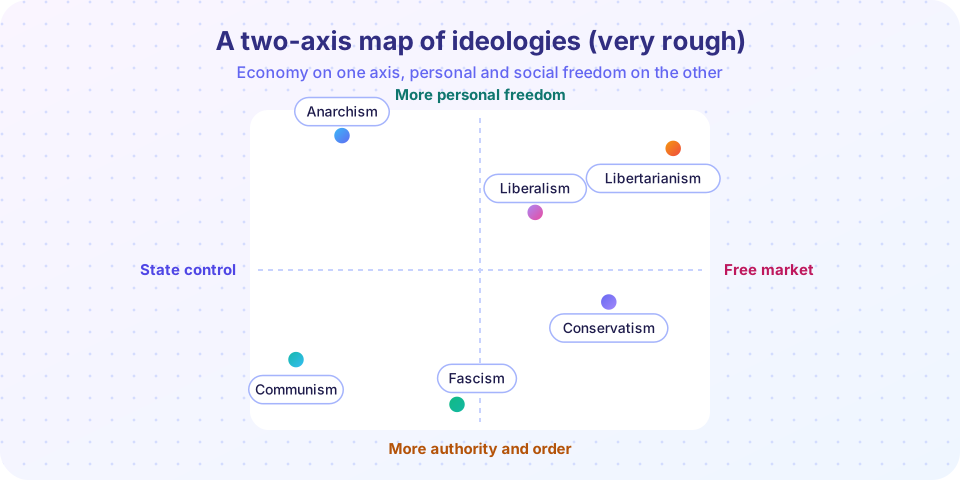
Plot ideologies on two axes: economic (state control to free market) and personal liberty versus authority. Anarchism lands at the high-liberty end of the vertical axis with little state control. Fascism sits at the high-authority end. Libertarians combine free markets and personal liberty, while many communist regimes combined state control with authority. This type of picture is a teaching aid: critics note that the axes are arbitrary, and that nationalism, religion and the environment are separate dimensions that the map does not show.
Common misconceptions
"Nationalism is always dangerous." It can be inclusive or exclusive. Anti-colonial nationalism, for instance, often aimed at self-rule and equality, while ethnic nationalism has fueled expulsion and war.
"Fascism is just another word for dictatorship." Fascism has particular features: mass mobilization, ultranationalism, a cult of the leader and violence, and not every dictatorship is fascist.
"Anarchism means chaos." Anarchists propose organization without a state; critics debate whether that is workable.
"Feminism has one program." It is a family of positions, with disagreement among feminists.
Try it
The first demonstration draws a two-axis map of six ideologies using invented coordinates. You can move the points to express your own reading, and see how the map changes your impression of "distance" between ideologies.
Press Run (or Ctrl + Enter) to see the result here.
Program input · what you'd type while the program runs
Type the answers before you press Run, one per line. Each time the program reads a line (with input()), it gets the next line from this box.
The second demonstration is a flashcard drill that picks four cards at random and shows the question, then the answer.
Press Run (or Ctrl + Enter) to see the console output here.
No output.
Check your understanding
Quick check · 5 questions
of 5 answered You scored / 5 · perfect!
-
1. What is the difference between civic and ethnic nationalism?
Civic nationalism builds on institutions and citizenship, ethnic on ancestry. -
2. Which feature is typical of fascism?
Fascism combined ultranationalism, a leader cult and violence, and rejected liberal democracy. -
3. What do anarchists mainly argue?
Anarchism proposes order without rulers. -
4. Who introduced the term intersectionality?
Crenshaw coined it in 1989 to describe overlapping forms of disadvantage. -
5. The Brundtland Report of 1987 is associated with which idea?
It defined sustainable development as meeting present needs without harming future generations.
Summary
- Nationalism makes the nation the unit of political life; it can be civic or ethnic, inclusive or exclusive.
- Fascism is an ultranationalist, authoritarian ideology with mass mobilization and violence; it is more specific than "dictatorship."
- Anarchism seeks order without a state; feminism is a family of movements for equality; environmentalism ties politics to ecological limits.
- Religion shapes politics in many ways, from Christian democracy to political Islam and secularism.
- A two-axis map helps, but no map captures every dimension.
Next: Chapter 3 Review
Track your progress
Create a free account to tick off lessons and pick up where you left off on any device.
of Political Science lessons completed