


















Lesson 44 of 44 · Projects and Practice
Where to Go Next: Further Study in Political Science
Plan your next steps after this course: how political science connects to statistics, economics, sociology and history, and how to read research and build a study plan.
You have finished the main arc of the course: how states, power and legitimacy work, how elections, policy and comparison are studied, and how world politics fits together. Political science is a broad field, so the best next step depends on which questions pulled you in. This lesson maps the neighboring subjects, suggests how to read research, and helps you draft a study plan.
What you will learn
- Which companion tracks deepen which parts of political science.
- How to read a research article critically.
- How to turn your interests into a weekly study plan.
Paths to follow
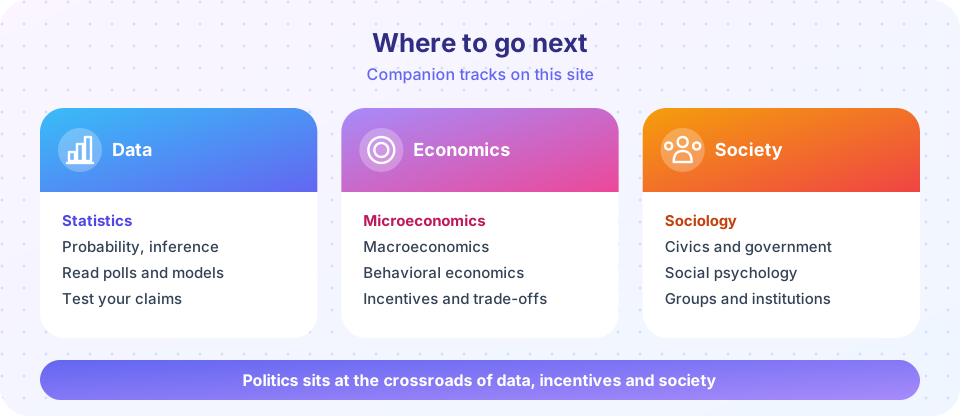
If you like evidence and numbers, study statistics and probability. Almost every claim about elections, public opinion or policy impact rests on data, and you will read polls and regressions with a sharper eye. The tools in this course, such as effective-number calculations and difference-in-differences, make more sense once you understand sampling, uncertainty and confounding.
If you like incentives and models, study microeconomics, macroeconomics and behavioral economics. Game theory, public goods, externalities, trade and voter behavior all use economic reasoning, and behavioral economics explains where people depart from rational-choice assumptions.
If you like societies and institutions, study sociology, civics and government and social psychology. They explain group identity, social movements, institutions and the psychology of attitudes that shape party identification and political behavior.
If you like the long run, study world history. The cleavages, regime waves and international orders in this course all have historical roots, and cases drawn from history are the raw material for comparative work.
If you want to do research yourself, study research methods in psychology for design, measurement and ethics, which transfer well to political science surveys and experiments.
How to read a research article
A research article is easier to read if you ask a fixed set of questions in a fixed order.
- What is the question? State it in one sentence.
- What is the claim? Find the hypothesis or main finding.
- What evidence supports it? Identify the data, cases and methods.
- What could explain the result instead? List rival explanations the author considers, and those they do not.
- What are the limits? Note how far the findings can be generalized.
- Has it been replicated or challenged? Search for follow-up studies.
Press Run (or Ctrl + Enter) to see the console output here.
No output.
Build a study plan
A plan turns good intentions into a schedule. The calculator below works out how many lessons you need to finish per week to complete a target by a deadline. It is a simple arithmetic helper.
Press Run (or Ctrl + Enter) to see the result here.
Program input · what you'd type while the program runs
Type the answers before you press Run, one per line. Each time the program reads a line (with input()), it gets the next line from this box.
Choose one companion track, pick a weekly target, and try to connect each new lesson to something from this course. A short note after each lesson, in your own words, helps more than rereading.
Staying balanced
Politics is full of strong opinions. A good habit is to read the best version of arguments you disagree with, to check claims against more than one source, and to separate what is known from what is debated. Political science does not tell you what to value, but it helps you understand how institutions work, what evidence exists, and what trade-offs are involved.
Check your understanding
Quick check · 3 questions
of 3 answered You scored / 3 · perfect!
-
1. Which companion subject best helps you evaluate claims based on polls and data?
Statistics teaches sampling, uncertainty and causal inference, which underpin political data analysis. -
2. Why does reading rival explanations matter?
Good research addresses other possible causes, and good readers look for them. -
3. Which subject would help you understand behavior that departs from rational-choice assumptions?
Behavioral economics studies systematic departures from rational-choice predictions.
Summary
- Political science connects to statistics, economics, sociology, psychology and history.
- A fixed set of questions makes research articles easier to read critically.
- A weekly study plan turns interest into progress.
- Keep an open, evidence-minded and balanced approach.
Next: back to the Political Science course map
Track your progress
Create a free account to tick off lessons and pick up where you left off on any device.
of Political Science lessons completed