


















Lesson 2 of 45 · Getting Started
What is neuroscience?
Learn what neuroscience studies, how the field grew from Cajal's drawings to modern imaging, and why scientists study the brain at six different levels.
Neuroscience is the scientific study of the nervous system and of how it produces perception, thought, emotion and action. It is not one subject but a meeting point: biologists study the cells, chemists study the molecules, physicists build the scanners, psychologists measure behavior, mathematicians model networks and doctors treat the diseases. What unites them is one target, the nervous system, and one conviction, that the mind is something the brain does.
What you will learn
- A working definition of neuroscience and its main subfields.
- Five milestones in the history of the field and the people behind them.
- Why the brain is studied at several levels at once.
- Which popular beliefs about the brain are myths.
Key terms
- Neuron: a cell specialized to receive, process and send electrical and chemical signals.
- Glia: non-neuronal cells that support, insulate and protect neurons.
- Nervous system: the network of neurons and glia that senses, decides and acts.
- Neuron doctrine: the idea that the nervous system is made of separate cells, not one continuous net.
- Level of analysis: the scale at which a question is asked, from molecule to behavior.
A short history of the brain sciences
People have wondered about the brain for thousands of years, but modern neuroscience rests on a few turning points.
The brain is the organ of the mind (antiquity to 1800s). Ancient Greek physicians such as Hippocrates argued that thoughts and feelings come from the brain, not the heart, though Aristotle disagreed. For centuries the debate rested on guesses, and the "organ of the mind" idea only became testable once people could study injured brains.
Localization of function (1800s). In 1861 the French physician Paul Broca described a patient who understood language but could say almost nothing; after death, a lesion in the left frontal lobe was found. Carl Wernicke later linked a different region, in the left temporal lobe, with understanding speech. The lesson was that different parts of the brain do different jobs. The well-known case of the railway worker Phineas Gage (1848), who changed in personality after an iron rod passed through his frontal lobes, pushed the same idea, although the details of his recovery are less certain than popular tellings suggest.
The neuron doctrine (about 1890-1906). Camillo Golgi invented a stain that colors a few neurons completely, so that each stands out against the tissue. Santiago Ramón y Cajal used it to draw the nervous system and argued that it is built of separate cells that touch but do not fuse. Golgi believed in a continuous net. They shared the 1906 Nobel Prize in Physiology or Medicine, and electron microscopy settled the argument in Cajal's favor in the 1950s.
The electrical basis of the spike (1952). Alan Hodgkin and Andrew Huxley recorded from the giant axon of the squid, wrote equations for the ion currents that create an action potential, and showed that the model predicted the shape and speed of real spikes. You will meet their model in Chapter 3. They received the Nobel Prize in 1963.
Memory and the hippocampus (1953 onward). A patient known as H.M. had parts of both temporal lobes removed to treat severe epilepsy. He could no longer form new long-term memories of facts and events, yet could still learn new motor skills. Brenda Milner's studies of H.M. showed that there are different memory systems with different brain locations.
Later chapters add more: David Hubel and Torsten Wiesel's recordings in visual cortex, the discovery of long-term potentiation, optogenetics and fMRI.
Six levels of analysis
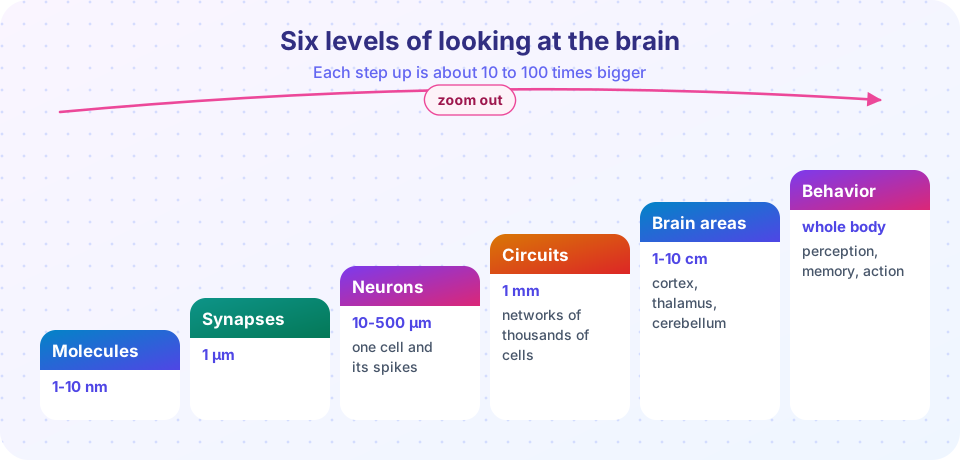
The picture above shows why neuroscientists cannot rely on one method. Take a simple act, grabbing a cup.
- Molecules: ion channels in muscle and nerve membranes open and close.
- Synapses: acetylcholine crosses the junction between a motor neuron and a muscle fiber.
- Neurons: a motor neuron fires a train of spikes.
- Circuits: loops between the cortex, spinal cord and cerebellum time the movement.
- Brain areas: motor cortex plans, parietal cortex tracks where the cup is.
- Behavior: you pick up the cup without spilling.
An explanation at one level often needs support from another. A drug (molecular) changes behavior (top level) by altering a circuit (middle). This is why the field is called an integrative science.
Subfields at a glance
| Subfield | Typical question |
|---|---|
| Molecular and cellular | How does a channel protein open? |
| Developmental | How do neurons find their targets in an embryo? |
| Systems | How does visual cortex represent edges? |
| Cognitive | Which brain regions support attention? |
| Behavioral | How do hormones change mating or feeding? |
| Clinical | What goes wrong in epilepsy or Parkinson's disease? |
| Computational | Can a network model reproduce rhythms in the brain? |
Common misconceptions
"We use only 10% of our brains." False. Brain imaging shows activity across the whole brain, and damage to almost any region causes some deficit. Over a day, you use all of it, although not every region at the same instant.
"Some people are left-brained and some right-brained." Language is usually (not always) dominated by the left hemisphere, and the hemispheres have different strengths, but studies of large groups find no evidence for left-brain and right-brain personality types. The two halves are connected by about 200 million fibers and work together.
"Neurons are never replaced." Mostly true for cortical neurons, but new neurons are born in a few regions, such as parts of the hippocampus in many mammals. How much this happens in adult humans is still debated.
Try it
Press Run (or Ctrl + Enter) to see the result here.
Program input · what you'd type while the program runs
Type the answers before you press Run, one per line. Each time the program reads a line (with input()), it gets the next line from this box.
Press Run (or Ctrl + Enter) to see the console output here.
No output.
Check your understanding
Quick check · 4 questions
of 4 answered You scored / 4 · perfect!
-
1. Who argued that the nervous system is made of separate cells?
Cajal used Golgi's stain to argue for separate cells (the neuron doctrine), though Golgi himself favored a continuous net. -
2. What did the case of H.M. mainly show?
H.M. lost the ability to form new fact and event memories but could still learn motor skills, so memory has separate systems. -
3. A drug that blocks a receptor changes someone's mood. Which levels of analysis are linked?
The drug acts on a molecule, but the effect shows up in behavior, so both levels are involved. -
4. Which statement about the 10% myth is correct?
Imaging and lesion studies show that all regions have functions.
Summary
- Neuroscience is an integrative science of the nervous system, drawing on biology, chemistry, physics, psychology, mathematics and medicine.
- Key milestones: Broca (localization), Golgi and Cajal (neuron doctrine), Hodgkin and Huxley (spike model), H.M. (memory systems).
- The brain is studied at six levels, from molecules to behavior, and good explanations connect them.
- Popular myths (10% of the brain, left-brained people) are not supported by evidence.
Track your progress
Create a free account to tick off lessons and pick up where you left off on any device.
of Neuroscience lessons completed