


















Lesson 24 of 45 · Sensory Systems
Touch, pain, taste and smell
Learn the four skin mechanoreceptors, how pain fibers work, how taste and smell receptors code chemicals and where each signal goes in the brain.
Vision and hearing detect energy at a distance. The senses in this lesson work on contact: the skin senses pressure, temperature and damage, and the tongue and nose detect molecules. They are old, close to survival, and tightly linked to emotion and memory.
What you will learn
- The four main mechanoreceptors and what each prefers
- How fast and slow pain fibers differ
- How taste and smell code chemicals
- How the cortex keeps maps of the body
Key terms
Mechanoreceptor: a receptor opened by deformation of its membrane.
Nociceptor: a free nerve ending that responds to damaging or potentially damaging stimuli.
Somatotopy: orderly mapping of body surface onto the cortex.
Olfactory receptor: a receptor protein on a nose neuron that binds odor molecules.
Glomerulus: a ball of synapses in the olfactory bulb where same-type receptor axons converge.
Touch
Skin contains four main mechanoreceptor types. They differ in depth, field size and how quickly they adapt.
| Receptor | Adaptation | Prefers | Field |
|---|---|---|---|
| Merkel disc | slow | fine texture, edges, pressure | small |
| Meissner corpuscle | fast | light touch, slip, flutter | small |
| Ruffini ending | slow | skin stretch | large |
| Pacinian corpuscle | fast | high-frequency vibration (about 200 to 300 Hz) | large |
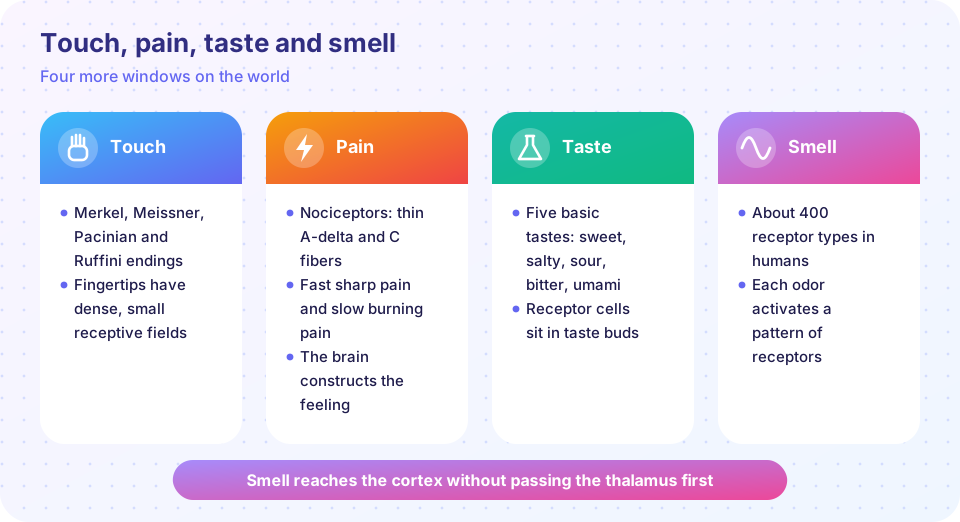
Receptor density sets acuity. Fingertips and lips have many small receptive fields and can tell two nearby points apart at a few millimeters; the back needs several centimeters. Large, myelinated A-beta axons carry touch to the spinal cord and up the dorsal column pathway to the thalamus and then primary somatosensory cortex (S1). S1 forms a homunculus, described by Wilder Penfield in the 1930s and 1940s, in which the hands and face take up disproportionate space.
Pain
Pain begins at nociceptors: free nerve endings with channels for heat, acid, chemicals and mechanical stress. TRPV1 is the capsaicin receptor, which is why chili feels hot. Two fiber types carry the signal:
- A-delta fibers: thinly myelinated, around 5 to 30 m/s. They give the first, sharp, well-localized pain.
- C fibers: unmyelinated, about 1 m/s. They give the later, dull or burning pain.
Both enter the spinal cord and cross to the spinothalamic tract. Pain is not a pure readout of injury. In 1965 Ronald Melzack and Patrick Wall proposed the gate control theory: touch fibers and descending signals can close a "gate" in the spinal cord and reduce pain, which is why rubbing a bumped elbow helps. The brain also produces its own opioid-like peptides (endorphins), and attention, expectation and mood change how much a signal hurts. Referred pain occurs because visceral and skin signals converge on the same spinal neurons, so heart trouble can be felt in the left arm.
Taste
Taste buds in the papillae of the tongue and mouth contain receptor cells for five basic tastes: sweet, salty, sour, bitter and umami (savory). Sweet, bitter and umami use G-protein-coupled receptors (T1R2+T1R3 for sweet, T1R1+T1R3 for umami, a family of about 25 T2R receptors for bitter). Salty and sour act mainly through ion channels. The classic "tongue map" of regions for each taste is a myth: all tastes can be sensed over the tongue. Taste signals travel through the brainstem and thalamus to the gustatory cortex in the insula.
Smell
Smell works differently. Each olfactory neuron in the nose expresses one type of receptor from a family of roughly 400 functional receptor genes in humans (discovered by Linda Buck and Richard Axel, Nobel Prize 2004). Odor molecules are recognized combinatorially: one molecule activates several receptor types, and one receptor type responds to several molecules. Axons of the same receptor type converge on the same glomeruli in the olfactory bulb, so each odor produces a spatial pattern. The bulb projects directly to the piriform cortex, the amygdala and the hippocampus, a reason smells can evoke vivid memories and emotions. What we call flavor is mostly smell plus taste, texture and temperature; a blocked nose makes food seem bland.
Common misconceptions
"Pain is a direct measure of tissue damage." Pain is a construction by the brain. It can occur without injury (phantom limb pain) and injuries can go unnoticed in a moment of intense focus.
"Taste has regional zones on the tongue." This comes from a misreading of early German data; modern work shows all taste regions respond to all qualities.
Try it
Press Run (or Ctrl + Enter) to see the result here.
Program input · what you'd type while the program runs
Type the answers before you press Run, one per line. Each time the program reads a line (with input()), it gets the next line from this box.
Press Run (or Ctrl + Enter) to see the console output here.
No output.
Check your understanding
Quick check · 5 questions
of 5 answered You scored / 5 · perfect!
-
1. Which receptor is best for detecting high-frequency vibration?
Pacinian corpuscles adapt rapidly and prefer vibration around 200 to 300 Hz. -
2. Why do you feel a sharp pain followed by a dull ache?
Thinly myelinated A-delta fibers arrive first; unmyelinated C fibers are slower. -
3. What does the gate control theory propose?
Melzack and Wall argued that spinal circuits modulate pain signals. -
4. How many functional olfactory receptor genes do humans have, roughly?
About 400, and odors are encoded by combinations. -
5. Which sense has a direct route to the cortex without a thalamic relay?
Olfactory bulb output goes straight to olfactory cortex and the limbic system.
Summary
- Four mechanoreceptors cover texture, flutter, stretch and vibration.
- Pain uses A-delta and C fibers, and the brain shapes the experience.
- Taste uses five basic qualities; the tongue map is a myth.
- Smell is a combinatorial code of about 400 receptor types with direct limbic links.
- Somatosensory cortex keeps a distorted map of the body.
Next: Chapter 5 review
Track your progress
Create a free account to tick off lessons and pick up where you left off on any device.
of Neuroscience lessons completed