


















Lesson 7 of 45 · Neurons and Glia
Neuron anatomy: dendrites, soma, axon and terminals
Learn the parts of a neuron: dendrites, soma, axon hillock, axon, myelin, nodes of Ranvier and terminals, plus how materials move along the axon.
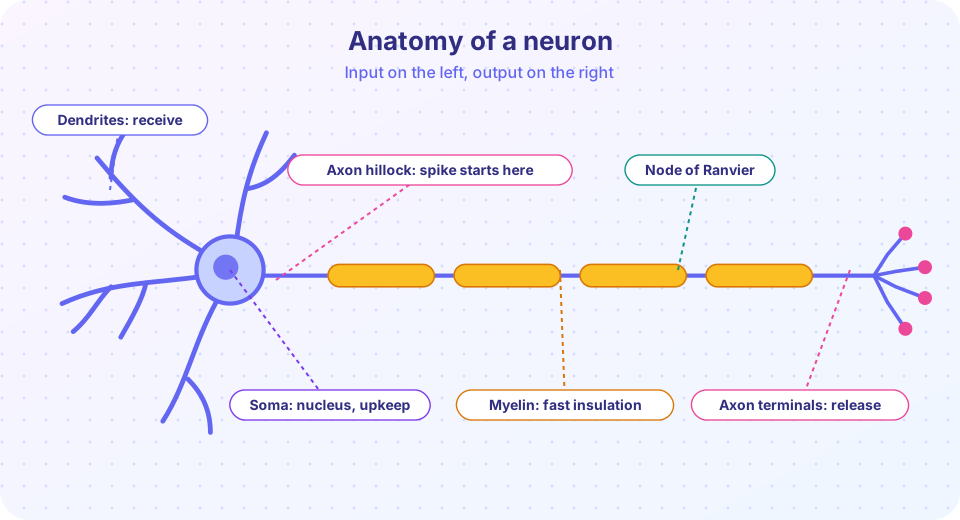
A neuron is a cell with an extraordinary shape. A typical body cell is a rounded blob about 10 to 20 micrometers (µm) across. A neuron has the same kind of cell body, but it also grows branches that can reach across a whole brain, and a single thread-like axon that may stretch a meter, from your lower spine to your big toe. This shape is not decoration. It lets a neuron collect thousands of inputs, make one decision and broadcast it, quickly and in one direction.
What you will learn
- The parts of a neuron and what each one does.
- How the cytoskeleton gives a neuron its shape and moves cargo.
- Why the axon hillock is special.
- How long materials take to travel along a long axon.
Key terms
- Dendritic spine: a tiny protrusion on a dendrite where many excitatory synapses land.
- Axon hillock: the cone-shaped region where the axon starts, usually where spikes begin.
- Node of Ranvier: a short gap in the myelin where the axon membrane is exposed.
- Axonal transport: movement of proteins and organelles along microtubules.
- Terminal (bouton): the swollen end of an axon branch that releases neurotransmitter.
Dendrites: the antennae
Dendrites are branching extensions that grow from the soma. Their job is to receive. They are studded with receptors, and many carry spines, small mushroom-shaped bumps about a micrometer across where a single synapse from another neuron connects. A cortical neuron may have thousands of spines. A cerebellar Purkinje cell, with one of the most elaborate dendritic trees in the body, receives on the order of 100,000 inputs.
Dendrites are not passive wires. Their branches contain voltage-gated channels and can perform local calculations: some inputs on a branch interact before they ever reach the soma. For now, picture each dendrite as collecting small electrical signals and passing them to the cell body, as Chapter 4 will explain in detail.
The soma: the control room
The soma, or cell body, contains the nucleus with the cell's DNA, plus the machinery that keeps the cell alive: ribosomes, rough endoplasmic reticulum (stained as clumps called Nissl bodies), Golgi apparatus and mitochondria. Almost all proteins are made here and then shipped out to dendrites and axon. If the soma dies, the whole neuron dies, which is why damage to the cell body is more serious than a cut to an axon.
Axon hillock and initial segment
The axon leaves the soma at the axon hillock, and the first stretch of the axon is the initial segment. This region packs a very high density of voltage-gated sodium channels and has a low threshold. Signals that have been added up from the dendrites arrive here, and if their sum is large enough, the neuron fires. That is why the hillock is called the trigger zone. You will see the physics in Chapter 3.
The axon: the output cable
Each neuron has typically one axon, which may branch many times. Axons range in diameter from about 0.2 µm to about 20 µm and in length from a fraction of a millimeter to over a meter. Many axons are wrapped in myelin, a fatty insulator made by glial cells. Gaps between myelin segments are nodes of Ranvier, about 1 µm wide, where the axon membrane is rich in ion channels. As you will learn in Chapter 3, myelin makes signals travel up to about 100 times faster than in a thin unmyelinated axon.
Terminals: where the message is passed on
At its far end, the axon splits into branches that end in terminals (boutons). Each contains vesicles filled with neurotransmitter and mitochondria to power release. When a spike arrives, vesicles release their contents into the narrow gap to the next cell. A single axon can contact hundreds or thousands of target cells.
The cytoskeleton and transport
A neuron's shape is held by a cytoskeleton of three polymers: thick microtubules, medium neurofilaments, and thin actin filaments. Microtubules run along axons like railway tracks, and motor proteins carry cargo along them.
- Anterograde transport (soma to terminal) uses the motor protein kinesin and carries vesicles, mitochondria and new proteins. Fast transport moves at up to a few micrometers per second.
- Retrograde transport (terminal to soma) uses dynein and returns worn-out material and signals such as growth factors.
Because proteins are made in the soma, a one-meter axon depends on this delivery system. Viruses such as rabies and herpes exploit retrograde transport to travel up nerves, and some neurodegenerative diseases involve transport failures (see Chapter 8).
Worked example: a journey down the sciatic nerve
Suppose a mitochondrion is made near the soma of a motor neuron and must reach a terminal 1 m away. At 1 µm per second:
time = distance / speed = 1 m / (1 × 10⁻⁶ m/s) = 1,000,000 s ≈ 11.6 days
At a faster transport speed of 4 µm/s, the trip takes about 2.9 days. Slow axonal transport, which carries structural proteins, moves only about 0.1 to 3 mm per day, so over a full meter the slowest cargo would need hundreds to thousands of days.
Common misconceptions
"The axon is a simple wire." Axons contain a busy transport system and active ion channels, and the axon membrane is a living, regenerating structure.
"All neurons have myelin." Many small axons are unmyelinated, and unmyelinated fibers are important for slow pain and for autonomic signaling.
"A neuron has only one input." Most neurons receive thousands. Their output, however, is a single signal: either a spike or no spike.
Try it
Press Run (or Ctrl + Enter) to see the result here.
Program input · what you'd type while the program runs
Type the answers before you press Run, one per line. Each time the program reads a line (with input()), it gets the next line from this box.
Check your understanding
Quick check · 5 questions
of 5 answered You scored / 5 · perfect!
-
1. Where does a spike usually begin?
The hillock and initial segment have a high density of sodium channels and a low threshold. -
2. Which motor protein carries cargo from the soma toward the terminals?
Kinesin drives anterograde transport; dynein carries cargo back toward the soma. -
3. Nodes of Ranvier are...
Nodes are short unmyelinated gaps rich in ion channels. -
4. A mitochondrion moves at 1 micrometer per second along a 1 m axon. About how long does it take?
1 m divided by 1 micrometer per second is a million seconds, about 11.6 days. -
5. Where is most of a neuron's protein made?
The soma contains the ribosomes and ER that make most proteins.
Summary
- Dendrites receive, the soma maintains and integrates, the hillock triggers, the axon conducts, and terminals release.
- Spines carry most excitatory synapses.
- Microtubules, with kinesin and dynein, carry cargo along the axon.
- Long axons depend on transport: a trip of 1 m takes days.
Next: Types of neurons
Track your progress
Create a free account to tick off lessons and pick up where you left off on any device.
of Neuroscience lessons completed