


















Lesson 16 of 45 · Synapses and Neurotransmitters
Chapter 4 overview: synapses and neurotransmitters
Preview Chapter 4: how neurons pass signals across synapses, which chemical messengers they use, and how a cell adds up thousands of inputs.
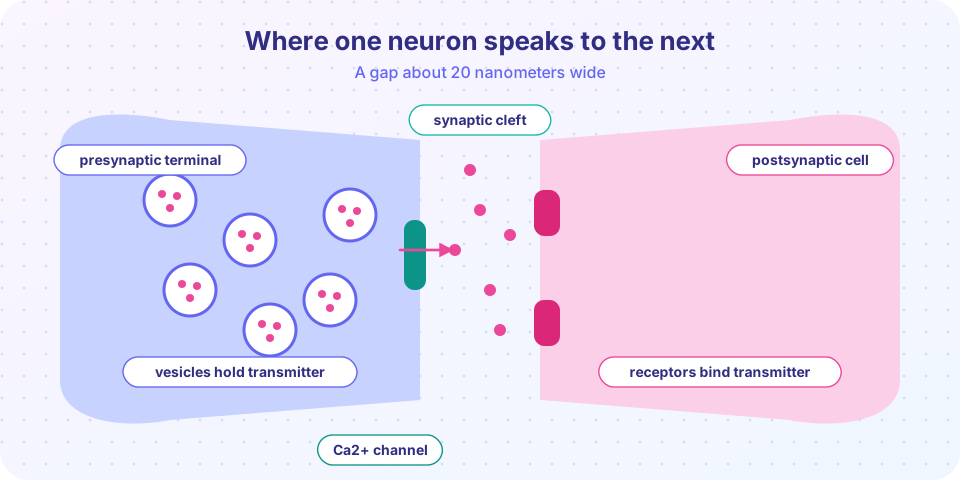
A spike cannot jump from one neuron to the next. Between almost all neurons lies a synapse, a specialized junction where the sending cell (presynaptic) influences the receiving cell (postsynaptic). Synapses are where learning happens, where drugs act and where many diseases begin. The adult human cortex contains on the order of 100 trillion of them (the exact figure is uncertain and varies between estimates).
What you will learn
- The two kinds of synapse, electrical and chemical.
- A roadmap of the chapter's three lessons.
- Why the synapse, not the neuron, is the unit of computation and plasticity.
Two kinds of synapse
Chemical synapse in five steps
Messages and receivers
The cell adds it up
Key terms
- Synapse: a junction where one neuron signals to another cell.
- Presynaptic / postsynaptic: the sending and the receiving side.
- Neurotransmitter: a chemical released by a neuron to signal across a synapse.
- Receptor: a protein on the target cell that binds the transmitter.
- Gap junction: a channel that directly links the cytoplasm of two cells.
Electrical and chemical synapses
At an electrical synapse, a gap junction made of connexin proteins joins the two cells. The gap is only about 3.5 nm wide. Current flows straight through the channels, in both directions, with almost no delay. Electrical synapses synchronize groups of neurons, for example in some rhythmic circuits of the brainstem and in the retina, and drive escape reflexes in some animals.
At a chemical synapse, a cleft of about 20 nm separates the cells. A chemical messenger crosses the gap and acts on receptors. This takes about 0.5 to 1 ms, and the signal goes in one direction. The extra steps are an advantage: the response can be amplified, excitatory or inhibitory, strengthened or weakened by experience, and tuned by drugs. Most synapses in the mammalian brain are chemical, so this is the focus of the chapter.
Roadmap
- The chemical synapse: release, vesicles, calcium, receptors and cleanup.
- Neurotransmitters: the main molecules and receptor families, ionotropic and metabotropic.
- Synaptic integration: EPSPs, IPSPs and how the cell decides to fire.
- Chapter 4 review: a summary picture and a ten-question quiz.
Try it
Press Run (or Ctrl + Enter) to see the result here.
Program input · what you'd type while the program runs
Type the answers before you press Run, one per line. Each time the program reads a line (with input()), it gets the next line from this box.
Press Run (or Ctrl + Enter) to see the console output here.
No output.
Check your understanding
Quick check · 4 questions
of 4 answered You scored / 4 · perfect!
-
1. Which synapse type allows current to flow directly between cells?
Gap junctions connect the cytoplasm of two cells. -
2. How wide is the cleft of a chemical synapse?
The cleft is about 20 nm wide. -
3. Why are chemical synapses useful despite being slower?
Flexibility, amplification and plasticity make them the main choice in the brain. -
4. Which lesson explains how a cell adds up inputs?
Synaptic integration covers EPSPs, IPSPs and summation.
Summary
- Synapses connect neurons; most in the brain are chemical.
- Electrical synapses (gap junctions) are fast and two-way; chemical synapses are slower but flexible.
- The chapter covers release, the transmitters and the integration of inputs.
Next: The chemical synapse
Track your progress
Create a free account to tick off lessons and pick up where you left off on any device.
of Neuroscience lessons completed