


















Lesson 20 of 45 · Synapses and Neurotransmitters
Chapter 4 review: synapses and neurotransmitters
Review Chapter 4 with a one-page picture, a table of transmitters and receptors, and a ten-question quiz on synaptic transmission and integration.
You now know how a spike becomes a chemical signal and how the next cell turns thousands of such signals into a decision. This review collects the key facts, then tests you with ten questions that mix all four lessons of the chapter.
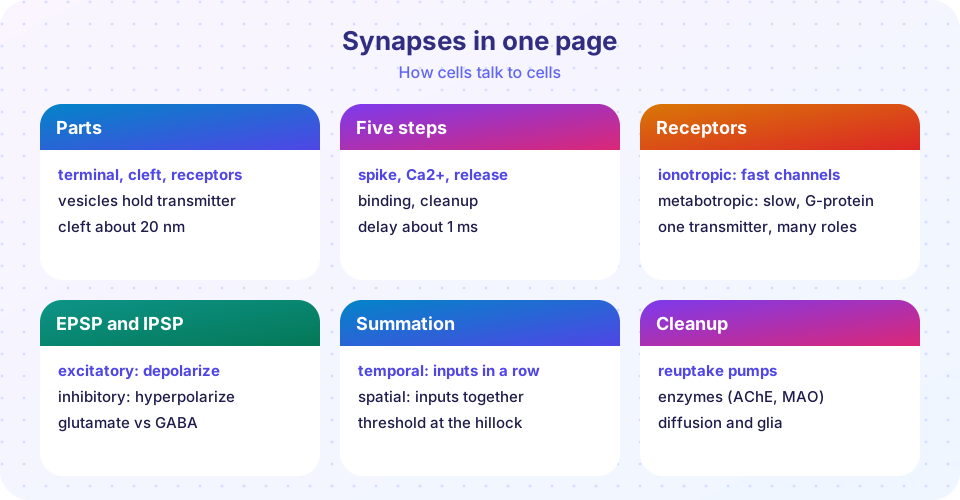
What you will learn
- A recap of synaptic transmission from release to integration.
- A compact table of the main transmitters and receptors.
- What to carry into Chapter 5 on sensory systems.
Recap table
| Topic | Remember |
|---|---|
| Overview | Electrical (gap junction, fast, two-way) vs chemical (cleft about 20 nm, one-way, flexible) |
| Chemical synapse | Spike, Ca²⁺ entry, SNARE-mediated fusion, receptor binding, cleanup; quantal release; delay about 0.5-1 ms |
| Neurotransmitters | Glutamate excites; GABA and glycine inhibit; dopamine, serotonin, noradrenaline and ACh modulate; ionotropic = fast, metabotropic = slow |
| Integration | EPSPs and IPSPs are graded; temporal and spatial summation; spike decided at the initial segment |
Bridge to Chapter 5
Sensory systems begin where the outside world meets the nervous system: receptor cells turn light, sound, pressure, chemicals and heat into graded potentials and spikes. Everything you learned in Chapters 3 and 4 appears again there: receptor potentials are graded like EPSPs, and the first synapses of sensory pathways use the same transmitters.
Try it
Press Run (or Ctrl + Enter) to see the console output here.
No output.
Press Run (or Ctrl + Enter) to see the result here.
Program input · what you'd type while the program runs
Type the answers before you press Run, one per line. Each time the program reads a line (with input()), it gets the next line from this box.
Check your understanding
Quick check · 10 questions
of 10 answered You scored / 10 · perfect!
-
1. Which event directly triggers vesicle fusion?
Ca2+ binds synaptotagmin, and SNARE proteins then drive fusion. -
2. A miniature end-plate potential reflects...
It is the response to one quantum of transmitter. -
3. Gap junctions...
They are channels that link two cells. -
4. Acetylcholine is broken down in the cleft by...
Acetylcholinesterase splits ACh rapidly. -
5. Which receptor is a coincidence detector?
It needs glutamate and depolarization to remove the Mg2+ block. -
6. An IPSP from GABA-A receptors moves Vm toward...
GABA-A is a Cl- channel, so Vm moves toward E_Cl. -
7. Temporal summation requires inputs that...
The membrane time constant gives a window of about 10-20 ms. -
8. A single central EPSP is typically about...
Many coincident EPSPs are needed to reach threshold. -
9. Metabotropic receptors act through...
They are G-protein-coupled receptors with slower, longer effects. -
10. Where does the neuron usually decide whether to fire?
Na+ channel density is highest and threshold lowest there.
Summary
- Synaptic transmission converts spikes into chemical messages and back into potentials.
- The effect of a transmitter depends on its receptor.
- Integration sums EPSPs and IPSPs in time and space; the initial segment decides.
- Chapter 5 turns to how the senses use these tools.
Track your progress
Create a free account to tick off lessons and pick up where you left off on any device.
of Neuroscience lessons completed