


















Lesson 26 of 45 · Motor Systems
Chapter 6 overview: How the nervous system moves you
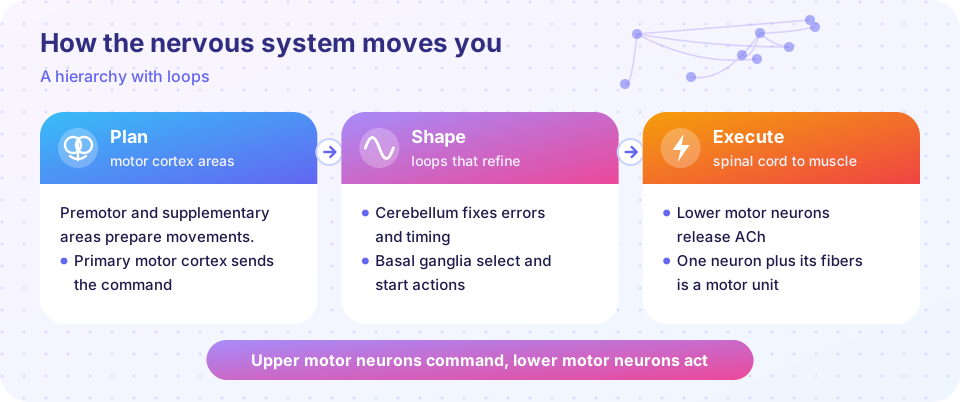
Meet the motor hierarchy: cortex plans, basal ganglia and cerebellum refine, spinal motor neurons and motor units drive muscles. A roadmap for the chapter.
Every action you take, from blinking to playing a violin, ends the same way: a motor neuron releases acetylcholine onto a muscle fiber. What differs is everything upstream: who decides, who plans the details, and who corrects errors in real time. This chapter walks from the muscle backward to the cortex.
What you will learn
- The difference between upper and lower motor neurons
- What a motor unit is and how force is graded
- Which brain regions plan, select and correct movement
- What each lesson in the chapter covers
Key terms
Lower motor neuron: a spinal or brainstem neuron whose axon contacts muscle.
Upper motor neuron: a cortical or brainstem neuron that commands lower motor neurons.
Motor unit: one motor neuron plus all the muscle fibers it controls.
Neuromuscular junction: the synapse between motor neuron and muscle fiber.
Reflex: a fast, stereotyped response to a stimulus handled mostly in the spinal cord.
Plan
Shape
Execute
The command chain
A voluntary movement begins in cortical planning areas (premotor and supplementary motor areas, and the parietal lobe for guiding by vision). Primary motor cortex sends commands through the corticospinal tract to the spinal cord. There the lower motor neurons release acetylcholine (ACh) at the neuromuscular junction. ACh opens receptors on the muscle membrane, the fiber depolarizes, calcium is released inside it and the contractile proteins slide.
The basal ganglia and cerebellum do not send commands directly to the spinal cord in a big way. They form loops with the cortex and brainstem that shape what the cortex sends: the basal ganglia help choose and initiate actions, the cerebellum compares intended with actual movement and corrects.
Graded force: the motor unit
A single motor neuron branches to between a handful and thousands of muscle fibers, depending on the muscle. Muscles that need fine control (eye muscles) have small units; large postural muscles have large units. The nervous system grades force in two ways: by firing faster (rate coding), and by recruiting more units. Elwood Henneman showed in the 1950s and 1960s that units are recruited in order of size: small, slow, fatigue-resistant ones first, large, powerful ones last. This is the size principle, and it gives smooth control: you recruit small steps first when you need delicate force.
Common misconceptions
"Muscles are controlled directly by the brain." Almost every command passes through spinal circuits, which add reflexes and rhythm generation.
"Motor learning happens only in motor cortex." The cerebellum, basal ganglia and parietal cortex all contribute.
Try it
Press Run (or Ctrl + Enter) to see the result here.
Program input · what you'd type while the program runs
Type the answers before you press Run, one per line. Each time the program reads a line (with input()), it gets the next line from this box.
Press Run (or Ctrl + Enter) to see the console output here.
No output.
What is in this chapter
- Spinal cord and reflexes: circuits that act without waiting for the brain.
- Cortex, basal ganglia and cerebellum: the three loops that plan and refine.
- Chapter 6 review.
Check your understanding
Quick check · 4 questions
of 4 answered You scored / 4 · perfect!
-
1. What is a motor unit?
One alpha motor neuron plus its fibers contract together. -
2. Which neurotransmitter does a lower motor neuron release onto muscle?
ACh acts on nicotinic receptors at the neuromuscular junction. -
3. What does the size principle say?
Recruitment order goes from small to large units. -
4. Which structure compares intended with actual movement?
The cerebellum computes errors and helps correct and time movement.
Summary
- Upper motor neurons command; lower motor neurons act.
- A motor unit is the basic output element; the size principle orders recruitment.
- Basal ganglia and cerebellum shape movement through loops.
Next: Spinal cord and reflexes
Track your progress
Create a free account to tick off lessons and pick up where you left off on any device.
of Neuroscience lessons completed