


















Lesson 31 of 45 · Learning, Memory and Emotion
Synaptic plasticity and long-term potentiation
Understand Hebbian learning, how NMDA receptors detect coincident activity, LTP and LTD, spike-timing-dependent plasticity and what makes memories last.
If memories are stored in the brain, they must be stored in something that can change. The best candidate is the synapse. The idea that synapses strengthen with use is old; the molecular proof is relatively recent. This lesson covers the discovery of long-term potentiation, the molecular trick that makes it work, and what happens when the timing of spikes decides the direction of change.
What you will learn
- What Hebbian plasticity says and how LTP was discovered
- How the NMDA receptor acts as a coincidence detector
- How LTD and spike-timing-dependent plasticity work
- Why early and late LTP differ
Key terms
LTP: long-term potentiation, a lasting increase in synaptic strength after high activity.
LTD: long-term depression, a lasting decrease in strength.
NMDA receptor: a glutamate receptor that also needs depolarization to open.
AMPA receptor: the main fast glutamate receptor, carrying most synaptic current.
STDP: spike-timing-dependent plasticity, where the order of pre- and postsynaptic spikes sets the sign of change.
Hebb's idea and its discovery
In The Organization of Behavior (1949), Donald Hebb wrote that when cell A repeatedly takes part in firing cell B, some growth or metabolic change makes A's efficiency at firing B increase. In 1973, Tim Bliss and Terje Lømo, working in anesthetized rabbits, stimulated the perforant path to the dentate gyrus of the hippocampus with a brief high-frequency train. The response to a test pulse then stayed larger for hours, and in later work for days and weeks. This is long-term potentiation. It appears in hippocampal neurons, which fits the role of the hippocampus in memory.
The coincidence detector
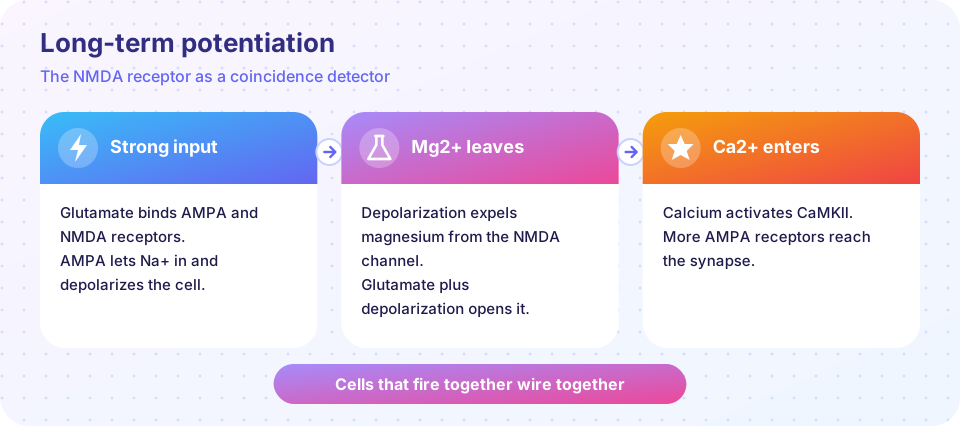
Most excitatory synapses use glutamate acting on two receptor types at the same postsynaptic site.
- AMPA receptors open when glutamate binds and let Na⁺ in. This gives the usual fast excitatory signal.
- NMDA receptors also bind glutamate, but at resting potential their channel is blocked by a magnesium ion (Mg²⁺).
If the postsynaptic cell is depolarized at the same time (because other inputs are active or it just fired), the Mg²⁺ is pushed out. Now glutamate plus depolarization opens the channel, and calcium ions enter. NMDA receptors are thus coincidence detectors: they fire only if the presynaptic cell released glutamate and the postsynaptic cell was already active. That is Hebb's rule built into a protein.
Calcium acts as a signal. It activates the enzyme CaMKII (and others), which leads to two effects: existing AMPA receptors are modified to carry more current, and extra AMPA receptors are inserted into the synapse. The same input now evokes a bigger response.
LTD and the sign of change
Strong, brief calcium rises lead to LTP. Lower, prolonged calcium rises (for example from low-frequency stimulation around 1 Hz) activate phosphatases instead and lead to LTD, removal of AMPA receptors. Strength can thus go both ways, which is essential: without weakening, all synapses would saturate.
Spike timing
In 1998 Guo-qiang Bi and Mu-ming Poo showed in cultured hippocampal neurons that timing matters: if the presynaptic spike comes just before the postsynaptic spike (a few to tens of ms), the synapse strengthens; if it comes just after, it weakens. This STDP rule makes sense causally: a synapse that helped cause the spike is rewarded, and one that fired too late is not. A common model is Δw = A₊ · exp(-Δt/τ₊) for Δt > 0 and Δw = -A₋ · exp(Δt/τ₋) for Δt < 0, with time constants around 10 to 20 ms.
Making it last
Early LTP lasts an hour or two and uses existing proteins. Late LTP needs gene expression and protein synthesis (the transcription factor CREB is central) and can last much longer. The synaptic tagging and capture hypothesis suggests that a weakly stimulated synapse can be "tagged" and capture newly made proteins triggered by a strong stimulus nearby, which explains how a trivial event near an important one may be remembered. Lasting changes also include structural plasticity: dendritic spines enlarge, and new ones form.
LTP evidence for behavior is strong but not complete. Blocking NMDA receptors in the hippocampus impairs learning in some spatial tasks in rats, and engineered mice lacking the NMDA receptor in hippocampal region CA1 show impaired spatial memory (Tsien, Tonegawa and colleagues, 1996). Some behaviors, however, can be learned with LTP blocked, so LTP is one important mechanism, not the only one.
Common misconceptions
"LTP is memory." LTP is a cellular model that is plausibly a mechanism of memory. A memory itself involves many synapses and circuits.
"Strengthening needs only presynaptic activity." Postsynaptic activity at the same time is required (cooperativity).
Try it
Press Run (or Ctrl + Enter) to see the result here.
Program input · what you'd type while the program runs
Type the answers before you press Run, one per line. Each time the program reads a line (with input()), it gets the next line from this box.
Press Run (or Ctrl + Enter) to see the result here.
Program input · what you'd type while the program runs
Type the answers before you press Run, one per line. Each time the program reads a line (with input()), it gets the next line from this box.
Check your understanding
Quick check · 5 questions
of 5 answered You scored / 5 · perfect!
-
1. Why is the NMDA receptor a coincidence detector?
Glutamate binding plus relief of Mg2+ block requires pre and postsynaptic activity together. -
2. Which ion entering through NMDA receptors triggers LTP?
Calcium activates CaMKII and related signals. -
3. In STDP, a presynaptic spike followed shortly by a postsynaptic spike causes
Pre-before-post pairings produce LTP. -
4. Which low-frequency stimulation tends to produce LTD?
Modest but prolonged calcium entry activates phosphatases and removes AMPA receptors. -
5. What is late LTP's key requirement?
CREB-dependent transcription and translation support long-lasting changes.
Summary
- Hebb proposed that synapses strengthen with coincident activity; Bliss and Lømo found LTP.
- NMDA receptors detect coincidence; calcium triggers more AMPA receptors.
- LTD and STDP allow weakening and timing-dependent change.
- Late LTP needs protein synthesis; LTP is a mechanism of memory, not the entire story.
Next: Memory systems
Track your progress
Create a free account to tick off lessons and pick up where you left off on any device.
of Neuroscience lessons completed