


















Lesson 21 of 45 · Sensory Systems
Chapter 5 overview: How the senses work
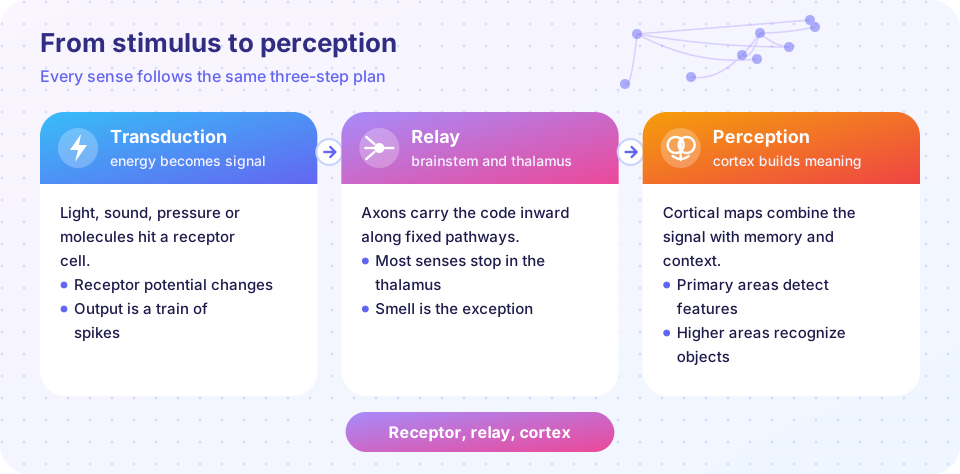
Meet the plan every sense follows: transduction, relay through the thalamus and cortical maps. A roadmap for vision, hearing, touch, taste and smell.
Your brain never touches the world directly. It sits in the dark, inside a skull, and receives only streams of electrical pulses from sensory receptors. Everything you see, hear and feel is built from those pulses. This chapter shows how receptors turn physical energy into signals, how those signals travel, and how the cortex turns them into perception.
Educational information only. This course explains how the nervous system works; it does not diagnose or treat any condition.
What you will learn
- The three-step plan shared by all senses
- What receptive fields, adaptation and topographic maps are
- Why perception is a construction and not a copy of the world
- What each lesson in this chapter covers
Key terms
Transduction: converting a physical stimulus (light, pressure, molecules) into an electrical signal in a receptor cell.
Receptive field: the region of the world or body that changes a given neuron's firing.
Adaptation: a fall in response when a stimulus stays constant.
Modality: a kind of sense, such as vision or touch.
Topographic map: neighboring neurons represent neighboring places, pitches or body parts.
The big picture
Step 1: Transduction
Step 2: Relay
Step 3: Perception
Chapter 5 lessons
Every sense begins with a receptor, a specialized cell tuned to one kind of energy. A photoreceptor absorbs photons. A hair cell is bent by sound-driven fluid motion. A Pacinian corpuscle is squeezed by vibration. In each case the stimulus opens or closes ion channels, the receptor's membrane potential changes, and that receptor potential controls the release of neurotransmitter or the firing of spikes.
The signal then travels along a fixed pathway. For vision, hearing, touch and taste it passes through a nucleus of the thalamus before reaching the cortex. Smell is the exception: olfactory axons reach the olfactory cortex directly. Finally, cortical areas arranged as maps process the signal in stages: simple features first, objects and meanings later.
Four ideas you will meet again and again
Labeled lines. A spike is a spike. Your brain knows a signal is "light" because it arrived on a pathway from the eye, not because the spike looks different. Press gently on your closed eyelid and you see a flash: the retina's pathway was activated, so you perceive light.
Receptive fields. Each sensory neuron cares about a patch of the world. A retinal ganglion cell responds to light in a small circle of the visual field. A fingertip neuron responds to touch on a tiny patch of skin. Fine detail needs small, dense receptive fields.
Adaptation. Walk into a room with a strong smell and after a few minutes you stop noticing it. Many receptors are phasic: they fire at the change and then fall silent. Others are tonic and keep firing while the stimulus stays on. Together they report both changes and steady states.
Maps. The cortex keeps order. Neighboring places on the retina map to neighboring places in area V1; neighboring pitches map to neighboring places in auditory cortex; neighboring skin sites map to neighboring places in somatosensory cortex. Maps are why a small stroke can remove one part of the visual field.
Common misconceptions
"The senses record the world like a camera." They do not. Receptors respond to a narrow band of energy, adapt, and send an already compressed code. Perception is the brain's best inference from that code.
"We have five senses." Aristotle's list is a starting point. Balance, body position (proprioception), temperature, pain and internal body states are also sensed.
The scaling of sensation
Perception does not grow in step with the physical stimulus. S. S. Stevens proposed that perceived magnitude follows a power law, ψ = k × S^a, where the exponent a depends on the sense. Brightness has an exponent well below 1, so doubling the light adds little. Loudness is around 0.6 to 0.7. Electric shock is above 1: a little more current feels much worse. Compression like this lets a sense cover a huge range of intensities with limited neural resources.
Try it
Press Run (or Ctrl + Enter) to see the result here.
Program input · what you'd type while the program runs
Type the answers before you press Run, one per line. Each time the program reads a line (with input()), it gets the next line from this box.
Press Run (or Ctrl + Enter) to see the console output here.
No output.
What is in this chapter
- Vision: from photons to V1: the eye, the retina and the visual cortex.
- Hearing and balance: the cochlea, sound localization and the vestibular system.
- Touch, pain, taste and smell: the somatosensory and chemical senses.
- Chapter 5 review: one picture, a table and a long quiz.
Check your understanding
Quick check · 4 questions
of 4 answered You scored / 4 · perfect!
-
1. What is transduction?
Receptors transduce light, pressure, sound or molecules into changes in membrane potential. -
2. Why do you see a flash when you press on a closed eyelid?
This is the labeled-line idea: the pathway, not the stimulus type, determines the sensation. -
3. Which sense reaches the cortex without passing through the thalamus first?
Olfactory bulb axons project directly to olfactory cortex. -
4. What does adaptation mean?
Adaptation lets sensory systems emphasize change over constant background.
Summary
- Senses share a plan: transduction, relay (usually via the thalamus), cortical maps.
- Receptive fields, adaptation and labeled lines shape what the brain receives.
- Perception is an inference built from a compressed neural code.
- Stevens' law describes how perceived magnitude scales with intensity.
Track your progress
Create a free account to tick off lessons and pick up where you left off on any device.
of Neuroscience lessons completed