


















Lesson 11 of 45 · Electrical Signaling
Chapter 3 overview: electrical signaling
Preview Chapter 3: how ion gradients create a resting voltage, how the action potential fires and how spikes travel down myelinated axons.
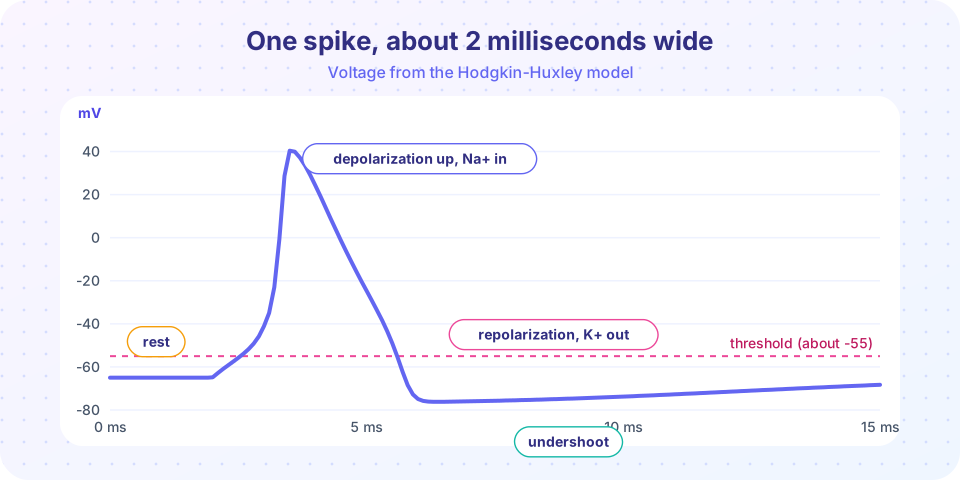
Neurons are cells that compute with electricity. Unlike the electric current in a wire, which is carried by electrons, the current in a neuron is carried by ions: charged atoms such as sodium (Na⁺), potassium (K⁺), chloride (Cl⁻) and calcium (Ca²⁺). A neuron keeps these ions unequally distributed across its membrane, and then opens and closes channels to let them flow. The result is a voltage change called an action potential, or spike, that travels along the axon in about a millisecond or two.
What you will learn
- How this chapter builds from a resting voltage to a travelling spike.
- Which three questions the chapter answers.
- The few numbers worth remembering before you start.
Key terms
- Membrane potential (Vm): the voltage difference across the cell membrane, inside relative to outside.
- Ion channel: a protein pore that lets particular ions cross the membrane.
- Depolarization / hyperpolarization: Vm becoming less negative / more negative.
- Threshold: the Vm at which a spike starts (about -55 mV in many neurons).
- Action potential: a brief, regenerative, all-or-none voltage spike.
Three questions, three lessons
Why is a resting neuron at about -70 mV?
How does a spike fire?
How does it travel?
- Resting membrane potential answers the first question with the Nernst and Goldman equations.
- The action potential explains the spike with the Hodgkin-Huxley model, and you will simulate it.
- Conduction and myelin shows how the spike travels, and why myelin makes it faster.
- Chapter 3 review is a one-page picture and a ten-question quiz.
Numbers to remember
| Quantity | Typical value |
|---|---|
| Resting potential | about -70 mV |
| Threshold | about -55 mV |
| Spike peak | about +40 mV |
| Spike width | about 1 to 2 ms |
| Fast axon speed | up to about 100 m/s |
| Membrane thickness | about 5 nm (so the field across it is about 14 million V/m) |
Try it
Press Run (or Ctrl + Enter) to see the result here.
Program input · what you'd type while the program runs
Type the answers before you press Run, one per line. Each time the program reads a line (with input()), it gets the next line from this box.
Press Run (or Ctrl + Enter) to see the console output here.
No output.
Check your understanding
Quick check · 4 questions
of 4 answered You scored / 4 · perfect!
-
1. Which particles carry current in a neuron?
Charged atoms (Na+, K+, Cl-, Ca2+) carry the current through channels. -
2. A typical neuron's resting membrane potential is closest to...
Inside is negative relative to outside by about 70 mV. -
3. What happens at threshold?
Opening of Na+ channels depolarizes the cell, which opens more channels. -
4. The main purpose of myelin is to...
Myelin speeds conduction by allowing spikes to jump between nodes.
Summary
- Neurons compute with ions flowing through channels.
- Chapter 3 goes from resting potential to action potential to conduction.
- Key numbers: -70 mV rest, -55 mV threshold, +40 mV peak, about 100 m/s fastest.
Track your progress
Create a free account to tick off lessons and pick up where you left off on any device.
of Neuroscience lessons completed