


















Lesson 33 of 45 · Learning, Memory and Emotion
Emotion, fear and the amygdala
Learn fear conditioning, the thalamic low road and cortical high road, extinction, the stress response and how emotion shapes memory, with simple models.
Emotions are not decoration on top of thought. They tell the brain what matters and what to do next. Of all emotions, fear is the best studied because it can be tested in animals: pair a harmless tone with a mild shock and the tone alone soon triggers freezing. This lesson follows that simple experiment into the circuits behind it.
Educational information only. Anxiety, trauma and other mental-health conditions are real and treatable; if you are struggling, talk to a qualified professional.
What you will learn
- How fear conditioning and extinction work
- The two routes to the amygdala and what each is for
- How the amygdala drives body responses
- How stress hormones change memory
- Why the neuroscience of emotion is still debated
Key terms
Conditioned stimulus (CS): a neutral cue (a tone) that comes to predict something important.
Unconditioned stimulus (US): something that naturally triggers a response (a shock).
Extinction: learning that the CS no longer predicts the US; it is new learning, not erasure.
HPA axis: hypothalamus-pituitary-adrenal system that releases cortisol.
Flashbulb memory: vivid memory of a surprising, emotional event.
The amygdala and fear conditioning
The amygdala is a cluster of nuclei in the medial temporal lobe. Early evidence came from animals: Heinrich Klüver and Paul Bucy (1939) found that removing the temporal lobes in monkeys made them tame and indiscriminate. In humans, the best-known case is patient S.M., who has bilateral amygdala damage from a rare disease (Urbach-Wiethe). She reports little fear in situations that frighten most people, though other emotions are present. In a notable study, inhaling carbon dioxide still triggered panic in her and in two other patients with amygdala damage, which suggests that internally driven panic may use other circuits.
Fear conditioning, studied extensively by Joseph LeDoux and others, goes like this. A tone (CS) activates auditory inputs to the lateral amygdala, a shock (US) activates pain inputs, and NMDA-dependent plasticity (the previous lesson) strengthens the tone's inputs there. After learning, the tone alone excites the lateral amygdala, which passes the signal to the central amygdala, the main output.
Two routes
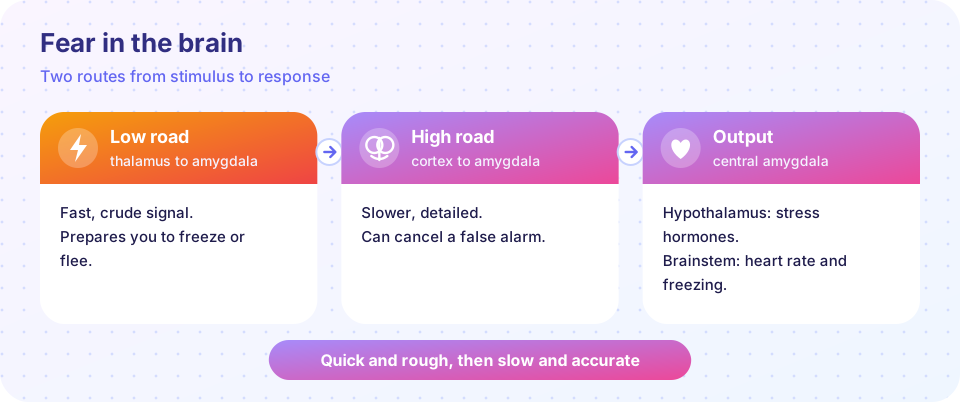
LeDoux's rat work described two routes for a sound to reach the amygdala. The low road goes straight from the thalamus: fast but crude. The high road goes via the auditory cortex: slower but detailed. The idea explains how you jump at a curved shape on a path before you recognize it as a stick rather than a snake. The cortex then either confirms the alarm or cancels it. The strict two-road picture is a simplification for humans, but the principle (quick rough appraisal and slower accurate appraisal in parallel) holds up well.
Output
The central amygdala drives the body response through the brainstem (freezing, heart rate, startle) and the hypothalamus. The HPA axis releases cortisol minutes later. Stress hormones (adrenaline, cortisol) acting on the amygdala strengthen consolidation in hippocampus and cortex, so emotionally arousing events are remembered better. Moderate arousal helps; chronic or very intense stress can impair hippocampal function and prefrontal control.
Extinction and regulation
Present the tone repeatedly without the shock and freezing declines. This is extinction, and it is not unlearning: the original memory remains, and extinction creates a competing "safe" memory involving the ventromedial prefrontal cortex and the amygdala. That is why fear can return after time away (spontaneous recovery) or in a new place (renewal). Exposure-based therapies for phobias rest on extinction, and human experiments have mapped much of the same circuitry with fMRI.
What are emotions, anyway?
William James proposed that we feel emotion because we perceive bodily changes (we are afraid because we run); Walter Cannon argued that the brain's emotional response and the body's response are parallel. Modern theories include appraisal and constructed-emotion accounts (Lisa Feldman Barrett), which argue that emotions are built from interoception, context and concepts and are not hardwired "circuits" with one location each. Some researchers (LeDoux) distinguish survival circuits from the conscious feeling of fear. This remains an open debate, so treat any "fear center" label cautiously. Flashbulb memories feel vivid, but studies after events such as the 1986 Challenger explosion (Neisser, Harsch) and 9/11 (Talarico, Rubin) show they are not more accurate than ordinary memories, just more confident.
Common misconceptions
"The amygdala is the fear center." It is a hub involved in many things (salience, reward, social cues). Fear involves many regions.
"Extinction erases a fear memory." It adds new inhibitory learning.
"Vivid memories must be accurate." Confidence and accuracy are only loosely linked.
Try it
Press Run (or Ctrl + Enter) to see the result here.
Program input · what you'd type while the program runs
Type the answers before you press Run, one per line. Each time the program reads a line (with input()), it gets the next line from this box.
Press Run (or Ctrl + Enter) to see the console output here.
No output.
Check your understanding
Quick check · 5 questions
of 5 answered You scored / 5 · perfect!
-
1. In fear conditioning, what does the tone become after pairing with a shock?
A neutral cue that predicts the US becomes a CS. -
2. What is the main idea of the low road?
It allows rapid defensive responses before detailed analysis. -
3. What is extinction?
The original memory remains, and a competing memory is formed. -
4. Which hormone from the adrenal cortex is the main output of the HPA axis?
Cortisol is released after hypothalamic and pituitary signals. -
5. What do studies of flashbulb memories show?
Confidence is high, but details change over time like ordinary memories.
Summary
- Fear conditioning relies on plasticity in the lateral amygdala; the central amygdala drives output.
- Fast and slow routes to the amygdala allow quick defense and careful correction.
- Extinction is new learning, so fear can return.
- Stress hormones strengthen consolidation; the nature of emotion is still debated.
Next: Chapter 7 review
Track your progress
Create a free account to tick off lessons and pick up where you left off on any device.
of Neuroscience lessons completed