


















Lesson 8 of 45 · Neurons and Glia
Types of neurons: shape, function and transmitter
Classify neurons by shape, by function and by transmitter: multipolar, bipolar, pseudounipolar, sensory, motor, interneurons, excitatory and inhibitory cells.
There is no single "typical" neuron. A touch receptor in a fingertip, a motor neuron in the spinal cord and a pyramidal cell in the cortex look different, sit in different places and send different messages. Scientists classify neurons in three complementary ways: by shape, by job and by chemical. Together these give a small set of categories that cover most of the nervous system.
What you will learn
- The four main shapes of neurons and where each is found.
- The functional classes: sensory, motor and interneurons.
- The difference between excitatory and inhibitory neurons.
- Why pyramidal cells and Purkinje cells are famous.
Key terms
- Multipolar: a neuron with one axon and several dendrites.
- Bipolar: a neuron with one axon and one dendrite at opposite ends.
- Pseudounipolar: a neuron with a single stem that splits into two branches.
- Interneuron: a neuron that connects other neurons, usually within one area.
- Dale's principle (modern form): a neuron releases the same main transmitter at all its synapses.
Classification by shape
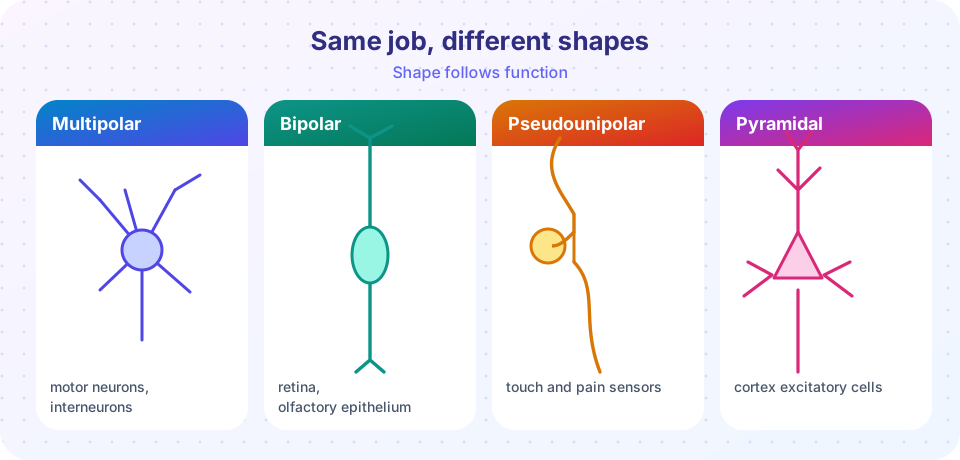
Multipolar neurons have one axon and many dendrites. They are by far the most common type in the brain and spinal cord. Motor neurons that drive muscles and most cortical neurons are multipolar.
Bipolar neurons have two processes: one dendrite and one axon, on opposite sides of the soma. They are rare and sit in sensory organs: bipolar cells in the retina pass signals from photoreceptors to ganglion cells, and olfactory receptor neurons in the nose are bipolar.
Pseudounipolar neurons start life as bipolar cells, but the two processes fuse into one stem during development. That stem then splits into a peripheral branch that goes to the skin, a muscle or a joint, and a central branch that enters the spinal cord. Most touch, temperature and pain sensors have this form. Their cell bodies cluster in dorsal root ganglia next to the spinal cord, and the spike can pass from the periphery to the central branch without detouring through the soma.
Classification by function
- Sensory (afferent) neurons convert a physical or chemical stimulus into electrical signals and send them toward the CNS.
- Motor (efferent) neurons carry commands from the CNS to muscles and glands. Lower motor neurons in the spinal cord go straight to muscle.
- Interneurons link other neurons. They are the majority of neurons in the CNS and are responsible for the processing in between sensing and acting. A simple spinal reflex may use one sensory neuron, one interneuron and one motor neuron; the brain uses billions of interneurons.
Classification by transmitter and effect
The chemical a neuron releases largely determines whether it excites or inhibits its targets (Chapter 4 covers how).
- Excitatory neurons mostly release glutamate. In the cortex, about 70 to 80% of neurons are excitatory, and most are pyramidal cells, which have a triangular soma, a long apical dendrite pointing to the cortex surface and a basal dendrite skirt. Their axons often travel to other brain areas.
- Inhibitory neurons mostly release GABA in the brain or glycine in the spinal cord and brainstem. In the cortex they are mostly small interneurons (about 20 to 30% of cortical neurons) that shape and time the activity of pyramidal cells.
- Modulatory neurons release dopamine, serotonin, noradrenaline or acetylcholine and tune the state of large networks rather than relaying precise messages.
By the modern version of Dale's principle, a neuron uses the same main transmitter at all its terminals. Some neurons release a second transmitter or a peptide as well, so the rule is not absolute.
Famous neurons
- Pyramidal cells (cortex and hippocampus) are the principal excitatory cells. Cajal drew them for the first time and thought they were the seat of mind.
- Purkinje cells in the cerebellum have a flat, fan-like dendritic tree that is among the most elaborate in the body. They are the only output of the cerebellar cortex and are inhibitory (GABA).
- Motor neurons in the spinal cord are among the largest cells, with axons up to a meter long.
- Dopamine neurons in the substantia nigra die in Parkinson's disease (Chapter 8).
Common misconceptions
"There are only a handful of neuron types." The count is large. Using gene activity, shape and firing pattern, researchers have described hundreds of types in the cortex alone, and the number is still being refined.
"Interneuron means inhibitory." Most interneurons in the cortex are inhibitory, but some interneurons in the spinal cord and elsewhere are excitatory. The terms describe different things (position in the circuit vs. effect).
"Excitatory means good; inhibitory means bad." Both are needed. Too little inhibition causes seizures, and too little excitation silences the circuit.
Try it
Press Run (or Ctrl + Enter) to see the result here.
Program input · what you'd type while the program runs
Type the answers before you press Run, one per line. Each time the program reads a line (with input()), it gets the next line from this box.
Check your understanding
Quick check · 5 questions
of 5 answered You scored / 5 · perfect!
-
1. Which neuron shape is the most common in the brain and spinal cord?
Most CNS neurons are multipolar: one axon and several dendrites. -
2. A touch receptor with a single stem that splits in two is...
Pseudounipolar neurons have one stem that divides into a peripheral and a central branch. -
3. The main excitatory transmitter in the cortex is...
Glutamate is the main excitatory transmitter; GABA is the main inhibitory transmitter in the brain. -
4. Which cell is the only output of the cerebellar cortex?
Purkinje cells send the cerebellar cortex's output and are inhibitory. -
5. Interneurons are best described as neurons that...
'Interneuron' describes the position in the circuit, not whether it excites or inhibits.
Summary
- By shape: multipolar, bipolar, pseudounipolar (plus specialized forms such as pyramidal and Purkinje cells).
- By function: sensory, motor, interneuron.
- By transmitter: excitatory (glutamate), inhibitory (GABA, glycine), modulatory (dopamine, serotonin, and others).
- About 70-80% of cortical neurons are excitatory and 20-30% inhibitory.
Next: Glial cells
Track your progress
Create a free account to tick off lessons and pick up where you left off on any device.
of Neuroscience lessons completed