


















Lesson 25 of 45 · Sensory Systems
Chapter 5 review: Sensory systems
Review the main ideas of sensory neuroscience with a one-picture summary, a comparison table and a ten-question quiz covering the whole chapter.
You have followed signals from receptors to cortex in vision, hearing, touch, pain, taste and smell. This review pulls the pieces together so you can see the common design and the key differences.
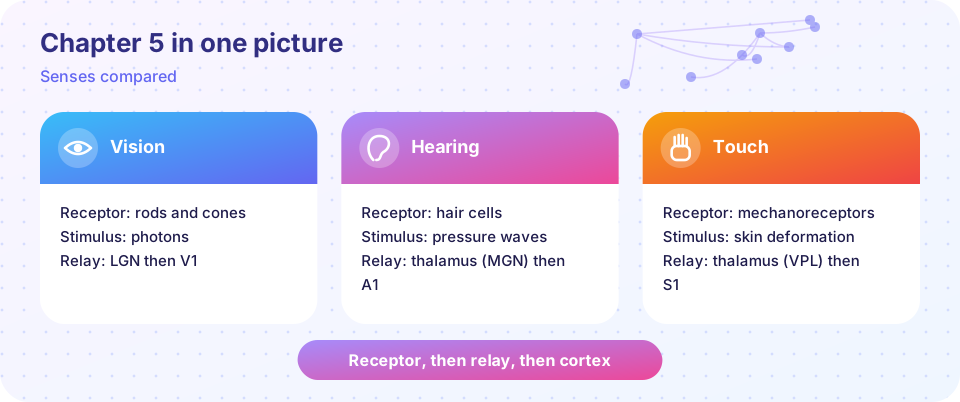
Chapter in one table
| Sense | Receptor | Stimulus | Key relay | Cortex |
|---|---|---|---|---|
| Vision | rods, cones | photons | LGN | V1 (occipital) |
| Hearing | hair cells | pressure waves | medial geniculate | A1 (temporal) |
| Touch | mechanoreceptors | skin deformation | VPL thalamus | S1 (parietal) |
| Pain | nociceptors | damage, heat, chemicals | spinothalamic route | S1, insula, cingulate |
| Taste | taste receptor cells | chemicals in food | thalamus | insula |
| Smell | olfactory neurons | airborne molecules | olfactory bulb (no thalamic relay) | piriform cortex |
| Balance | vestibular hair cells | head motion | vestibular nuclei | various |
Ideas to remember
- Transduction turns energy into a receptor potential. Photoreceptors are unusual: light hyperpolarizes them.
- Center-surround receptive fields report contrast; V1 cells report oriented edges.
- Place codes (cochlear tonotopy, retinotopy, somatotopy) keep order across stages.
- Pain is shaped by spinal gating, expectation and attention.
- Smell uses a combinatorial code with direct limbic links.
Check your understanding
Quick check · 10 questions
of 10 answered You scored / 10 · perfect!
-
1. What is the correct order of the visual pathway?
Photoreceptors signal via bipolar and ganglion cells; the optic nerve passes the chiasm to the LGN and then V1. -
2. In the dark, a photoreceptor is
The dark current keeps it depolarized, so it releases glutamate continuously. -
3. Which cells give the cochlea its sharp tuning by adding energy?
Outer hair cells change length and amplify the basilar membrane motion. -
4. A sound arrives at the left ear 0.4 ms before the right. The source is most likely
The nearer ear hears the sound first. -
5. Which fiber type carries slow, burning pain?
C fibers are unmyelinated and slow. -
6. What does a center-surround ganglion cell mainly signal?
Opposite center and surround responses emphasize differences in light. -
7. The homunculus in S1 shows that
Cortical area follows receptor density and importance, not body size. -
8. Which statement about the tongue map is correct?
Receptors for each quality are spread across taste areas. -
9. Why can smells trigger strong memories?
Olfactory bulb projections reach limbic structures without a thalamic relay. -
10. Stevens' power law for brightness has an exponent below 1. What does this imply?
An exponent below 1 means compression of perceived magnitude.
Summary
- All senses transduce, relay and map; they differ in receptors, pathways and cortical areas.
- Contrast, tonotopy and combinatorial codes are efficient ways to compress sensory data.
- Perception is an active construction influenced by attention and expectation.
Track your progress
Create a free account to tick off lessons and pick up where you left off on any device.
of Neuroscience lessons completed