


















Lesson 35 of 45 · Disease and Neurotechnology
Chapter 8 overview: Disease and neurotechnology
A roadmap to neurodegeneration, epilepsy, stroke and the tools used to study and treat the brain, with a Bayes calculator for understanding screening tests.
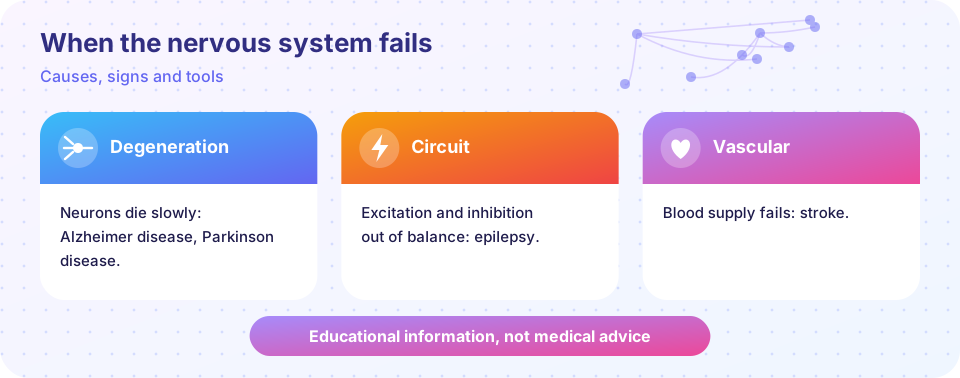
Understanding how the healthy nervous system works is only half the story. Disease shows what each part does when it fails, and treatments depend on that understanding. This chapter surveys three broad kinds of problems (slow degeneration, circuit disorders and vascular injury) and the technologies used to measure and modify brain activity.
Educational information only. Nothing here is medical advice. If you or someone near you has symptoms, contact a doctor; in an emergency call your local emergency number.
What you will learn
- The main categories of neurological disease
- How clinicians reason from symptoms to location
- Why test results need base rates to interpret
- What each lesson in the chapter covers
Key terms
Neurodegeneration: progressive loss of neurons and function.
Lesion: damaged tissue; also the experimental removal of tissue.
Ischemia: insufficient blood supply to tissue.
Sensitivity: the share of people with a condition whom a test correctly flags.
Specificity: the share of people without the condition whom a test correctly clears.
Degeneration
Circuits
Vessels
Tools
Reasoning from signs to location
Neurology is a localization science. Where a problem lies predicts what goes wrong: a lesion in the left frontal cortex can produce right-sided weakness and speech difficulty; a cerebellar lesion produces clumsiness. Doctors combine the time course (sudden suggests vascular, episodic suggests seizure or migraine, gradual suggests degeneration or tumor) with the pattern of signs, then use imaging, EEG and lab tests to confirm. You have already learned much of the map: senses, motor control, memory and emotion. Disease uses that map in reverse.
Interpreting tests
A test is rarely 100 percent right. Suppose a screening test has 90 percent sensitivity and 95 percent specificity. If only 1 person in 100 has the condition, most positive results are still false: among 1,000 people, 10 have it and 9 test positive; of the 990 without it, about 50 test positive. So roughly 9 of 59 positives, about 15 percent, are true. The numbers here are hypothetical, but the lesson is real: the positive predictive value depends on the base rate. This matters for how new biomarker tests for brain diseases should be used.
Common misconceptions
"A brain scan reads thoughts or diagnoses disease on its own." Scans give measurements that clinicians interpret with history and examination.
"Brain diseases are rare." Together, neurological disorders are among the leading causes of disability and death worldwide.
Try it
Press Run (or Ctrl + Enter) to see the result here.
Program input · what you'd type while the program runs
Type the answers before you press Run, one per line. Each time the program reads a line (with input()), it gets the next line from this box.
Press Run (or Ctrl + Enter) to see the console output here.
No output.
What is in this chapter
Check your understanding
Quick check · 4 questions
of 4 answered You scored / 4 · perfect!
-
1. A sudden loss of speech and arm strength most suggests which kind of problem?
Sudden onset points to vascular causes; this needs emergency care. -
2. A test has high sensitivity and specificity but the condition is rare. Most positives are
At low base rates, false positives can outnumber true ones. -
3. What is ischemia?
Tissue is starved of oxygen and glucose. -
4. Sensitivity is the proportion of
That is the true positive rate.
Summary
- Neurological problems arise from degeneration, circuit imbalance or vascular injury.
- Localization uses time course plus the pattern of signs.
- Test interpretation needs base rates.
Track your progress
Create a free account to tick off lessons and pick up where you left off on any device.
of Neuroscience lessons completed