


















Lesson 3 of 45 · Getting Started
How the nervous system is organized
Map the nervous system: central and peripheral parts, somatic and autonomic branches, protective layers, cerebrospinal fluid and the blood-brain barrier.
Before studying cells, you need a map. The nervous system is a hierarchy: a central processing core, a peripheral network that reaches every organ, and protective structures that keep the delicate tissue alive. Learning the vocabulary here (afferent, efferent, ganglion, tract) will save you confusion in every later chapter.
What you will learn
- The difference between the central and peripheral nervous systems.
- How somatic and autonomic pathways differ, and what sympathetic and parasympathetic do.
- Names for groups of neurons and fibers in each part.
- How the brain is protected by bone, membranes, fluid and a chemical barrier.
Key terms
- CNS: central nervous system, the brain and spinal cord.
- PNS: peripheral nervous system, all nerves and ganglia outside the CNS.
- Afferent / efferent: signals traveling toward the CNS (sensory) or away from it (motor).
- Ganglion: a cluster of neuron cell bodies in the PNS.
- Nucleus: a cluster of neuron cell bodies inside the CNS (a different use from the cell nucleus).
Central and peripheral
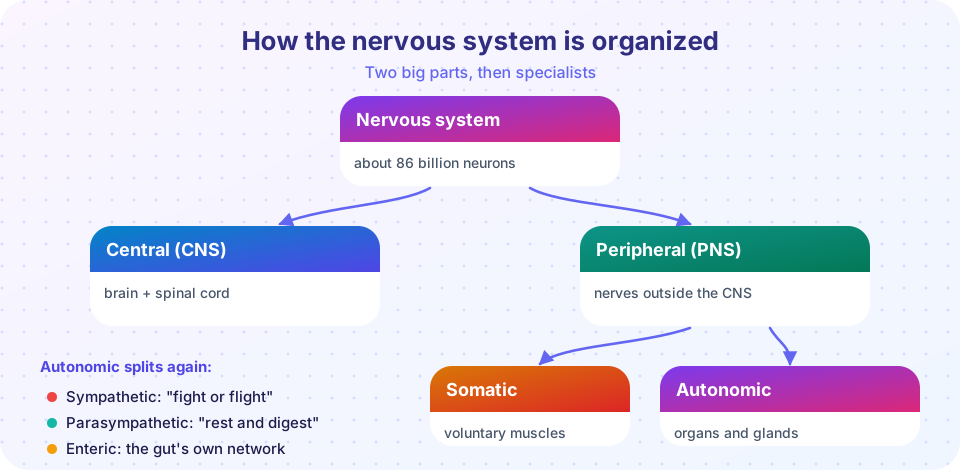
The central nervous system (CNS) consists of the brain and spinal cord. It receives information, integrates it and sends commands. The peripheral nervous system (PNS) is everything else: the 12 pairs of cranial nerves that leave the brain, the 31 pairs of spinal nerves, and the ganglia that sit along them. It works like a cable network joining the CNS to skin, muscles, glands and organs.
Two directions matter. Afferent fibers carry sensory signals toward the CNS (think "arrive"). Efferent fibers carry commands away from it (think "exit"). Every reflex, from pulling your hand off a hot pan to a changing heart rate, uses an afferent limb, some integration in the CNS and an efferent limb.
The 31 spinal nerve pairs are grouped by the part of the vertebral column where they exit: 8 cervical (neck), 12 thoracic (chest), 5 lumbar (lower back), 5 sacral and 1 coccygeal. The spinal cord is not just a cable. It contains circuits that produce reflexes and rhythmic walking patterns even without the brain's help.
Somatic and autonomic
The PNS has two output branches.
- Somatic nervous system: motor neurons that command skeletal muscle (voluntary movement), plus sensory neurons from skin, muscle and joints. One motor neuron goes from the spinal cord straight to the muscle it controls.
- Autonomic nervous system (ANS): controls smooth muscle, heart muscle and glands, mostly without conscious effort. Its pathway has two neurons in a row: a preganglionic neuron from the CNS to a ganglion, and a postganglionic neuron from the ganglion to the organ.
The ANS has three divisions:
- Sympathetic: prepares the body for action, often called "fight or flight". It raises heart rate, widens airways and pupils and redirects blood to muscles. Postganglionic neurons mostly release noradrenaline (norepinephrine).
- Parasympathetic: supports "rest and digest". It slows the heart, stimulates digestion and narrows the pupils. Its neurons release acetylcholine.
- Enteric: a network of about 100 million or more neurons in the gut wall that can run digestion largely on its own, though it is modulated by the other two.
The two main divisions often oppose each other, but both are active all the time, like two people holding a seesaw level. Calling sympathetic "emergency only" is an oversimplification.
Protecting the CNS
The brain is soft, so it comes wrapped in four layers of protection.
- Bone: the skull and the vertebral column.
- Meninges: three membranes, from outer to inner the dura mater (tough), arachnoid mater (web-like) and pia mater (thin, hugging the surface).
- Cerebrospinal fluid (CSF): a clear fluid in the space under the arachnoid and in the brain's four ventricles. The brain floats in it, which reduces its effective weight from about 1,400 g to about 50 g. CSF is made by the choroid plexus at roughly 500 mL per day, while the total volume is about 150 mL, so it is renewed about three times a day.
- Blood-brain barrier: capillaries in the brain have cells joined by tight junctions, assisted by astrocyte endfeet (Chapter 2). Small fat-soluble molecules such as oxygen and carbon dioxide cross easily, glucose crosses through transporters, and many large or charged molecules are kept out. This is why many drugs cannot reach the brain.
Gray and white matter
Tissue in the CNS looks either gray or white. Gray matter contains neuron cell bodies and dendrites. White matter contains axons, and its color comes from fatty myelin. In the brain, gray matter forms the outer cortex and deep nuclei, while white matter fills the middle. In the spinal cord the arrangement flips: gray matter forms a butterfly-shaped core and white matter surrounds it. Bundles of axons in the CNS are called tracts; in the PNS they are nerves.
Common misconceptions
"The autonomic system is entirely involuntary." Mostly, but you can influence it. Slow breathing raises parasympathetic activity, and trained meditators and athletes can change heart rate on purpose.
"The sympathetic and parasympathetic systems are on and off switches." Both are active at once. Their balance shifts, so heart rate is the net result of both.
"CSF is just a cushion." It also clears waste and delivers some signaling molecules, and its pressure and composition help doctors diagnose disease.
Try it
Press Run (or Ctrl + Enter) to see the result here.
Program input · what you'd type while the program runs
Type the answers before you press Run, one per line. Each time the program reads a line (with input()), it gets the next line from this box.
Check your understanding
Quick check · 5 questions
of 5 answered You scored / 5 · perfect!
-
1. Which division of the nervous system controls skeletal muscle voluntarily?
Somatic motor neurons command skeletal muscle. The autonomic system serves smooth muscle, heart and glands. -
2. Afferent fibers carry signals...
Afferent means arriving at the CNS, as in sensory information. -
3. Which meningeal layer lies directly on the brain surface?
From outside in: dura, arachnoid, pia. The pia touches the brain. -
4. What best describes white matter?
Myelin is fatty and pale, so axon bundles look white. -
5. Why do many drugs fail to reach the brain?
Tight junctions between brain capillary cells restrict passage.
Summary
- The CNS (brain and spinal cord) integrates information; the PNS (cranial and spinal nerves, ganglia) connects it to the body.
- Afferent fibers carry sensory input in; efferent fibers carry commands out.
- The somatic branch moves skeletal muscle; the autonomic branch (sympathetic, parasympathetic, enteric) runs organs and glands.
- Bone, meninges, CSF and the blood-brain barrier protect the CNS.
- Gray matter holds cell bodies; white matter holds myelinated axons.
Track your progress
Create a free account to tick off lessons and pick up where you left off on any device.
of Neuroscience lessons completed