


















Lesson 34 of 45 · Learning, Memory and Emotion
Chapter 7 review: Learning, memory and emotion
Review plasticity, memory systems and emotional learning with a one-picture summary, a recap table and a ten-question quiz mixing the chapter's lessons.
This chapter built memory at three levels: molecules and synapses, brain systems and emotional context. Use this page to see how they fit together.
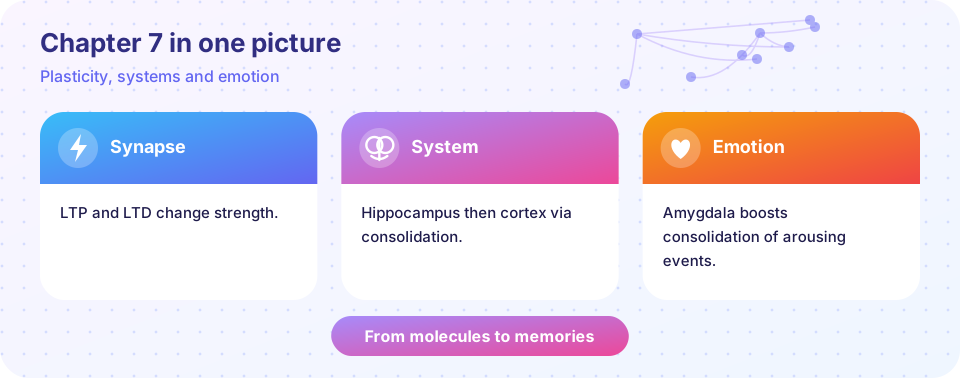
Recap table
| Level | Key ideas | Key people |
|---|---|---|
| Synapse | NMDA coincidence detection, LTP, LTD, STDP, late LTP needs protein synthesis | Hebb, Bliss and Lømo, Bi and Poo |
| System | declarative versus nondeclarative; hippocampus forms, cortex stores; replay in sleep | Scoville, Milner, Squire, O'Keefe, Moser |
| Emotion | amygdala, fear conditioning, extinction, stress hormones | LeDoux, Pavlov, Rescorla and Wagner |
| Cognition | working memory has a small capacity; recall is reconstructive | Baddeley, Cowan, Loftus, Nader |
Check your understanding
Quick check · 10 questions
of 10 answered You scored / 10 · perfect!
-
1. Which receptor needs both glutamate and depolarization to pass current?
Mg2+ blocks the NMDA channel until depolarization removes it. -
2. If a presynaptic spike follows a postsynaptic spike by 10 ms, STDP predicts
Post-before-pre pairings weaken the synapse. -
3. H.M. could still learn which of these?
Procedural learning was intact. -
4. Where are place cells found?
O'Keefe discovered them in rat hippocampus. -
5. What is reconsolidation?
Nader showed that retrieval reopens the memory. -
6. Which structure is the main output of the amygdala for the fear response?
The central nucleus drives brainstem and hypothalamic outputs. -
7. Extinction of conditioned fear is best described as
Renewal and spontaneous recovery show that the original memory persists. -
8. In the Rescorla-Wagner model, learning is driven by
The change in strength is proportional to lambda minus current prediction. -
9. Capacity of working memory is now often estimated at about
Cowan's estimate when chunking is controlled. -
10. Why is a flashbulb memory not guaranteed to be accurate?
Studies show accuracy declines as for ordinary memories.
Summary
- Memory is built from changed synapses, organized by systems and prioritized by emotion.
- Plasticity rules (Hebb, STDP, prediction error) are the common thread.
- Recall is reconstructive, so confidence is not proof.
Track your progress
Create a free account to tick off lessons and pick up where you left off on any device.
of Neuroscience lessons completed