


















Lesson 10 of 45 · Neurons and Glia
Chapter 2 review: neurons and glia
Review Chapter 2 with a one-page picture, a recap table and a ten-question quiz on neuron anatomy, neuron types and glial cells.
This review pulls together the three lessons on cells. Read the one-page picture, check yourself against the table, and then take the quiz. Explanations name the lesson to revisit when you miss a question.
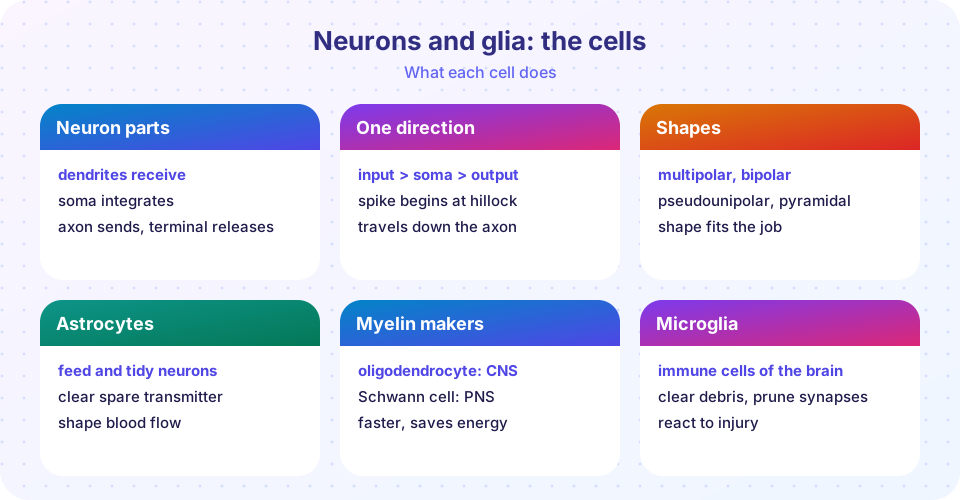
What you will learn
- A quick recap of neuron anatomy, types and glia.
- How to reason from the shape of a cell to its function.
- Which concepts to review before Chapter 3.
Recap table
| Concept | Key facts |
|---|---|
| Neuron anatomy | Dendrites receive, soma integrates, hillock triggers, axon conducts, terminals release; transport by kinesin (out) and dynein (in) |
| Neuron types | Multipolar, bipolar, pseudounipolar; sensory, motor, interneuron; excitatory (glutamate) vs. inhibitory (GABA, glycine) |
| Glial cells | Astrocytes (support), oligodendrocytes and Schwann cells (myelin), microglia (defense and pruning), ependymal cells (CSF) |
From shape to function
Use this reasoning pattern for any cell you meet in the rest of the course.
- Where does input arrive? Look for dendrites and spines.
- Where is the decision made? The axon hillock.
- How far must the output travel, and how fast? Long, myelinated axon for speed; short axon for local circuits.
- What does it release? Glutamate excites, GABA inhibits, dopamine and serotonin modulate.
- Which glia look after it? Astrocytes feed it, myelin makers insulate it, microglia watch over it.
Try it
Press Run (or Ctrl + Enter) to see the console output here.
No output.
Press Run (or Ctrl + Enter) to see the result here.
Program input · what you'd type while the program runs
Type the answers before you press Run, one per line. Each time the program reads a line (with input()), it gets the next line from this box.
Check your understanding
Quick check · 10 questions
of 10 answered You scored / 10 · perfect!
-
1. Which structure is the usual site of spike initiation?
Sodium channel density and low threshold make this the trigger zone. -
2. Kinesin moves cargo...
Kinesin drives anterograde transport. -
3. Which neuron type is found among retinal bipolar cells?
Retinal bipolar cells have one dendrite and one axon on opposite sides. -
4. Most touch and pain sensors are which shape?
Their single stem splits into peripheral and central branches. -
5. Which cell is the only output of the cerebellar cortex?
Purkinje cells send inhibitory output from the cerebellar cortex. -
6. Roughly what share of cortical neurons are excitatory?
About 70-80% are excitatory (mostly pyramidal cells). -
7. A cell that makes myelin around parts of many CNS axons is a(n)...
One oligodendrocyte myelinates many axons; one Schwann cell wraps one internode. -
8. Which glial cell absorbs spare glutamate and potassium?
Astrocytes carry transporters and buffer K+. -
9. Microglia come from...
Unlike neurons, microglia are immune cells of non-neural origin. -
10. Which claim is a myth?
Overall the ratio is around one to one.
Summary
- Neurons receive, integrate and send; glia support and defend.
- Shape (multipolar, bipolar, pseudounipolar), function (sensory, motor, interneuron) and transmitter all classify neurons.
- Chapter 3 now shows how the electrical signal itself works.
Track your progress
Create a free account to tick off lessons and pick up where you left off on any device.
of Neuroscience lessons completed