


















Lesson 32 of 45 · Learning, Memory and Emotion
Memory systems and the hippocampus
Explore declarative and nondeclarative memory, the case of Henry Molaison, place cells, consolidation during sleep and working memory in prefrontal cortex.
In 1953 a surgeon removed the medial temporal lobes from both sides of a young man's brain, hoping to stop his severe seizures. The seizures improved, but the patient, known for decades as H.M. and now named Henry Molaison, could no longer form new lasting memories of events. This case taught neuroscience more about memory than almost any other.
What you will learn
- The taxonomy of memory systems
- What H.M. lost and what he kept
- How the hippocampus represents space and binds episodes
- How memories consolidate and why recall is reconstruction
- How working memory differs
Key terms
Episodic memory: memory for events in a time and place.
Semantic memory: memory for facts and meanings.
Procedural memory: memory for skills and habits.
Place cell: a hippocampal neuron that fires when an animal is in a particular place.
Reconsolidation: a retrieved memory becomes labile and must be stored again.
The taxonomy
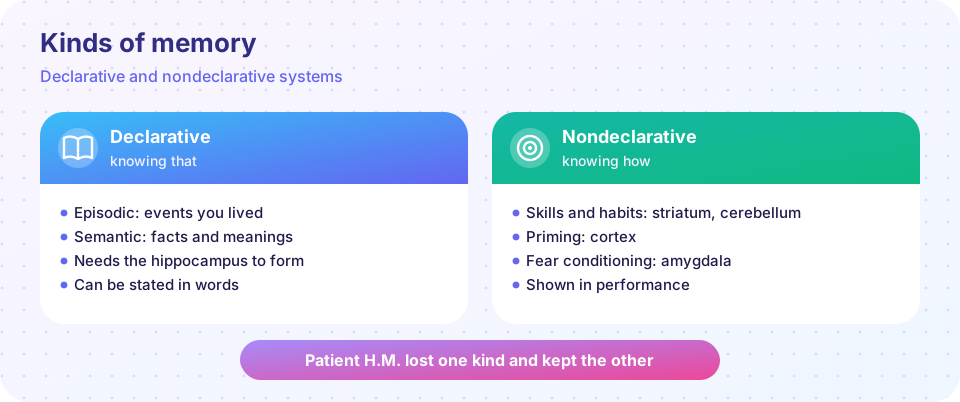
Larry Squire's influential scheme divides long-term memory into declarative (explicit) and nondeclarative (implicit) kinds.
| System | Examples | Main structures |
|---|---|---|
| Episodic | your last birthday | hippocampus, cortex |
| Semantic | facts, word meanings | temporal and other cortex |
| Procedural | riding a bicycle | striatum, cerebellum, motor cortex |
| Priming | faster at a primed word | sensory cortex |
| Conditioning | fear learned to a tone | amygdala, cerebellum |
Declarative memories can be declared; nondeclarative ones show up as changed behavior.
Patient H.M.
William Scoville removed H.M.'s medial temporal lobes in 1953 (the hippocampus on both sides, parts of the amygdala and adjacent cortex). Brenda Milner then tested him for years. The pattern:
- Anterograde amnesia: he could not form new episodic or semantic memories. He met Milner repeatedly and every time it was new.
- Retrograde loss was limited mostly to a few years before surgery; older memories were largely intact.
- Working memory and intelligence were roughly normal: he could hold a conversation and repeat digits.
- Procedural learning was intact: in a mirror-drawing task he improved over days without remembering the sessions.
This showed three things: the hippocampal region is needed to form new declarative memories, it is not the final store of old ones, and different memory systems can be separated.
The hippocampus at work
In 1971 John O'Keefe recorded from rat hippocampus and found place cells: each fires when the animal is in a specific location. Together they form a map. In 2005, May-Britt and Edvard Moser found grid cells in the neighboring entorhinal cortex that fire in a hexagonal lattice. O'Keefe and the Mosers shared the 2014 Nobel Prize. In humans the hippocampus supports both navigation and the binding of "what, where and when" into episodes. Remarkably, new neurons are born in the adult rodent dentate gyrus; whether they are added meaningfully in adult humans is debated.
Consolidation
New memories are fragile. In the standard model of consolidation, the hippocampus initially binds the cortical pieces of an experience and, over days to years, repeated reactivation strengthens direct cortico-cortical links so that the memory no longer needs the hippocampus. Reactivation is visible in sleep: place-cell sequences from a day of exploration are replayed in compressed form during sharp-wave ripples in slow-wave sleep. Disrupting ripples after learning impairs memory in rats. Alternative views (multiple trace theory) argue that vivid episodic detail always depends on the hippocampus.
Recall is not playback. Karim Nader's 2000 experiments showed that a consolidated fear memory in rats becomes labile when retrieved and needs protein synthesis to be stored again (reconsolidation). Elizabeth Loftus's studies showed that wording of questions ("smashed" versus "hit") changes witnesses' estimates, and that false details can be planted. Confidence is not a reliable sign of accuracy.
Working memory
Working memory holds and manipulates a small amount of information for seconds. Baddeley and Hitch's model has a phonological loop, a visuospatial sketchpad and a central executive. George Miller's 1956 "magical number seven, plus or minus two" has been revised: when chunking is controlled, capacity looks closer to about four chunks (Nelson Cowan). Monkey prefrontal neurons keep firing during delays while an item is held, and lateral prefrontal cortex is central.
Common misconceptions
"The hippocampus is where memories are stored forever." It is critical for forming and retrieving detailed episodic memories, but older memories distribute across the cortex.
"H.M. could not learn anything." He learned skills; he lost the ability to remember the learning episodes.
Try it
Press Run (or Ctrl + Enter) to see the result here.
Program input · what you'd type while the program runs
Type the answers before you press Run, one per line. Each time the program reads a line (with input()), it gets the next line from this box.
Check your understanding
Quick check · 5 questions
of 5 answered You scored / 5 · perfect!
-
1. What did H.M. lose after his surgery?
He had severe anterograde amnesia but intact procedural learning and working memory. -
2. What are place cells?
O'Keefe found place cells in the rat hippocampus. -
3. During which state are place-cell sequences replayed most prominently?
Sharp-wave ripples in slow-wave sleep replay compressed sequences. -
4. Reconsolidation means that
Retrieval can reopen a memory to modification. -
5. Which memory type is intact in H.M. despite amnesia?
He improved on skill tasks across sessions without recalling them.
Summary
- Long-term memory has declarative and nondeclarative systems with different structures.
- H.M. showed that the medial temporal lobe is needed to form new declarative memories.
- Place and grid cells map space; replay in sleep helps consolidate memory.
- Recall is reconstruction; working memory has a small capacity.
Next: Emotion and the amygdala
Track your progress
Create a free account to tick off lessons and pick up where you left off on any device.
of Neuroscience lessons completed