


















Lesson 45 of 45 · Projects and Practice
Further study: where to go next in neuroscience
Plan your next steps after this course: cognitive, computational and clinical neuroscience, useful skills and related tutorials on this site.
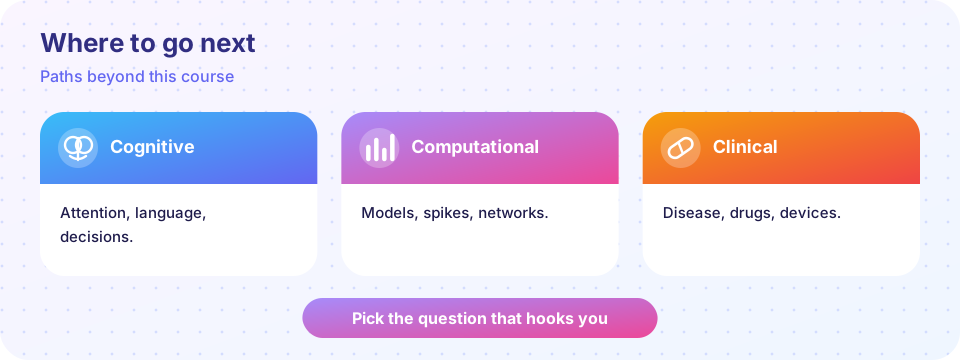
You now know how neurons build senses, movements, memories and emotions, and how things go wrong. Neuroscience is large, so the best next step depends on the question that excites you. This page maps three paths, the skills each one needs and where to find related material on this site.
What you will learn
- Three broad directions for further study
- Which skills to build for each
- How this course connects to other tutorials on the site
Key terms
Cognitive neuroscience: how brain activity gives rise to attention, language, decisions and thought.
Computational neuroscience: using math and code to model neurons and circuits.
Clinical neuroscience: studying and treating diseases of the nervous system.
Reproducibility: the ability of independent studies to obtain consistent results.
Path 1: cognitive neuroscience
Questions here include how attention selects information, how language is produced and understood, how decisions weigh reward and risk, and what consciousness is. You will combine behavior (reaction times like the project in this chapter), imaging and lesion evidence. Strong study habits include learning research methods and statistics well, because small samples and flexible analyses have produced many results that did not replicate. Related tutorials: Cognitive psychology, Cognitive science and Research methods in psychology.
Path 2: computational neuroscience
Here you write models: single-neuron equations, networks, learning rules (you met Hebb, STDP and Rescorla-Wagner), and decoding methods like the place-cell example. Useful skills are calculus, linear algebra, probability and Python. The same ideas drive artificial neural networks, though real neurons are far more complex. Related tutorials: Python, NumPy, Statistics and probability, Machine learning and Signals and systems.
Path 3: clinical and translational neuroscience
This path leads toward medicine, pharmacology and engineering: why diseases happen, how drugs act, how devices such as DBS and BCIs are designed and tested. Learn anatomy and physiology well, then pharmacology and clinical research design. Related tutorials: Anatomy and physiology, Pharmacology and Clinical psychology.
Habits that make you better
- Read primary sources slowly: a classic paper such as Hubel and Wiesel 1962, Bliss and Lømo 1973 or Scoville and Milner 1957 teaches how arguments are built.
- Ask what a result cannot show: correlation, small samples, animal-to-human leaps.
- Build small models: even ten lines of code make an idea concrete.
- Revisit the basics: review the first half of this course when a new topic feels unfamiliar.
Try it
Press Run (or Ctrl + Enter) to see the console output here.
No output.
Press Run (or Ctrl + Enter) to see the result here.
Program input · what you'd type while the program runs
Type the answers before you press Run, one per line. Each time the program reads a line (with input()), it gets the next line from this box.
Check your understanding
Quick check · 3 questions
of 3 answered You scored / 3 · perfect!
-
1. Which path focuses on models and code for neurons and networks?
Computational neuroscience uses mathematics and programming to model neural systems. -
2. Why study statistics and research methods?
Good methods guard against false findings. -
3. Which habit does this lesson recommend?
Critical reading is the core skill.
Summary
- Choose a path: cognitive, computational or clinical.
- Build skills in methods, math and code, and anatomy and pharmacology respectively.
- Read primary sources and build small models.
Back to the course: Neuroscience
Track your progress
Create a free account to tick off lessons and pick up where you left off on any device.
of Neuroscience lessons completed