


















Lesson 6 of 45 · Neurons and Glia
Chapter 2 overview: neurons and glia
Preview Chapter 2: how neurons are built, why they come in different shapes, and what glial cells do, with a roadmap of the lessons ahead.
Every thought, sensation and movement begins in cells. The nervous system has two big families: neurons, which send signals, and glia, which keep neurons alive and working. In this chapter you will learn what a neuron looks like, why some look so different from others, and how glial cells insulate, feed and defend them.
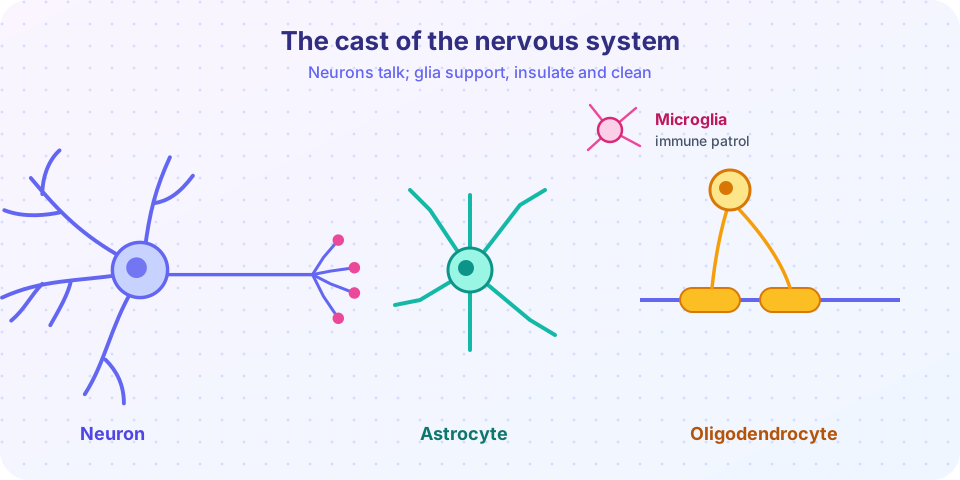
What you will learn
- The big picture of cells in the nervous system.
- A roadmap of the three lessons in this chapter.
- Why cell shape matters for signaling.
Cells of the nervous system
A neuron has three jobs
Shape follows function
Glia keep the system running
Key terms
- Soma: the cell body, which holds the nucleus.
- Dendrite: a branching extension that receives signals.
- Axon: a long extension that carries signals away from the soma.
- Myelin: a fatty insulating sheath wrapped around many axons.
- Glia: non-neuronal cells of the nervous system.
What each lesson covers
- Neuron anatomy: the parts of a neuron, what each does, and how materials travel along the axon.
- Types of neurons: classification by shape, by function and by the transmitter used; pyramidal cells and interneurons.
- Glial cells: astrocytes, oligodendrocytes, Schwann cells, microglia and others, and how glia take part in signaling.
- Chapter 2 review: a one-page picture and a ten-question quiz.
Why start with cells?
The neuron doctrine, which you met in Chapter 1, is the foundation of the rest of the course. Everything in later chapters, from a spike to a memory, is a property of cells and the connections between them. Two numbers are useful to hold in mind. First, a single cortical neuron may receive thousands of synaptic inputs. Second, glia are roughly as numerous as neurons overall, not ten times more numerous as an old textbook estimate claimed.
Try it
Press Run (or Ctrl + Enter) to see the console output here.
No output.
Press Run (or Ctrl + Enter) to see the result here.
Program input · what you'd type while the program runs
Type the answers before you press Run, one per line. Each time the program reads a line (with input()), it gets the next line from this box.
Check your understanding
Quick check · 4 questions
of 4 answered You scored / 4 · perfect!
-
1. Which cell type mainly sends electrical and chemical signals?
Neurons are the signaling cells; glia support them. -
2. Roughly how do glia compare with neurons in number?
Modern counting studies find roughly equal numbers of neurons and non-neuronal cells in the human brain. -
3. Which part of a neuron receives input?
Dendrites collect synaptic input. -
4. Which lesson of this chapter covers pyramidal cells and interneurons?
Classification of neurons is the topic of the types lesson.
Summary
- Neurons signal; glia support, insulate and defend.
- A neuron receives, integrates and sends.
- Glia are about as numerous as neurons overall.
- This chapter: anatomy, types, glia, review.
Next: Neuron anatomy
Track your progress
Create a free account to tick off lessons and pick up where you left off on any device.
of Neuroscience lessons completed