


















Lesson 14 of 45 · Electrical Signaling
Conduction and myelin: how spikes travel
See how an action potential travels along an axon: passive cable spread, regeneration, the roles of diameter and myelin, nodes of Ranvier and conduction velocities.
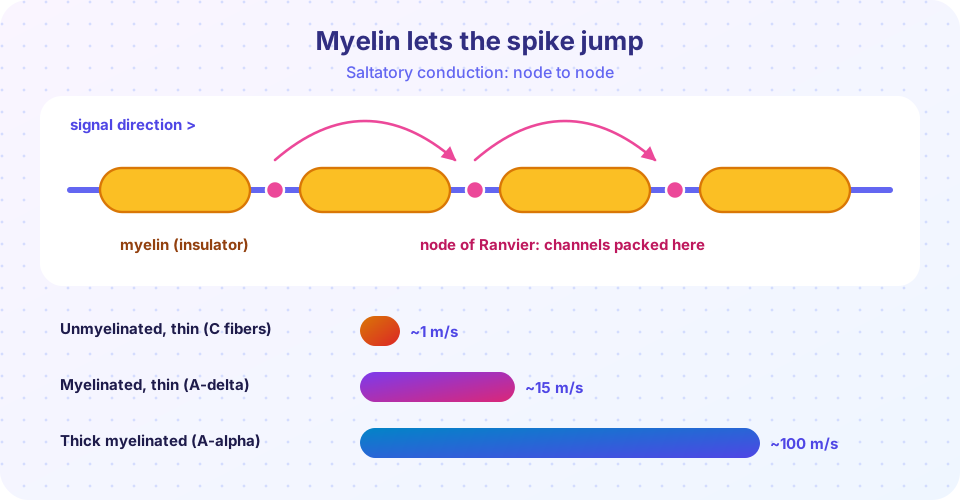
A spike made at the axon hillock is useless unless it reaches the terminals. In a long axon, that means traveling up to a meter without fading. This lesson explains how, and why evolution found two solutions to the speed problem: fat axons (as in squid and some invertebrates) and myelin (in vertebrates). The difference is dramatic. A thin unmyelinated fiber conducts at about 1 meter per second, while a thick myelinated one conducts at close to 100 m/s.
What you will learn
- Why a spike has to be regenerated and cannot just spread passively.
- How axon diameter and myelin set the conduction velocity.
- What saltatory conduction means.
- The main nerve fiber classes and what happens when myelin is damaged.
Key terms
- Length constant (λ): the distance over which a passive voltage change falls to about 37% (1/e) of its starting size.
- Time constant (τ): the time a membrane takes to charge to about 63% of a voltage step; τ = R_m·C_m.
- Saltatory conduction: conduction in which the spike jumps from node to node.
- Internode: the myelinated stretch between two nodes of Ranvier.
- Conduction velocity: the speed at which the spike travels.
Why a spike must be regenerated
Imagine injecting current into a long axon. The axon behaves like a leaky cable: current flows along the inside (against axial resistance) but also leaks out across the membrane. A voltage change therefore decays with distance as V(x) = V₀·e^(-x/λ), where the length constant is λ = √(r_m / r_i). For typical axons λ is only about a millimeter or so. If this were the whole story, a signal from your toe could never reach your spinal cord. Active regeneration solves the problem: the passive current spreading ahead of the spike depolarizes the next patch of membrane to threshold, Na⁺ channels open there, and a fresh full-size spike is built. The spike moves like a row of falling dominoes, each one tipping the next one at full strength.
The refractory period guarantees direction. Behind the spike the Na⁺ channels are inactivated, so the spike cannot go backward, and only the patch ahead is ready.
Two ways to go faster
Speed depends on how quickly the next patch reaches threshold. That depends on two things.
- Axon diameter. A wider axon has lower internal (axial) resistance, so current spreads further and faster. In an unmyelinated axon, velocity grows with the square root of diameter. The squid giant axon, about 0.5 mm wide, reaches about 25 m/s this way, which lets squid contract their mantle for fast escape jets. But the price is high: a 1 m/s fiber needs only about 1 µm, while a 25 m/s fiber needs a diameter of 500 µm, a very bulky cable.
- Myelin. Glial wrappings make the membrane a better insulator, raising the resistance and cutting the capacitance of the covered membrane. Current stays inside the axon and spreads far down the internode almost instantly. The active channels sit at the nodes of Ranvier, gaps of about 1 µm between myelin segments, where Na⁺ channels are packed at very high density. The spike "jumps" from node to node: this is saltatory conduction (from the Latin saltare, to leap). In myelinated axons velocity grows roughly in proportion to diameter, about 6 m/s per micrometer of fiber diameter (a rule of thumb).
Myelin also saves energy. Only the nodes need to be restored by the pump after each spike, so far fewer ions cross the membrane. Vertebrates fit tens of thousands of fast axons into a spinal cord only a centimeter wide, which would be impossible with giant axons.
Fiber classes
Peripheral nerve fibers are grouped by diameter and speed. The ranges below are approximate.
| Class | Diameter | Velocity | Typical job |
|---|---|---|---|
| Aα | 13 to 20 µm | 80 to 120 m/s | Muscle position sense, motor neurons to muscle |
| Aβ | 6 to 12 µm | 35 to 75 m/s | Touch and pressure |
| Aδ | 1 to 5 µm | 5 to 35 m/s | Sharp, fast pain; cold |
| C | 0.2 to 1.5 µm (unmyelinated) | 0.5 to 2 m/s | Slow, dull pain; warmth; itch |
This explains an everyday experience. If you stub your toe, sharp pain arrives first (Aδ fibers), followed about a second later by the throbbing ache (C fibers). The worked example below shows the delay.
When myelin fails
In multiple sclerosis, the immune system damages CNS myelin. Spikes slow down, fail to cross damaged segments and can leak, causing symptoms such as numbness, weakness and vision problems, which vary widely between patients. In Guillain-Barré syndrome and some inherited neuropathies (such as Charcot-Marie-Tooth disease), peripheral myelin is affected. Doctors use nerve conduction studies, which measure how fast a pulse travels along a nerve, to detect slowing. These conditions are discussed in Chapter 8; this lesson only explains why the loss of insulation matters.
Worked example: toe to spinal cord
Suppose the distance from your big toe to your spinal cord is 1.0 m.
- Aα at 100 m/s:
t = 1.0 / 100 = 0.010 s = 10 ms. - Aδ at 15 m/s:
t = 1.0 / 15 ≈ 0.067 s = 67 ms. - C at 1 m/s:
t = 1.0 / 1 = 1.0 s.
The C-fiber signal lags the fast one by almost a second, which matches the "first sharp pain, then ache" experience (although the full delay you notice also includes processing in the central nervous system).
Common misconceptions
"The spike is just electricity flowing along the axon like current in a wire." The spike is a regenerated wave of channel openings. A wire's signal would fade; the axon renews it.
"Myelin increases the speed by making the spike bigger." The spike is the same size. Myelin reduces how much current is needed to charge the membrane and concentrates active channels at nodes.
"Faster is always better." Faster axons need more space and are only used where timing matters, such as reflexes. Slow C fibers are perfectly suited to slow, diffuse signals.
Try it
Press Run (or Ctrl + Enter) to see the result here.
Program input · what you'd type while the program runs
Type the answers before you press Run, one per line. Each time the program reads a line (with input()), it gets the next line from this box.
Press Run (or Ctrl + Enter) to see the console output here.
No output.
Check your understanding
Quick check · 5 questions
of 5 answered You scored / 5 · perfect!
-
1. Why must the spike be regenerated along the axon?
Passive spread decays with a length constant of about a millimeter, so active renewal is needed. -
2. Saltatory conduction means...
Myelin insulates the internodes so the spike is regenerated only at nodes. -
3. Which fiber type conducts slowest?
C fibers are thin and unmyelinated, about 1 m/s. -
4. Which of these does myelin do?
Myelin insulates the membrane, so current spreads farther and conduction is faster and cheaper. -
5. Why can a spike not travel backward?
The refractory period behind the wave front makes propagation one-directional.
Summary
- Passive spread fades (length constant about a millimeter), so spikes are regenerated along the axon.
- Speed rises with diameter (square-root law unmyelinated, linear with myelin).
- Myelin concentrates channels at nodes of Ranvier and makes conduction saltatory, fast and economical.
- Fibers range from C (about 1 m/s) to A-alpha (about 100 m/s).
- Demyelinating diseases slow or block conduction.
Next: Chapter 3 review
Track your progress
Create a free account to tick off lessons and pick up where you left off on any device.
of Neuroscience lessons completed