


















Lesson 18 of 45 · Synapses and Neurotransmitters
Neurotransmitters and receptors
Meet the major neurotransmitters, glutamate, GABA, acetylcholine, dopamine and serotonin, and the ionotropic and metabotropic receptors that decide their effects.
There are dozens of chemical messengers in the nervous system, but a short list does most of the work. In this lesson you will learn the main transmitters, which cells make them and what they do, and why the same molecule can excite one cell and inhibit another. The key idea: the receptor, not the transmitter, determines the effect.
What you will learn
- The main classes of neurotransmitter and the six you should know best.
- The difference between ionotropic and metabotropic receptors, with examples.
- Special features of NMDA receptors and the GABA-A receptor.
- Where major modulatory systems come from in the brain.
Key terms
- Ionotropic receptor: a receptor that is also an ion channel (ligand-gated).
- Metabotropic receptor: a G-protein-coupled receptor that acts through second messengers.
- Agonist / antagonist: a molecule that activates / blocks a receptor.
- Modulator: a transmitter that adjusts how a circuit responds, rather than conveying fast signals.
- Reuptake transporter: a protein that pumps transmitter back into cells.
Classes of transmitter
- Amino acids: glutamate, GABA, glycine. These mediate most fast signaling in the brain.
- Monoamines and acetylcholine: dopamine, noradrenaline (norepinephrine), serotonin, histamine and acetylcholine. They are released from relatively small groups of neurons whose axons spread widely and modulate whole networks.
- Neuropeptides: short chains of amino acids such as endorphins, substance P and oxytocin. They are released by strong or sustained activity and act slowly.
- Others: ATP and adenosine, gases such as nitric oxide (which diffuses freely and is not stored in vesicles), and endocannabinoids (lipids made on demand by the postsynaptic cell that signal backward).
The six to know
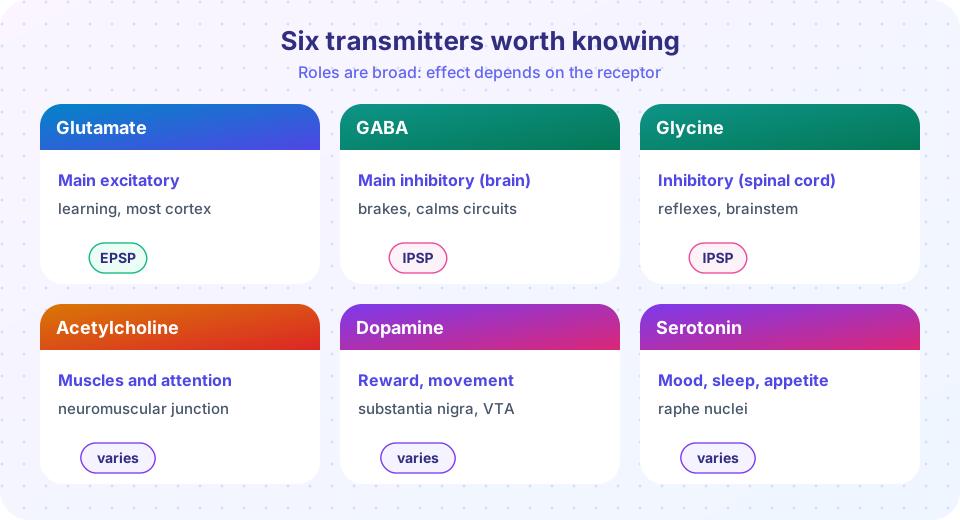
Glutamate is the main excitatory transmitter in the brain, used by most pyramidal neurons. It acts on AMPA receptors (fast; they pass Na⁺ and K⁺), NMDA receptors (slower; they pass Ca²⁺ too and are central to learning, Chapter 7) and kainate receptors, as well as metabotropic mGluRs. Too much glutamate kills neurons, a process called excitotoxicity that contributes to damage after stroke.
GABA (gamma-aminobutyric acid) is the main inhibitory transmitter in the brain. Its GABA-A receptor is a Cl⁻ channel, and GABA-B is a metabotropic receptor. Many sedatives and anticonvulsants enhance GABA-A signaling; their effects emerge from this mechanism rather than from any general "sleepiness" chemical. Glycine plays the equivalent role in the spinal cord and brainstem. It is blocked by strychnine, a poison that causes convulsions.
Acetylcholine (ACh) is used at the neuromuscular junction, where nicotinic receptors (ionotropic) cause muscle to contract. In the brain, it supports attention and memory. Muscarinic receptors (metabotropic) mediate parasympathetic effects, such as slowing the heart. Curare, a South American arrow poison, blocks nicotinic receptors and causes paralysis.
Dopamine is made by a few hundred thousand neurons in the midbrain, but they influence enormous territories. The nigrostriatal pathway (substantia nigra to striatum) supports movement; its loss causes Parkinson's disease. The mesolimbic pathway (ventral tegmental area to nucleus accumbens) is tied to reward prediction and motivation. All dopamine receptors are metabotropic. A common shorthand, "dopamine is the pleasure chemical", is too simple: it signals "better than expected" and drives learning and wanting, not just pleasure.
Serotonin (5-HT) comes from the raphe nuclei of the brainstem. It influences mood, sleep, appetite and many other functions, and acts on more than a dozen receptor types (almost all metabotropic; the 5-HT3 receptor is a channel). Several widely used antidepressants block the serotonin reuptake transporter; how they relieve depression is still under study, and nothing in this lesson is treatment advice.
Noradrenaline from the locus coeruleus raises arousal and attention. Histamine supports wakefulness (which is why older antihistamines make people drowsy).
Ionotropic and metabotropic receptors
| Property | Ionotropic | Metabotropic |
|---|---|---|
| Structure | channel and receptor in one protein | receptor linked to a G-protein |
| Speed | about 1 ms | tens of ms to seconds |
| Duration | brief | long-lasting |
| Examples | nicotinic ACh, AMPA, NMDA, GABA-A, glycine | mGluR, GABA-B, muscarinic, dopamine, most serotonin |
| Effect | direct change in Vm | changes in channels, enzymes or gene expression |
Two special receptors
The NMDA receptor is a molecular coincidence detector. At rest, its channel is plugged by a magnesium ion (Mg²⁺). It conducts only when two things happen at once: glutamate is bound, and the postsynaptic cell is depolarized enough to expel the Mg²⁺. Then Ca²⁺ enters, triggering changes that strengthen the synapse. This "AND gate" is a core mechanism for learning.
The GABA-A receptor passes Cl⁻. In a mature neuron, E_Cl is near or below rest, so opening it either hyperpolarizes the cell or simply clamps Vm near rest (shunting inhibition), either way making it harder to reach threshold. Benzodiazepines and alcohol act as modulators of this receptor, in different ways. In developing neurons E_Cl can be above rest, so GABA is excitatory early in life.
One transmitter, many effects
Acetylcholine excites skeletal muscle through nicotinic receptors and slows the heart through muscarinic receptors. Dopamine can excite or inhibit depending on the receptor subtype. So labels like "excitatory transmitter" refer to a molecule's typical effect, while the real rule is always: transmitter + receptor + target cell = effect.
Common misconceptions
"Serotonin is the happiness chemical." Mood involves many systems. Serotonin affects mood, but a single-chemical explanation (such as a simple chemical imbalance) is not supported by the evidence.
"Dopamine is the pleasure chemical." It is closer to a learning and motivation signal about expected reward.
"More transmitter means a stronger effect." Receptor number, sensitivity, reuptake and circuit context all matter.
Try it
Press Run (or Ctrl + Enter) to see the result here.
Program input · what you'd type while the program runs
Type the answers before you press Run, one per line. Each time the program reads a line (with input()), it gets the next line from this box.
Check your understanding
Quick check · 5 questions
of 5 answered You scored / 5 · perfect!
-
1. What is the main excitatory transmitter in the brain?
Glutamate acts on AMPA, NMDA and kainate receptors to excite most cortical cells. -
2. Which receptor is a coincidence detector needing both glutamate and depolarization?
The Mg2+ block of the NMDA channel is relieved only when the cell is depolarized while glutamate is bound. -
3. Metabotropic receptors differ from ionotropic ones because they...
They trigger intracellular cascades via G-proteins. -
4. Loss of dopamine neurons in the substantia nigra is linked to...
The nigrostriatal pathway supports movement; its neurons die in Parkinson's disease. -
5. Why can the same transmitter excite one cell and inhibit another?
Effect depends on receptor, not on the transmitter alone.
Summary
- Fast signaling uses glutamate (excites), GABA and glycine (inhibit); modulators include dopamine, serotonin, noradrenaline and acetylcholine.
- Ionotropic receptors are channels (fast); metabotropic receptors act through G-proteins (slow, long-lasting).
- NMDA receptors detect coincident activity; GABA-A receptors pass Cl⁻.
- Transmitter + receptor + target determine the effect.
Next: Synaptic integration
Track your progress
Create a free account to tick off lessons and pick up where you left off on any device.
of Neuroscience lessons completed