


















Lesson 1 of 45 · Getting Started
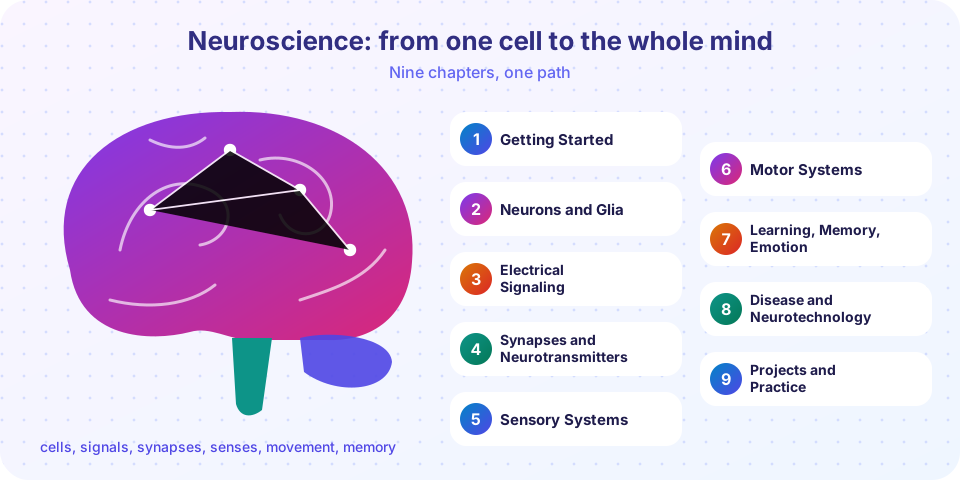
Course map: your path through neuroscience
See the whole neuroscience course at a glance: who it is for, how to study it, and what each of the nine chapters teaches, from neurons to neurotechnology.
Neuroscience is the study of the nervous system: the brain, the spinal cord and the nerves that connect them to every part of your body. It asks how a few hundred grams of soft tissue can read this sentence, remember a face, steer a bicycle and feel afraid. This course answers those questions step by step, starting with single cells and ending with brain-scanning technology and real-world case studies.
Educational information only. This course explains how the nervous system works. It is not medical advice and cannot diagnose or treat any condition. If you or someone you know has symptoms, speak with a qualified health professional.
What you will learn
- Who this course is for, and what you need to know before you start.
- How the nine chapters build on each other.
- A study routine that works for a science subject.
- A few headline numbers that give you a feel for the scale of the brain.
Who this course is for
The course is written for learners aged about 14 and up, and for adults who want a clear introduction. It follows the common core of international school and first-year university courses (IB Biology and Psychology options, Cambridge A Level Biology and Psychology, US AP Biology and AP Psychology, and introductory university neuroscience). You do not need to be an expert in anything. You do need a little school-level biology (what a cell is) and chemistry (what an ion is), and you should be comfortable reading a simple graph. The maths stays light: some arithmetic, one logarithm and a handful of formulas, each explained when it appears.
How the nine chapters fit together
Each chapter answers one question, and the answer is the starting point for the next chapter.
Part 1: the building blocks
- Getting started
- Neurons and glia
Part 2: how cells signal
- Electrical signaling
- Synapses
Part 3: the brain in action
- Sensory systems
- Motor systems
- Learning and memory
Part 4: when things go wrong, and tools
- Disease and technology
- Projects and practice
Chapters 1 to 4 (the first half of the course, which you are reading now) cover structure and signaling. Chapters 5 to 9 then use those tools to explain senses, movement, memory, emotion and disease. If a later idea feels hard, the explanation almost always lives a chapter or two earlier.
A study routine that works
- Read with a question. Before each lesson, read the "What you will learn" list and turn one bullet into a question you want answered.
- Draw it. Sketch the neuron, the spike or the synapse from memory. Drawing exposes gaps that reading hides.
- Run the examples. The runnable examples are small simulations. Change a number, predict the result, then run it.
- Self-test. Use the quiz at the end of each lesson, and the longer review quiz at the end of each chapter. Retrieving an answer from memory beats re-reading.
- Space it out. Revisit old chapters a few days later. The brain you are studying is the brain doing the learning, and it consolidates better with spacing (you will see why in Chapter 7).
The brain by the numbers
A few numbers make later chapters easier to picture. The human brain has about 86 billion neurons, and roughly as many non-neuronal cells. An adult brain weighs about 1.3 to 1.4 kg, around 2% of body weight, yet it uses about 20% of the body's resting energy, roughly 20 watts. Most neurons (about four in five) sit in the cerebellum, even though the cerebral cortex is what we usually picture. These figures are estimates from counting studies and vary between people, so treat them as orders of magnitude.
Try it
Press Run (or Ctrl + Enter) to see the result here.
Program input · what you'd type while the program runs
Type the answers before you press Run, one per line. Each time the program reads a line (with input()), it gets the next line from this box.
Check your understanding
Quick check · 4 questions
of 4 answered You scored / 4 · perfect!
-
1. Roughly how many neurons does the human brain contain?
Counting studies estimate about 86 billion neurons, with a similar number of non-neuronal cells. -
2. Which share of the body's resting energy does the brain use?
The brain is about 2% of body weight but uses roughly 20% of resting energy. -
3. Which chapter explains how a spike is produced?
Chapter 3, Electrical Signaling, covers the resting potential and the action potential. -
4. Which study habit is best supported by research on memory?
Retrieval practice and spaced repetition beat passive re-reading.
Summary
- Neuroscience studies the nervous system at every scale, from molecules to behavior.
- The course has nine chapters: cells, signals and synapses first, then senses, movement, memory, disease and technology.
- The brain has about 86 billion neurons and uses about 20 W.
- Study actively: question, draw, run, self-test, space.
Next: What is neuroscience?
Track your progress
Create a free account to tick off lessons and pick up where you left off on any device.
of Neuroscience lessons completed