


















Lesson 5 of 45 · Getting Started
Chapter 1 review: getting started
Review Chapter 1: levels of analysis, nervous system divisions, brain regions and research methods, with a one-page summary picture and a ten-question quiz.
You have now mapped the field and the nervous system. This review ties the four lessons together with a one-page picture, a recap table and a ten-question quiz. If you miss a question, the explanation tells you which lesson to revisit.
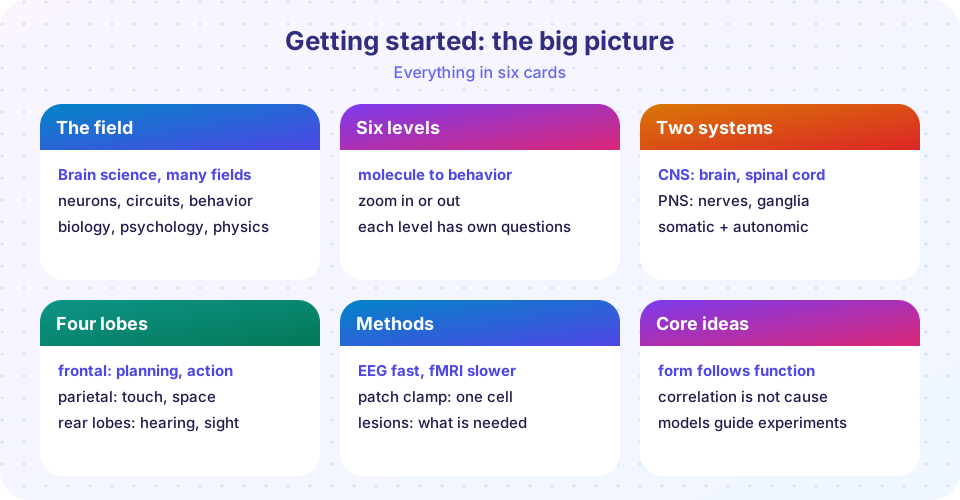
What you will learn
- A compact recap of Chapter 1.
- Which topics you still need to practice.
- A short list of habits that carry into the rest of the course.
Recap table
| Lesson | Big idea | One fact to remember |
|---|---|---|
| Course map | The course climbs from cells to behavior | About 86 billion neurons, about 20 W |
| What is neuroscience? | An integrative science with six levels | Cajal showed neurons are separate cells |
| Nervous system organization | CNS and PNS; somatic and autonomic | 12 cranial and 31 spinal nerve pairs |
| Brain regions and methods | Regions specialize; methods trade space for time | BOLD tracks blood oxygen, not spikes |
Three ideas to carry forward
- Form follows function. The shape of a structure (folded cortex, myelinated axon, narrow synaptic gap) usually explains what it does.
- No region works alone. Slogans like "fear center" are shorthand for a busy network.
- Match the method to the question. Correlational tools (EEG, fMRI) show what goes with a task; lesions and stimulation test necessity.
Try it
Press Run (or Ctrl + Enter) to see the console output here.
No output.
Press Run (or Ctrl + Enter) to see the result here.
Program input · what you'd type while the program runs
Type the answers before you press Run, one per line. Each time the program reads a line (with input()), it gets the next line from this box.
Check your understanding
Quick check · 10 questions
of 10 answered You scored / 10 · perfect!
-
1. Who is credited, with Golgi, for the 1906 Nobel Prize linked to the neuron doctrine debate?
Santiago Ramón y Cajal and Camillo Golgi shared the 1906 Nobel Prize in Physiology or Medicine. -
2. At which level of analysis do ion channels belong?
Ion channels are proteins, so they belong to the molecular level. -
3. Which pair is correct?
Parasympathetic activity supports rest and digest. Sympathetic prepares the body for action. -
4. Gray matter in the brain mostly contains...
White matter is myelinated axons; gray matter is cell bodies and dendrites. -
5. The three meninges from outside in are...
Dura (tough), arachnoid (web-like), pia (clinging to the brain). -
6. Which lobe is most associated with hearing and language comprehension?
The temporal lobe contains auditory cortex and Wernicke's area (usually left). -
7. fMRI has better spatial detail than EEG but is slower because...
BOLD signals rise a few seconds after neural activity. -
8. Which method is best for testing whether a region is necessary for a skill?
Lesion and stimulation interfere with the region, which tests necessity. -
9. What is the main role of the thalamus?
The thalamus relays most sensory signals to the cortex. -
10. Which statement about the brain's energy use is right?
The brain is small but costly.
Summary
- Chapter 1 gave you the vocabulary: levels, divisions, lobes, structures and methods.
- Next you will zoom into the cells themselves, starting with Chapter 2: neurons and glia.
Track your progress
Create a free account to tick off lessons and pick up where you left off on any device.
of Neuroscience lessons completed